
Citizenship I: Meaning & Benefit of Citizenship Education – SS1 Civic Education Lesson Note (First Term)
Download this term · ₦1,000Lesson note at a glance
- Subject
- Civic Education
- Class
- SS1
- Term
- First Term
- Topic
- Citizenship I: Meaning & Benefit of Citizenship Education
- Order
- Topic 9 of 11 this term
- Reading time
- 4 min
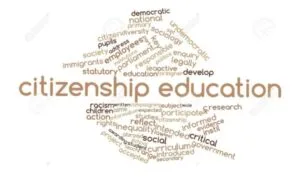
A citizen is a legal member of a state or country who enjoys full rights and owes the state certain duties.
Behavioural objectives
By the end of the lesson, students should be able to:
- define a citizen and citizenship;
- explain the meaning of citizenship education;
- state the goals of citizenship education;
- list and explain the benefits of citizenship education.
Who is a citizen?
A citizen is a legal member of a community, state or country who has full rights and owes the state certain duties.
- Legal member: a citizen is a national who possesses political and legal rights.
- Rights and privileges: a citizen enjoys the rights and privileges that the state provides.
- Duties: a citizen performs certain duties for the state.
- Allegiance: a citizen owes loyalty to the government of the state.
- Protection: a citizen is entitled to protection by the state in which he or she lives.
What is citizenship?
Citizenship is the status of a person recognised under custom or law as a legal member of a sovereign state or nation.
- Right to belong: it is the legal right of a person to belong to a country and enjoy full rights in it.
- Rights, privileges and duties: a citizen is vested with all three.
- Duties come with rights: a citizen must perform duties and obligations to the state to enjoy his or her rights.
- State’s responsibility: the state must guarantee and protect the rights of citizens once their duties are discharged.
What are examples of the rights and duties of a citizen?
| Rights of a citizen | Duties of a citizen |
|---|---|
| Right to life | Obey the laws of the land |
| Right to personal liberty | Pay taxes and levies |
| Right to freedom of expression | Vote in elections |
| Right to freedom of movement | Respect the rights of others |
| Right to fair hearing | Protect public property |
What is citizenship education?
Citizenship education is the training given to citizens on their rights and responsibilities, so that they become responsible members of society.
- Enlightenment: it is a process of enlightening and training citizens on their rights and responsibilities.
- Responsible individuals: it makes citizens committed to the meaningful development of their societies.
- Values and skills: it instils desirable values, attitudes, skills and knowledge in individuals.
- Participation: it enables individuals to take part in their group and adjust functionally as good citizens.
Where is citizenship education given?
- Home: parents teach honesty, respect and obedience.
- School: subjects such as Civic Education teach rights, duties and values.
- Community and religious bodies: they teach good conduct and community service.
- Mass media: radio, television and newspapers educate the public on civic matters.
What is the difference between a citizen, citizenship and citizenship education?
- Citizen: the person who belongs to the state.
- Citizenship: the status of belonging, with its rights, privileges and duties.
- Citizenship education: the training that prepares citizens to use their rights and perform their duties.
| Term | What it refers to | Example |
|---|---|---|
| Citizen | A person | A Nigerian who votes and pays taxes |
| Citizenship | A legal status | The status of being a Nigerian |
| Citizenship education | A form of training | A Civic Education class on rights and duties |
What are the goals of citizenship education?
The goals of citizenship education are to prepare young people to live and take part in society as informed, tolerant and responsible citizens.
- National unity: to balance regional and cultural diversity with national unity.
- Equality: to eliminate inequalities related to race, gender, age, class and ethnicity.
- Economic functioning: to ensure the successful functioning of the economy.
- Handling conflict: to equip young people to deal with conflict and controversy knowledgeably and tolerantly.
- Understanding consequences: to understand the consequences of their actions and those of the adults around them.
- Critical judgement: to recognise bias, evaluate an argument, weigh evidence, and look for other viewpoints and sources of evidence.
- Giving reasons: to give good reasons for what they say and do, and to expect good reasons from others.
- Character and soft skills: to build character and skills such as communication, initiative, social interaction and teamwork, which employers look for.
What are the benefits of citizenship education?
The benefits of citizenship education are the gains that individuals and society get from citizens who know their rights and duties.
- Promotes good values: it teaches the importance of honesty, respect and responsibility.
- Encourages active participation: students learn how to be involved in their communities and make a positive impact.
- Develops critical thinking: it helps students think about issues in society and find solutions to problems.
- Teaches tolerance: it teaches respect for different cultures, beliefs and opinions.
- Builds awareness: students become more aware of their rights and duties as citizens.
- Enhances social skills: it encourages teamwork, communication and understanding in diverse groups.
- Prepares for leadership: it helps students develop the skills needed to lead and make informed decisions.
Evaluation
- Who is a citizen?
- What is citizenship?
- What is citizenship education?
- State four goals of citizenship education.
- Give three examples of the duties of a citizen.
Assignment
List and explain five benefits of citizenship education.
This term's Civic Education topics
SS1 First Term · 11 topics
- Responsibilities of Individuals and Groups in Maintaining UDHR
- Values I
- Values II: Community Service
- Values III: Opportunity to Defend Oneself
- HIV/AIDS I
- HIV/AIDS II
- Youth Empowerment I
- Youth Empowerment II
- Citizenship I: Meaning & Benefit of Citizenship Education
- Citizenship II: Functions of Government
- Nationalism
Get Civic Education as PDF and Word
Every week of SS1 Civic Education, First Term, formatted and ready to print. Ad-free, and the copy lock comes off.
Get this term Card, bank transfer, USSD or OPay
SS1 Civic Education Lesson Notes for Other Topics
Responsibilities Of Individuals And Groups In Maintaining UDHR
Read the full lesson note.
Values I
Read the full lesson note.
Values II - Community Service
Read the full lesson note.
Values III - Opportunity to Defend Oneself
Read the full lesson note.
HIV/AIDS I
Read the full lesson note.
HIV/AIDS II
Read the full lesson note.
Youth Empowerment I
Read the full lesson note.
Youth Empowerment II
Read the full lesson note.
Citizenship II - Functions of Government
Read the full lesson note.
Nationalism
Read the full lesson note.
Representative Democracy
Read the full lesson note.
Rule Of Law I
Read the full lesson note.

Rule Of Law II : Liberty & Types of Liberty
Read the full lesson note.

Pillars Of Democracy - The Constitution
Read the full lesson note.

Strong Institutions as Major Pillars Of Democracy
Read the full lesson note.
Lesson Notes for Other Classes

SS2 Lesson Note
The complete lesson note to guide your studies.

SS3 Lesson Note
The complete lesson note to guide your studies.
