
Three Column Cash Book – SS1 Book Keeping Lesson Note (Third Term)
Download this term · ₦1,000Lesson note at a glance
- Subject
- Book Keeping
- Class
- SS1
- Term
- Third Term
- Topic
- Three Column Cash Book
- Order
- Topic 1 of 3 this term
- Reading time
- 6 min
A three-column cash book is a cash book with discount, cash and bank columns on both the debit and credit sides.
- Debit side: records discounts allowed, cash received and money paid into the bank.
- Credit side: records discounts received, cash paid and money paid out of the bank.
- Discount columns: memoranda only, so their totals are taken to the ledger discount accounts.
Behavioural objectives
By the end of the lesson, students should be able to:
- describe the three-column cash book;
- explain how the discount columns are totalled and posted to the ledger;
- distinguish between cash discount and trade discount;
- state the difference between discount allowed and discount received;
- give reasons why discounts are granted;
- record simple transactions in a three-column cash book.
What is a three-column cash book?
A three-column cash book is a cash book that adds a discount column to the cash and bank columns on each side.
- Discount allowed column: on the debit (left) side.
- Discount received column: on the credit (right) side.
- Double entry: the principle of double entry also applies in this cash book.
- Memoranda: the discount columns look like account columns but are only memoranda.
- Periodic totals: totals from the discount columns are entered into the discount accounts.
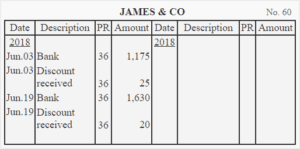
What are the columns of a three-column cash book?
There are three money columns on each side: discount, cash and bank.
| Column | Debit side | Credit side |
|---|---|---|
| Discount | Discount allowed | Discount received |
| Cash | Cash received | Cash paid out |
| Bank | Cheques and cash paid into the bank | Cheques issued and cash withdrawn |
- Date: the day the transaction took place.
- Details: the name of the account affected.
- Folio: the page number of the ledger account, used for cross-reference.
How are the discount columns treated in the cash book?
The discount columns are totalled and not balanced.
- Why not balanced: the columns only collect figures, so there is no opening balance to carry down.
- When totalled: weekly or monthly, when the cash and bank columns are balanced and ruled off.
- Where posted: the totals go to the discount accounts in the ledger.
- Which side: each total is entered on the same side of the discount account as in the cash book.
| Cash book column | Ledger account | Side in ledger |
|---|---|---|
| Discount allowed total | Discount allowed account | Debit |
| Discount received total | Discount received account | Credit |
- Personal accounts: a debtor’s account is credited with the cash and the discount allowed.
- Creditor’s account: it is debited with the cash and the discount received.
What are discounts?
Discounts are allowances, in the form of a deduction in price or a percentage payment, made to retailers by suppliers or manufacturers.
What are the types of discounts?
There are two types of discount: cash discount and trade discount.
1. What is cash discount?
A cash discount is an allowance given in return for prompt payment.
- Who gives it: businesses or suppliers, when buyers pay immediately or within a set period.
- Period: the set period may be from 7 days to 30 days.
- Entered in cash book: yes, in the discount columns.
Discount allowed
Discount allowed is a reduction in the cash a debtor pays for prompt payment.
- Entry: the amount is entered in the discount allowed column on the debit side.
- Nature: it is a cost to the business that allows it.
Discount received
Discount received is the reduction a trader gets off accounts paid to a creditor.
- Entry: the amount is entered in the discount received column on the credit side.
- Nature: it is a gain to the business that receives it.
2. What is trade discount?
A trade discount is a reduction from the retail list price offered to a trader.
- Who gives it: manufacturers or suppliers, as a deduction from catalogue prices.
- Gross selling price: the catalogue or list price.
- Net selling price: the price after the trade discount is deducted.
- Entered in cash book: no, trade discounts are not entered in the cash book.
- Example: list price ₦10,000 less 10% trade discount (₦1,000) gives a net price of ₦9,000.
What is the difference between cash discount and trade discount?
| Point | Cash discount | Trade discount |
|---|---|---|
| Reason | Prompt payment | Trade or bulk buying |
| Basis | Time of payment | Catalogue or list price |
| Cash book | Recorded in discount columns | Not recorded |
| Ledger | Posted to discount accounts | Not posted to a discount account |
What is the difference between discount allowed and discount received?
| Point | Discount allowed | Discount received |
|---|---|---|
| Given to or by | Given by the business to its debtors | Received by the business from its creditors |
| Cash book side | Debit | Credit |
| Ledger account | Discount allowed account (debit) | Discount received account (credit) |
How do you record transactions in a three-column cash book?
- Enter opening cash and bank balances on the debit side as balances b/d.
- Enter money received in the cash or bank column on the debit side.
- Enter any discount allowed in the debit discount column.
- Enter payments in the cash or bank column on the credit side.
- Enter any discount received in the credit discount column.
- Total the discount columns.
- Balance the cash and bank columns and carry the balances down.
- Post the discount totals to the ledger discount accounts.
What is a contra entry?
A contra entry is a transaction where both the debit and the credit entries are in the same cash book.
- Cash paid into bank: debit the bank column and credit the cash column.
- Cash withdrawn from bank: debit the cash column and credit the bank column.
- Folio: write C in the folio column, meaning contra.
What does a worked example look like?
The example below uses these transactions.
- 1 Jan: cash balance ₦5,000 and bank balance ₦20,000.
- 3 Jan: Ade paid by cheque ₦1,900 after a discount allowed of ₦100.
- 5 Jan: paid Bola by cheque ₦2,850 after a discount received of ₦150.
- 8 Jan: cash sales ₦4,000.
- 10 Jan: paid ₦3,000 cash into the bank.
Debit side
| Date | Details | Discount allowed (₦) | Cash (₦) | Bank (₦) |
|---|---|---|---|---|
| Jan 1 | Balances b/d | 5,000 | 20,000 | |
| Jan 3 | Ade | 100 | 1,900 | |
| Jan 8 | Sales | 4,000 | ||
| Jan 10 | Cash (C) | 3,000 | ||
| Total | 100 | 9,000 | 24,900 | |
| Jan 11 | Balances b/d | 6,000 | 22,050 |
Credit side
| Date | Details | Discount received (₦) | Cash (₦) | Bank (₦) |
|---|---|---|---|---|
| Jan 5 | Bola | 150 | 2,850 | |
| Jan 10 | Bank (C) | 3,000 | ||
| Jan 10 | Balances c/d | 6,000 | 22,050 | |
| Total | 150 | 9,000 | 24,900 |
- Ledger posting: debit ₦100 to the discount allowed account.
- Ledger posting: credit ₦150 to the discount received account.
Why are discounts granted?
- Bulk purchases: to encourage customers to buy in large quantities.
- Prompt payment: to ensure debtors pay quickly.
- New customers: to attract customers.
- Bad debts: to avoid the risk of bad debts.
- Profit margin: to provide for the buyer’s or customer’s profit margin.
Evaluation
- On which side of the three-column cash book is the discount allowed column?
- Why are the discount columns totalled and not balanced?
- What is the difference between cash discount and trade discount?
- Which type of discount is not entered in the cash book?
- What is a contra entry?
Assignment
- State four features of each of the following:
- (a) Trade discounts
- (b) Cash discounts
- List five reasons why a trader will grant a discount to his customers.
This term's Book Keeping topics
SS1 Third Term · 3 topics
- Three Column Cash Book
- Petty Cashbook
- Trial Balance
Get Book Keeping as PDF and Word
Every week of SS1 Book Keeping, Third Term, formatted and ready to print. Ad-free, and the copy lock comes off.
Get this term Card, bank transfer, USSD or OPay
SS1 Book Keeping Lesson Notes for Other Topics

Petty Cashbook
Read the full lesson note.

Trial Balance
Read the full lesson note.

Introduction To Bookkeeping
Read the full lesson note.

Stock Valuation
Read the full lesson note.

Assets And Liabilities
Read the full lesson note.

Business Transactions
Read the full lesson note.

Debtors And Creditors
Read the full lesson note.

Source Documents
Read the full lesson note.

Books Of Original Entry
Read the full lesson note.

Principles Of Double Entry
Read the full lesson note.

Ledgers
Read the full lesson note.

Single Column Cash Book
Read the full lesson note.

Double Column Cash Book
Read the full lesson note.

Contra Entries
Read the full lesson note.
Lesson Notes for Other Classes

SS2 Lesson Note
The complete lesson note to guide your studies.

SS3 Lesson Note
The complete lesson note to guide your studies.
