
Petty Cashbook – SS1 Book Keeping Lesson Note (Third Term)
Download this term · ₦1,000Lesson note at a glance
- Subject
- Book Keeping
- Class
- SS1
- Term
- Third Term
- Topic
- Petty Cashbook
- Order
- Topic 2 of 3 this term
- Reading time
- 7 min
A petty cash book is the subsidiary book of account used for recording low-value (petty) cash payments and occasional small cash receipts.
Behavioural objectives
By the end of the lesson, students should be able to:
- state what a petty cash book is and what it is used for;
- explain how the imprest system works;
- list the features and advantages of the imprest system;
- draw the layout of a petty cash book with analysis columns;
- prepare a petty cash book and complete the double entry for its totals.
What is a petty cash book?
A petty cash book is a book of prime entry that records small cash payments, so they do not clutter the main Cash Book.
- Similar to the Cash Book: it records cash received and cash paid.
- Book of prime entry: transactions are first written here before they are posted elsewhere.
- Ledger account: it is part of the double entry system, so it also works as a ledger account.
- Purpose: small payments need not be entered one by one in the Cash Book or the ledger, so the number of entries falls.
What items are paid for from petty cash?
- Postage: stamps and small courier charges.
- Stationery: pens, paper and similar items.
- Cleaning: cleaning materials and small cleaning services.
- Travelling expenses: local transport fares for staff.
- Small payments to creditors: low-value amounts owed to suppliers.
Who keeps the petty cash book?
- Petty cashier: usually a junior member of staff who receives a cash float to make small payments.
- Chief (main) cashier: is free to concentrate on more important tasks.
- Training: the work trains the junior member of staff.
- Checking: the chief cashier checks the petty cashier’s work at regular intervals.
What is a petty cash voucher?
A petty cash voucher is a document, duly authorised, that a staff member presents to the petty cashier to obtain petty cash.
- Purpose: it shows why the money is required.
- Date: it shows the date of the payment.
- Signature: it carries the signature of the person receiving the cash.
- Checking: at regular intervals, the petty cashier checks the vouchers against the total cash spent.
What is the imprest system?
The imprest system is a method of running petty cash in which the petty cashier starts every period with the same fixed amount of money.
- Imprest amount (cash float): the fixed sum the petty cashier starts each period with.
- Period: it may be a week, a fortnight, a month and so on.
- Control: the main cashier knows exactly how much petty cash was spent in each period.
- Adjustment: the imprest amount can be raised or lowered if it is too little or too much.
How does the imprest system work?
- The main cashier gives the petty cashier enough money for the period. This is the imprest amount.
- During the period, payments are made from the float and recorded in the petty cash book.
- At the end of the period, the petty cash book is balanced.
- The main cashier gives the petty cashier enough cash to restore the balance to the imprest amount.
- The petty cashier starts the next period with the same amount of cash.
What are the features of the imprest system?
- Petty cashier: a petty cashier is selected.
- Fixed float: the main cashier gives the petty cashier a fixed sum (the imprest amount or cash float).
- Vouchers: the petty cashier pays out petty cash only against duly authorised petty cash vouchers.
- Reimbursement: the main cashier refunds the total amount paid in the period, which restores the imprest to its original figure.
What are the advantages of the imprest system?
- Less work for the main cashier: the main cashier’s burden is greatly reduced.
- Training: it trains young account clerks.
- Accountability: every expense is supported by documentary evidence.
- Fraud control: it helps to eliminate or discourage fraudulent practices.
- Budget control: it reveals extravagance and items of spending that overshoot the budget.
- Cost control: the total for each expense item can be used for cost-control decisions.
- Limited liability: the petty cashier’s liability can never exceed the imprest amount.
- Fewer entries: the main Cash Book and general ledger are relieved of many small, insignificant items.
- Check at any time: cash in hand plus the amount spent according to the vouchers should always equal the cash float.
- Reduced losses: losses through the petty cashier are minimised.
What is the layout of a petty cash book?
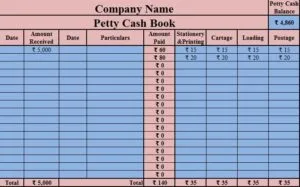
A petty cash book looks like a ledger account with several money columns on the credit side, called analysis columns.
- Analysis columns: they divide the payments into categories of expense.
- One column per main expense: each business decides the number of columns and the expenses.
- Voucher number column: it replaces the folio column on the credit side and shows the voucher for each payment.
- Examinations: guidance is given on the columns required.
Petty cash book
| Date | Details | F | Total received | Date | Details | Total paid | Voucher number | Transport | Cleaning | Postage | Ledger |
|---|---|---|---|---|---|---|---|---|---|---|---|
| ₦ | ₦ | ₦ | ₦ | ₦ | ₦ |
What does each column show?
| Column | What it shows |
|---|---|
| Total received | Cash received from the main cashier or other sources (debit side). |
| F | Folio number of the related ledger or cash book entry. |
| Total paid | Every payment made from petty cash (credit side). |
| Voucher number | The number of the petty cash voucher for each payment. |
| Transport, Cleaning, Postage | Analysis of the payment by type of expense. |
| Ledger | Payments that must be posted to a ledger other than the general ledger. |
How is a petty cash book prepared?
What is done during the period?
Money received or balance brought down
- Debit the total received column with money received from the main cashier, or with the balance brought down from the previous period.
- Write “cash”, “bank” or “balance b/d” in the details column, as appropriate.
- Debit the total received column with money received from any other source.
- Write the name of the account to be credited in the details column.
Examples of other receipts:
- Debtor: a debtor pays an account in cash.
- Travel expenses: an employee repays the cost of private travel.
- Telephone expenses: an employee repays the cost of private telephone calls.
Money paid
- Credit the total paid column with the money paid out.
- Enter the same amount in the analysis column for that expense.
- Write a brief reason for the payment in the details column.
What is done at the end of the period?
- Add the total paid column and insert the total.
- Add each analysis column and insert the totals.
- Check that the analysis totals, added across, agree with the total paid column.
- Balance the total received and total paid columns, as in any other ledger account.
- Carry the balance down from the credit side to the debit side to start the new period.
- When the imprest is restored, enter the amount received as described above.
How is the double entry completed?
The double entry is completed by debiting each expense account in the general (nominal) ledger with the total of its analysis column.
- Analysis column totals: debit the relevant expense account in the general ledger.
- Folio number: it is often written below the analysis total to show that the entry has been posted.
- Ledger column: it holds items that need posting outside the general ledger.
| Item | Account to debit |
|---|---|
| Total of an analysis column (for example, Postage) | The matching expense account in the general ledger |
| Purchases ledger account of a creditor settled from petty cash | The creditor’s account in the purchases ledger |
| Refund to a customer who overpaid | The customer’s (debtor’s) account in the sales ledger |
What points should students remember?
- Double-entry book: the petty cash book must be included in the Trial Balance.
- Fixed maximum: the maximum cash held in the petty cash book is fixed.
- Reimbursement: the cashier must be refunded the amount paid out.
- Source documents: receipts, cheques and petty cash vouchers, duly authorised by the designated officers.
Evaluation
- What is a petty cash book?
- Explain how the imprest system works.
- State five advantages of the imprest system.
- What is the purpose of the analysis columns in a petty cash book?
- How is the double entry completed for the totals of the analysis columns?
Assignment
Write a short set of notes on the petty cash book that includes the following:
- the four features of the imprest system;
- the layout of a petty cash book with analysis columns for transport, cleaning and postage;
- the source documents for entries in the petty cash book.
This term's Book Keeping topics
SS1 Third Term · 3 topics
- Three Column Cash Book
- Petty Cashbook
- Trial Balance
Get Book Keeping as PDF and Word
Every week of SS1 Book Keeping, Third Term, formatted and ready to print. Ad-free, and the copy lock comes off.
Get this term Card, bank transfer, USSD or OPay
SS1 Book Keeping Lesson Notes for Other Topics

Three Column Cash Book
Read the full lesson note.

Trial Balance
Read the full lesson note.

Introduction To Bookkeeping
Read the full lesson note.

Stock Valuation
Read the full lesson note.

Assets And Liabilities
Read the full lesson note.

Business Transactions
Read the full lesson note.

Debtors And Creditors
Read the full lesson note.

Source Documents
Read the full lesson note.

Books Of Original Entry
Read the full lesson note.

Principles Of Double Entry
Read the full lesson note.

Ledgers
Read the full lesson note.

Single Column Cash Book
Read the full lesson note.

Double Column Cash Book
Read the full lesson note.
Contra Entries
Read the full lesson note.
Lesson Notes for Other Classes

SS2 Lesson Note
The complete lesson note to guide your studies.

SS3 Lesson Note
The complete lesson note to guide your studies.
