
Source Documents – SS1 Book Keeping Lesson Note (First Term)
Download this term · ₦1,000Lesson note at a glance
- Subject
- Book Keeping
- Class
- SS1
- Term
- First Term
- Topic
- Source Documents
- Order
- Topic 6 of 6 this term
- Reading time
- 5 min
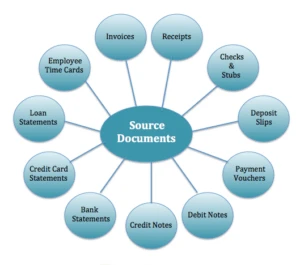
Source documents are the written records made when a business enters into a transaction with another party, and they give the essential facts of that transaction.
Behavioural objectives
- Define source documents.
- List examples of source documents.
- Describe the purpose and contents of each source document.
- State the reasons a seller issues a credit note.
- State the uses of source documents.
What are source documents?
Source documents are the original written evidence of business transactions, from which entries are first made in the books of account.
- Cash transactions: every cash transaction must be supported by a source document.
- Credit transactions: every credit transaction must be supported by a source document too.
- Verification: accounting records can only be checked when the right source documents are available.
- Preparation of books: the books of account are prepared from the facts on these documents.
What are the examples of source documents?
There are eight common source documents: receipt, invoice, cheque, bank paying-in slip, debit note, credit note, statement of account and voucher.
- Receipt: proof that money or property has been received.
- Invoice: a bill sent by the seller to the buyer for goods sold.
- Cheque (or cheque stub): an order to a bank to pay money.
- Bank paying-in slip: a form used to pay money into a bank account.
- Debit note: a document that corrects an undercharge.
- Credit note: a document that corrects an overcharge or reduces the amount due.
- Statement of account: a summary of transactions with a credit customer.
- Voucher: a document that authorises a payment.
What does each source document do?
What is a receipt?
A receipt is a written document issued by one person to another to acknowledge that money or valuable property has been received.
- When issued: the customer is usually given a receipt when goods are sold for cash.
- Use: it can serve as proof of payment or ownership of property.
What is an invoice?
An invoice is a business document prepared by the seller and sent to the buyer when goods are sold.
- When issued: a business issues an invoice to the purchaser when it sells goods on credit.
- Sales invoice: the seller’s copy of the invoice.
- Purchase invoice: the same document in the hands of the buyer.
An invoice contains the following information:
- Supplier details: the name and address of the supplier.
- Customer details: the name, address and account number of the customer.
- Invoice number: the supplier’s invoice number.
- Order number: the customer’s order number, for goods supplied in response to an order.
- Date: the date on which the transaction is effected.
- Description of goods: the quantity bought, unit price and total price.
- Terms: the terms of sale, terms of payment and details of trade discount.
What is a cheque?
A cheque is a written order made by a customer to the bank to pay a stated sum of money to the person or business named on it.
- Source document for payment: when a cheque is issued, the cheque itself or its counterfoil (stub) is the source document.
What is a bank paying-in slip?
A bank paying-in slip is the standard form filled in whenever money is paid into an account kept with a bank.
- Copies: it is filled in duplicate or triplicate.
- Items paid in: cash, cheques, bank drafts and similar items.
What is a debit note?
A debit note is a document issued by the seller of goods to correct an undercharge made in the account of the purchaser.
Worked example:
- The amount due from the purchaser is ₦18,500.
- The seller mistakenly charged ₦15,800 on the invoice.
- The undercharge is ₦18,500 – ₦15,800 = ₦2,700.
- The seller issues a debit note of ₦2,700 to the purchaser.
What is a credit note?
A credit note is a document issued by the seller of goods to correct an overcharge made in the account of the purchaser.
- When prepared: when the amount due from a customer who bought on credit is to be reduced.
A seller issues a credit note for these reasons:
- Overcharge: the customer was charged too much, for example by a mistake on the sales invoice.
- Returns: the customer returns some of the goods previously bought.
- Allowance: a reduction is given, for example for damaged goods the customer keeps.
What is a statement of account?
A statement of account is a summary of the transactions between a seller and a credit customer over a period.
- Issued by: the seller.
- Sent to: credit customers at regular intervals, usually at the end of each month.
What is a voucher?
A voucher is a source document used to obtain authorisation for payments.
- Covers: payments by cash, by cheque or by letters of authority.
What is the difference between a debit note and a credit note?
A debit note corrects an undercharge, so the buyer owes more. A credit note corrects an overcharge, so the buyer owes less.
| Point | Debit note | Credit note |
|---|---|---|
| Issued by | Seller | Seller |
| Corrects | Undercharge | Overcharge |
| Effect on buyer’s account | Amount due increases | Amount due decreases |
| Example | Invoice shows ₦15,800 instead of ₦18,500 | Customer returns some goods |
What is the difference between a sales invoice and a purchase invoice?
A sales invoice is the seller’s copy of an invoice. A purchase invoice is the buyer’s copy of the same invoice.
| Point | Sales invoice | Purchase invoice |
|---|---|---|
| Held by | Seller | Buyer |
| Shows | Goods sold on credit | Goods bought on credit |
| Document | Same invoice | Same invoice |
What are the uses of source documents?
Source documents are used to prepare the books of account and to prove that transactions took place.
- Preparing books: they are used in the preparation of accounting books.
- Evidence: they give written evidence of transactions that have taken place.
- Proof of ownership: a receipt can prove ownership of property.
- Audit: they are used for audit purposes.
- Reconciliation: they are used for the reconciliation of accounts.
- Authorisation: vouchers are used to authorise payments.
- Correction: debit and credit notes correct an undercharge or overcharge in a customer’s account.
Evaluation
- What are source documents?
- List five examples of source documents.
- State the difference between a debit note and a credit note.
- Give three reasons why a seller may issue a credit note to a customer.
- State the difference between a sales invoice and a purchase invoice.
Assignment
Write short notes on the following: five uses of source documents, six items of information found on an invoice, and what a statement of account is and when it is usually sent to customers.
This term's Book Keeping topics
SS1 First Term · 6 topics
Get Book Keeping as PDF and Word
Every week of SS1 Book Keeping, First Term, formatted and ready to print. Ad-free, and the copy lock comes off.
Get this term Card, bank transfer, USSD or OPay
SS1 Book Keeping Lesson Notes for Other Topics
Introduction To Bookkeeping
Read the full lesson note.

Stock Valuation
Read the full lesson note.

Assets And Liabilities
Read the full lesson note.
Business Transactions
Read the full lesson note.

Debtors And Creditors
Read the full lesson note.
Books Of Original Entry
Read the full lesson note.
Principles Of Double Entry
Read the full lesson note.
Ledgers
Read the full lesson note.
Single Column Cash Book
Read the full lesson note.

Double Column Cash Book
Read the full lesson note.
Contra Entries
Read the full lesson note.
Three Column Cash Book
Read the full lesson note.
Petty Cashbook
Read the full lesson note.
Trial Balance
Read the full lesson note.
Lesson Notes for Other Classes

SS2 Lesson Note
The complete lesson note to guide your studies.

SS3 Lesson Note
The complete lesson note to guide your studies.
