
Assets and Liabilities – SS1 Book Keeping Lesson Note (First Term)
Download this term · ₦1,000Lesson note at a glance
- Subject
- Book Keeping
- Class
- SS1
- Term
- First Term
- Topic
- Assets and Liabilities
- Order
- Topic 3 of 6 this term
- Reading time
- 5 min
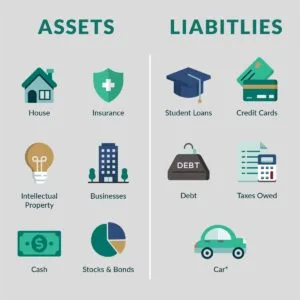
Assets are the resources a business owns, together with the amounts other people owe it. Liabilities are the amounts the business owes to other people or firms.
- Assets: divided into fixed assets and current assets.
- Liabilities: divided into current liabilities and long-term liabilities.
- Aim: a business aims to have more assets than liabilities.
Behavioural objectives
By the end of the lesson, students should be able to:
- define assets and liabilities;
- distinguish between fixed assets and current assets, and give examples of each;
- distinguish between current liabilities and long-term liabilities, and give examples of each;
- state the difference between assets and liabilities;
- state the link between assets, liabilities and capital.
What are assets?
Assets are the resources, properties or possessions owned by the business, as well as what other people or firms owe the business.
- Owned resources: land and buildings, motor vehicles, furniture, equipment, machinery, tools and stock.
- Money held: cash at hand and cash at the bank.
- Money owed to the business: debtors, who are customers that bought goods on credit.
- Classes: assets are divided into fixed assets and current assets.
What are fixed assets?
Fixed assets are long-lasting assets which are acquired for use in the business rather than for resale.
- Purpose: they help the business to earn revenue.
- Life span: they are kept for many years.
- Not for sale: the business does not buy them to sell to customers.
Examples of fixed assets:
- Land and buildings: the shop, office or factory site and the structures on it.
- Plant and machinery: a bakery oven or a grinding machine.
- Motor vehicles: a delivery van or a company bus.
- Furniture and fittings: tables, chairs, shelves and counters.
- Tools and equipment: computers, generators and hand tools.
What are current assets?
Current assets are assets held by the business for a short period, which change from one form to another in the course of business.
- Form: they are either cash or can be turned into cash fairly easily.
- Short life: they are used up or changed often.
Examples of current assets:
- Stock (inventory): goods bought for resale, such as bags of rice in a provision store.
- Trade debtors (sundry debtors): customers who owe the business for goods bought on credit.
- Bank: money kept in the business bank account.
- Cash: money kept in the till or cash box.
What is the difference between fixed assets and current assets?
A fixed asset is kept to be used for a long time. A current asset is held for a short time and changes form.
| Point | Fixed assets | Current assets |
|---|---|---|
| Purpose | Bought for use in the business | Bought for resale or held as money |
| Length of time held | Long term | Short term |
| Change into cash | Not easily changed into cash | Cash or easily changed into cash |
| Examples | Land, buildings, vehicles, machinery | Stock, debtors, bank, cash |
What are liabilities?
Liabilities are obligations arising from past transactions, and they represent what the business owes other people or firms.
- Outsiders’ claims: they are claims by outsiders on the assets of the business.
- Past transactions: they arise from things already bought, borrowed or received.
- Classes: liabilities are divided into current liabilities and long-term liabilities.
What are current liabilities?
Current liabilities are short-term liabilities due for settlement (repayment) within twelve months (one year) of the date of the Balance Sheet.
- Trade creditors (sundry creditors): suppliers the business owes for goods bought on credit.
- Bank overdraft: money the business has taken from the bank above what its account holds.
- Expenses owing: bills such as rent or electricity that are not yet paid.
What are long-term liabilities?
Long-term liabilities are amounts owed by the business which are not due for repayment within twelve months (one year) of the date of the Balance Sheet.
- Long-term loans: money borrowed from a bank and repaid over several years.
- Mortgages: loans taken to buy property, with the property as security.
- Debentures: long-term loans to a company, repaid on a fixed future date.
What is the difference between current liabilities and long-term liabilities?
The difference is the time of repayment. Current liabilities fall due within one year. Long-term liabilities fall due after one year.
| Point | Current liabilities | Long-term liabilities |
|---|---|---|
| Repayment time | Within twelve months | After twelve months |
| Examples | Trade creditors, bank overdraft | Long-term loans, mortgages, debentures |
How are assets and liabilities classified?
Assets and liabilities each split into two classes, as the diagram shows.
What is the difference between assets and liabilities?
Assets are resources a business owns or is owed, while liabilities are financial obligations a business owes to others.
- Assets: show what the business has.
- Liabilities: show what the business owes.
- Financial strength: a business with more assets than liabilities is stable and can meet its debts.
| Point | Assets | Liabilities |
|---|---|---|
| Meaning | What the business owns or is owed | What the business owes to others |
| Types | Fixed assets and current assets | Current liabilities and long-term liabilities |
| Examples | Land and buildings, motor vehicles, stock, debtors, cash | Trade creditors, bank overdrafts, long-term loans, mortgages, debentures |
How are assets, liabilities and capital related?
Capital is the amount the owner has invested in the business, and it equals assets minus liabilities.
- Accounting equation: Assets = Capital + Liabilities.
- Capital: Capital = Assets − Liabilities.
- Example: a trader has assets of ₦500,000 and liabilities of ₦200,000, so capital is ₦300,000.
Evaluation
- Define assets and liabilities.
- What is the difference between fixed assets and current assets?
- List three examples of current assets.
- When is a current liability due for settlement?
- Give two examples of long-term liabilities.
Assignment
Explain the difference between current liabilities and long-term liabilities. Give two examples of each.
This term's Book Keeping topics
SS1 First Term · 6 topics
Get Book Keeping as PDF and Word
Every week of SS1 Book Keeping, First Term, formatted and ready to print. Ad-free, and the copy lock comes off.
Get this term Card, bank transfer, USSD or OPay
SS1 Book Keeping Lesson Notes for Other Topics
Introduction To Bookkeeping
Read the full lesson note.

Stock Valuation
Read the full lesson note.

Business Transactions
Read the full lesson note.

Debtors And Creditors
Read the full lesson note.
Source Documents
Read the full lesson note.
Books Of Original Entry
Read the full lesson note.
Principles Of Double Entry
Read the full lesson note.
Ledgers
Read the full lesson note.

Single Column Cash Book
Read the full lesson note.

Double Column Cash Book
Read the full lesson note.
Contra Entries
Read the full lesson note.

Three Column Cash Book
Read the full lesson note.

Petty Cashbook
Read the full lesson note.
Trial Balance
Read the full lesson note.
Lesson Notes for Other Classes

SS2 Lesson Note
The complete lesson note to guide your studies.

SS3 Lesson Note
The complete lesson note to guide your studies.
