Decimal and Fractions Whole Numbers and Fractions – Basic 4 Mathematics Lesson Note (Second Term)
Download Lesson NoteLesson note at a glance
- Subject
- Mathematics
- Class
- Basic 4
- Term
- Second Term
- Topic
- Decimal and Fractions Whole Numbers and Fractions
- Order
- Topic 3 of 7 this term
- Reading time
- 2 min
PERFORMANCE OBJECTIVES
By the end of the lesson, most of the pupils should have attained the following objectives (cognitive, affective and psychomotor) and should be able to:
Spot tense
- read and write decimals in their values.
- convert fractions to decimals and vice versa.
- solve multiplication on fractions of whole numbers.
ENTRY BEHAVIOUR
- addition involving per decimal.
- subtraction involving per decimal.
- multiplication involving per decimal.
The pupils can multiply using the fractions decimal to multiplication.
INSTRUCTIONAL MATERIALS
The teacher will teach the lesson with the aid of:
- Board
- flash cards showing decimal arithmetic exercises.
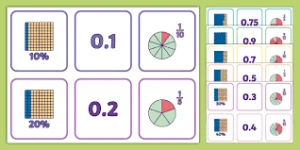
- Flip chart
METHOD OF TEACHING – Choose a suitable and appropriate methods for the lessons.
Note – Irrespective of choosing methods of teaching, always introduce an activities that will arouse pupil’s interest or lead them to the lessons.
METHOD OF TEACHING
- Explanation
- Question
- Demonstration
- Assignment
REFERENCE MATERIALS
- 9 – Years Basic Education Curriculum
- Lagos State Scheme of work
- All Relevant Material
- Online Materials
CONTENT OF THE LESSON
FOCUS LESSON – INTRODUCTION
PUPIL’S ACTIVITIES
The teacher asks the pupils what decimals he had learnt
Sample 1
0.3
= 3/10
0.17
= 17/100
1.6
= 16/10
= 1 6/10
Sample 2
1/2
= 0.5
5/10
= 0.5
1/4
= 0.25
Sample 3 – decimals multiplying and dividing tens of right numbers
Sample 4
0.3 × 5 = 1.5
3/10 × 5
= 15/10
= 1.5
0.45 × 6
= 2.7
45/100 × 6
= 270/100
= 2.70
Sample 5 – to multiply display of right numbers
0.45 × 10
= 4.5
0.45 × 100
= 45
4.5 × 10
= 45
0.6 × 1000
= 600
6.03 × 100
= 603
0.007 × 1000
= 7
When we move to the decimal to the right side, zeros and add the zero, for the right of 45, 600, 603, 7
PUPIL’S ACTIVITIES:
EXERCISE ONE – Multiplication of Three fractions
Complete the fractions:
- Change these results into fractions following:
- a) 0.6 = /
- b) Express the fraction below and convert it to lowest terms:
- 25/100 = /
- c) Express 7: Main Fractions:
/ = /
EXERCISE TWO
Complete each of the following and express in lowest terms:
- 0.7 = /
- 0.09 = /
/ = /
Exercise 3 – Expressing whole numbers
4/5 × 100
= 400/5
= 80
24/8
= 3
Exercise 4
7 × 1/7
= 7/7
= 1
Exercise 4
Examples:
4 1/2 × 3 = 7/2
= 1/2 × 3 = 3/2
= 13.5
Sample 5 – multiplication of fractions to right numbers
Examples 4:
- Common fractions: Use the appropriate.
- 1/3 × 6
Sample: Factors allow fractions to change their base properly.
1/3 × 6
= 6/3
= 2
1 1/4 × 2 = 1 × 1/4 × 2 = fractions allow the pupils some focus you allow with the class set to make proper fractions to convert.
5/4 × 2
= 10/4
= 2 1/2
3 1/2 × 2 = 1 × 1/2 × 2
= 7/2 × 2
= 14/2
= 7
3 × 2 1/3
= 3 × 7/3
= 21/3
= 7
Allow work allow and night long teacher work now
PUPIL EXERCISES
Write each mixed number as fractions and multiply. Express your fractions in it’s recommended.
Exercise
Pupils can use the multiplication of these numbers, decimals and fractions for recommended problem.
- a) Work Examples by folded refers to Objective:
- To introduce the lesson the teacher revises the previous lesson based on this, he/she briefly explains the pupils some questions.
- Guides pupils to find out x by right action concerning ½ – all decimal fractions.
- Teacher guides pupils and let them compare their work ½ – all decimal fractions.
Pupil’s Activities – convert fractions to decimals and vice versa.
- Guides pupils to identify fractions by divisors and make compare.
- Guides pupils to identify fraction to decimal conversion.
Pupil’s Activities – read and write decimal in their values.
- Guide pupils to solve multiplication on fractions of whole numbers.
Pupil’s Activities – solve multiplication on fractions of whole numbers.
CONCLUSION
- To conclude the lesson for the week, the teacher revises the entire lesson and links it to the following week’s lesson.
- Next lesson.
CONCLUSION EVALUATION
Ask pupils to:
This term's Mathematics topics
Basic 4 Second Term · 7 topics
- Decimal Fractions
- Conversion of Decimal to Fractions
- Decimal and Fractions Whole Numbers and Fractions
- Square and Square Root One or More
- Estimation
- Money
- Open Sentence
Second Term Mathematics Lesson Notes for Other Topics

Whole Numbers 121-130 & Number Skills
Read the full lesson note.
Numbers 110-120 & Subtraction Facts
Read the full lesson note.

Numbers 101-110 & Addition Facts
Read the full lesson note.
Identification & Counting Numbers 1-100
Read the full lesson note.
Subtraction & Numbers 81-100
Read the full lesson note.
Math Facts & Numbers 71-80
Read the full lesson note.

Numbers 1-250
Read the full lesson note.

Data Collection
Read the full lesson note.
Numbers 241-250
Read the full lesson note.

Numbers 231-240
Read the full lesson note.
3D Shapes
Read the full lesson note.
Capacity
Read the full lesson note.
Revision of First Term’s Work
Read the full lesson note.
Length and Pythagoras Rule
Read the full lesson note.
Revision of First Term's Topic
Read the full lesson note.
Lesson Notes for Other Classes
Basic 1 Lesson Note
The complete lesson note to guide your studies.
Basic 2 Lesson Note
The complete lesson note to guide your studies.

Basic 3 Lesson Note
The complete lesson note to guide your studies.
Basic 5 Lesson Note
The complete lesson note to guide your studies.

Basic 6 Lesson Note
The complete lesson note to guide your studies.

JSS1 Lesson Note
The complete lesson note to guide your studies.