
Oral, Structure, Comprehension , Writing, Words of the Week 8 – SS2 English Lesson Note (Third Term)
Lesson note at a glance
- Class
- SS2
- Subject
- English Studies
- Term
- Third Term
- Reading time
- 7 min
This lesson covers three vowel pairs, the adverbials called adjuncts, conjuncts and disjuncts, the expository essay, and seven vocabulary words for the week.
Behavioural objectives
By the end of the lesson, students should be able to:
- pronounce and tell apart the vowel sounds /ʊ/ and /u:/, /æ/ and /a:/, and /ɪ/ and /i:/;
- give examples of words that contain each of these sounds;
- explain what adjuncts, conjuncts and disjuncts are, and identify each in a sentence;
- describe the structure of an expository essay and the steps for writing one;
- write an expository essay from an outline.
How do the vowel pairs /ʊ/ and /u:/, /æ/ and /a:/, /ɪ/ and /i:/ differ?
Each vowel pair differs in length and in the position of the tongue and lips.
How do /ʊ/ and /u:/ differ?
/ʊ/ is a short vowel sound and /u:/ is a long vowel sound, both made with rounded lips.
- /ʊ/: short sound, lips rounded, back of the tongue raised, as in “full”.
- /u:/: long sound, lips rounded more tightly, back of the tongue raised higher, as in “fool”.
How to pronounce /ʊ/ and /u:/
- /ʊ/: make a short, tight “oo” sound, as in “full”.
- /u:/: make a longer “oo” sound, as in “fool”.
- Main difference: /ʊ/ is shorter than /u:/.
Which words contain /ʊ/ and /u:/?
- /ʊ/: full, would, put.
- /u:/: fool, pool, rule, soup, blue, true, few.
- Contrast pair: pull /pʊl/ and pool /pu:l/.
How do /æ/ and /a:/ differ?
/æ/ is a short vowel sound made at the front of the mouth, and /a:/ is a long vowel sound made with the mouth wider open.
What is the sound /a:/?
/a:/ is a long vowel sound, often called the “long A”, made with the mouth open, the tongue low and the lips relaxed.
Steps to pronounce /a:/:
- Open your mouth wide.
- Keep your tongue low and towards the back of your mouth.
- Prolong the sound.
Examples of words with /a:/:
- Car: /ka:/
- Father: /ˈfa:ðər/
- Garden: /ˈɡa:dn/
- Part: /pa:t/
- Calm: /ka:m/
What is the sound /æ/?
/æ/ is a short vowel sound, often called the “short A”, made with the mouth open less wide than for /a:/.
Steps to pronounce /æ/:
- Open your mouth moderately.
- Keep your tongue low and towards the front of your mouth.
- Make the sound short and crisp.
Examples of words with /æ/:
- Cat: /kæt/
- Apple: /ˈæpl/
- Back: /bæk/
- Hat: /hæt/
- Man: /mæn/
Contrast pairs: cat and cart, hat and heart, back and bark.
How do /ɪ/ and /i:/ differ?
/ɪ/ is a short vowel sound and /i:/ is a long vowel sound, both made by raising the middle of the tongue towards the roof of the mouth.
- /ɪ/: short sound, tongue raised but not as high as for /i:/, lips slightly spread.
- /i:/: long sound, tongue raised higher than for /ɪ/, lips spread wider.
Examples of words with /ɪ/:
- Common spelling with i: hill, ink, village, sit, fit, fifth, rich, trick.
- Unusual spellings: women, nymph, rhythm, symbol.
Examples of words with /i:/:
- Spelt ee: bee, need, free, tree, glee, seem, meet, cheek.
- Spelt ea: sea, beans, beat, leaf, eat.
- Spelt ei: receive, deceive, seize, ceiling.
- Other spellings: machine, kerosene, margarine, we, be, these, Peter, people, quay, key.
- Contrast pairs: sit and seat, bit and beat, hill and heel.
How can the three pairs be compared?
| Pair | Short sound | Long sound | Key difference |
|---|---|---|---|
| /ʊ/ and /u:/ | /ʊ/ as in full | /u:/ as in fool | Length, with tighter lips and higher tongue for /u:/ |
| /æ/ and /a:/ | /æ/ as in cat | /a:/ as in car | Length, with a wider mouth and tongue further back for /a:/ |
| /ɪ/ and /i:/ | /ɪ/ as in sit | /i:/ as in seat | Length, with wider lips and higher tongue for /i:/ |
What are adjuncts, conjuncts and disjuncts?
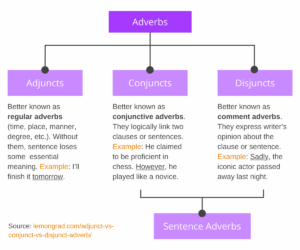
Adjuncts, conjuncts and disjuncts are three types of adverbial, which are words or phrases that give extra information in a sentence.
What is an adjunct?
An adjunct is a word or phrase that adds information about the action, such as when, where, how or why it happens.
- Time: Yesterday, we played football.
- Place: He worked at the library.
- Manner: She spoke quietly.
- Reason: We stayed indoors because of the rain.
- Test: remove the adjunct and the sentence is still correct, but it has less detail.
What is a conjunct?
A conjunct is a word or phrase that connects two sentences or clauses and shows how their ideas are related.
- I studied hard; therefore, I passed the exam. (Cause and effect)
- She wanted to leave early; however, she stayed until the end. (Contrast)
- He was tired, yet he continued working. (Contrast)
- Addition: moreover, in addition, also.
- Contrast: however, nevertheless, yet.
- Result: therefore, consequently.
- Example: “therefore” shows that passing the exam is the result of studying hard.
What is a disjunct?
A disjunct is a word or phrase that gives the speaker’s or writer’s opinion, attitude or comment on the whole sentence.
- Honestly, I don’t think that’s a good idea.
- Unfortunately, the meeting was cancelled.
- Clearly, he wasn’t prepared for the test.
- Honestly: the speaker is giving a true opinion.
- Unfortunately: the speaker feels sadness or disappointment.
- Clearly: the speaker is sure of the statement.
- Other disjuncts: fortunately, frankly, obviously, surprisingly.
What are the differences between adjuncts, conjuncts and disjuncts?
| Feature | Adjunct | Conjunct | Disjunct |
|---|---|---|---|
| Job | Adds information to the action | Joins ideas or sentences | Gives the speaker’s attitude or comment |
| Shows | Time, place, manner, reason | Addition, contrast, result | Opinion or feeling |
| Examples | yesterday, at the library, quietly | therefore, however, yet | honestly, unfortunately, clearly |
What is an expository essay?
An expository essay is an essay in which the writer explains a topic clearly, using facts and evidence.
- Purpose: to give clear information or explain something to the reader.
- Content: facts, examples and explanations, with no argument and no personal opinion.
- Paragraphs: one main idea in each paragraph.
- Linking: conjuncts such as “moreover” and “therefore” connect the ideas.
What are examples of expository essay topics?
- How to maintain a healthy lifestyle.
- The benefits of education.
- The process of recycling.
What is the structure of an expository essay?
An expository essay has three parts: the introduction, the body paragraphs and the conclusion.
- Introduction: the first paragraph. It introduces the topic, gives a brief overview and holds the reader’s attention.
- Body paragraphs: they explain the topic in detail. Each focuses on one main idea, supported by examples and facts.
- Conclusion: the final paragraph. It sums up the main points and ends with a final thought. It adds no new information.
What are the steps in writing an expository essay?
There are four steps in writing an expository essay: choose a topic, plan, draft, and revise and edit.
- Choose a topic: pick a subject you can explain with facts.
- Plan your ideas: list the main points and put them in order.
- Write a draft: write the introduction, body paragraphs and conclusion.
- Revise and edit: correct spelling, grammar and punctuation, and improve unclear sentences.
What does an expository essay outline look like?
Topic: “The Importance of Education”
- Introduction:
- Define education.
- Briefly state why education is important.
- Body paragraph 1:
- Explain how education helps individuals acquire knowledge.
- Body paragraph 2:
- Discuss how education opens up job opportunities.
- Body paragraph 3:
- Talk about how education contributes to personal development.
- Conclusion:
- Summarise the importance of education in society and for individuals.
What are the words for the week?
The words for the week are new vocabulary items that students should learn to spell, define and use in sentences.
| Word | Meaning | Example |
|---|---|---|
| Seminar | A meeting or class where a group discusses a subject | The school held a seminar on career choices. |
| Quandary | A state of not knowing what to do | She was in a quandary about which course to study. |
| Ruse | A trick used to deceive someone | The phone call was a ruse to get his money. |
| Quagmire | Soft, wet ground, or a difficult situation that is hard to escape | The path became a quagmire after the rain. |
| Ominous | Suggesting that something bad will happen | Ominous dark clouds gathered over the town. |
| Novice | A beginner in a skill or activity | He is a novice at playing the piano. |
| Mundane | Ordinary and dull, part of everyday life | She found the daily chores mundane. |
Evaluation
- State two differences between how /a:/ and /æ/ are pronounced.
- Give three words that contain /ɪ/ and three words that contain /i:/.
- What is the difference between an adjunct, a conjunct and a disjunct?
- In the sentence “Unfortunately, the meeting was cancelled”, what does “unfortunately” show?
- Name the three parts of an expository essay and the four steps in writing one.
Assignment
Write an expository essay on the topic “How to Improve Family Functioning through Love, Cooperation, and Communication.” Use at least one adjunct, one conjunct and one disjunct, and underline each one.
This term's English Studies topics
SS2 Third Term · 10 topics
- Grammar: Revises Tenses, Words for the Week 1
- Grammar, Writing, Vocabulary Development, Words for the Week 2
- Grammar, Summary, Vocabulary Development, Words for the Week 3
- Grammar, Oral, Writing, Words for the Week 4
- Oral, Comprehension , Grammar, Words for the Week 5
- Structure, Writing, Vocabulary Development, Words for the Week 6
- Oral, Structure, Comprehension , Writing, Words of the Week 8
- Structure, Writing , Vocabulary Development, Words of the Week 9
- Structure, Comprehension, Vocabulary Development, Words for the Week 10
- Oral, Structure, Vocabulary Development, Words for the Week 11
SS2 English Studies Lesson Notes for Other Topics
Grammar: Revises Tenses, Words For The Week 1
Read the full lesson note.
Grammar, Writing, Vocabulary Development, Words For The Week 2
Read the full lesson note.

Grammar, Summary, Vocabulary Development, Words For The Week 3
Read the full lesson note.

Grammar, Oral, Writing, Words For The Week 4
Read the full lesson note.

Oral, Comprehension ,Grammar, Words For The Week 5
Read the full lesson note.
Structure, Writing, Vocabulary Development, Words For The Week 6
Read the full lesson note.

Structure, Writing , Vocabulary Development, Words Of The Week 9
Read the full lesson note.
Structure, Comprehension, Vocabulary Development, Words For The Week 10
Read the full lesson note.

Oral, Structure, Vocabulary Development, Words For The Week 11
Read the full lesson note.
Structure: The Use Of Possesive Apostrophe
Read the full lesson note.
Structure: Punctuation Marks
Read the full lesson note.
Vocabulary Development: Words Associated With Press
Read the full lesson note.

Oral: Intonation
Read the full lesson note.
Structure: Sentences Types
Read the full lesson note.
Oral: Falling Tone Statements
Read the full lesson note.
Lesson Notes for Other Classes

SS1 Lesson Note
The complete lesson note to guide your studies.

SS3 Lesson Note
The complete lesson note to guide your studies.
