
Structure: The Use of Possesive Apostrophe – SS2 English Lesson Note (Second Term)
Download this term · ₦1,000Lesson note at a glance
- Subject
- English Studies
- Class
- SS2
- Term
- Second Term
- Topic
- Structure: The Use of Possesive Apostrophe
- Order
- Topic 1 of 16 this term
- Reading time
- 2 min
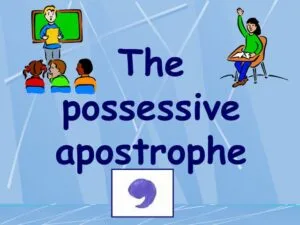
The apostrophe (‘) is used in four ways: to show the genitive (possessive) of nouns and noun phrases, to show the genitive of indefinite pronouns, to mark contractions, and to indicate plurals of numbers, letters, items, figures and cited words. Examples are the girl’s book, nobody’s business and can’t.
Behavioural objectives
By the end of the lesson, students should be able to:
- state the uses of the apostrophe in sentences;
- write the genitive form of nouns and noun phrases;
- write the genitive form of indefinite pronouns;
- write common contractions with the apostrophe correctly.
What are the uses of the apostrophe?
1. To indicate the genitive of nouns and noun phrases
The genitive is also the possessive form of a noun. Examples:
- The girl’s book
- The girl’s books
- A child’s toy
- Dorcas’ money (you pronounce it Dorcas’s money)
Note that the genitive form of a word is the same as the possessive form of that word. If your name is Joan, the genitive form of Joan is Joan’s, while the genitive form of people is people’s.
2. To indicate the genitive of indefinite pronouns
- This is someone’s child.
- It is nobody’s business.
- It is everybody’s business.
3. To mark contractions in words
- can’t (cannot)
- won’t (will not)
- hasn’t (has not)
4. To indicate plurals
The apostrophe is also used to indicate plurals of numbers, letters, items, figures and cited words or expressions.
Evaluation
- State the four uses of the apostrophe.
- Write the genitive form of Joan and of people.
- Write the contracted forms of cannot, will not and has not.
- Write one sentence each using someone’s, nobody’s and everybody’s.
Assignment
Write two sentences that show the genitive of a noun, two that show the genitive of an indefinite pronoun, and two that use a contraction.
Words for the week
Morass, Abject, Blandish, Duplicity, Ennui, Maudlin, Abscond, Alias, Dither, Emaciated
This term's English Studies topics
SS2 Second Term · 16 topics
- Structure: The Use of Possesive Apostrophe
- Structure: Punctuation Marks
- Vocabulary Development: Words Associated with Press
- Oral: Intonation
- Structure: Sentences Types
- Oral: Falling Tone Statements
- Oral: Rhyme Scheme
- Structure: Pronouns
- Oral: Rising Tone
- Vocabulary Development: Words Associated with Environment
- Introduction to Sequence of Tenses
Get English Studies as PDF and Word
Every week of SS2 English Studies, Second Term, formatted and ready to print. Ad-free, and the copy lock comes off.
Get this term Card, bank transfer, USSD or OPay
Second Term English Studies Lesson Notes for Other Topics

Activities on Future Tense
Read the full lesson note.

Future Tense: Simple Future
Read the full lesson note.
Argumentative: Day School is Better than Boarding School
Read the full lesson note.

Contrasting Vowels /e/ and /ᴣ:/
Read the full lesson note.

Literature: Comparing Myths and Legends
Read the full lesson note.
Making Sentences with Simple Present Tense and Simple Past Tense
Read the full lesson note.
Introduction to Vowel Contrast /ᴂ/, /a:/ and /ᴅ/, /ᴐ:/
Read the full lesson note.
Vocabulary Development: Child Labour and Development
Read the full lesson note.

Comprehension: Currency
Read the full lesson note.
Activities on Tenses
Read the full lesson note.
Comprehension: Moi-Moi
Read the full lesson note.
Speech Work: Long Sound /ᴣ:/
Read the full lesson note.
Vocabulary Development: Words Related to Marriage
Read the full lesson note.

Comprehension: The Yoruba Family
Read the full lesson note.
Speech Work: /ᴧ/ Sound
Read the full lesson note.
Lesson Notes for Other Classes

Basic 1 Lesson Note
The complete lesson note to guide your studies.

Basic 2 Lesson Note
The complete lesson note to guide your studies.

Basic 3 Lesson Note
The complete lesson note to guide your studies.

Basic 4 Lesson Note
The complete lesson note to guide your studies.

Basic 5 Lesson Note
The complete lesson note to guide your studies.
Basic 6 Lesson Note
The complete lesson note to guide your studies.
