
Oral: Intonation – SS2 English Lesson Note (Second Term)
Lesson note at a glance
- Class
- SS2
- Subject
- English Studies
- Term
- Second Term
- Reading time
- 5 min
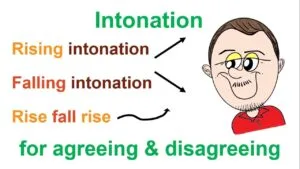
Intonation is the rise and fall of the voice, called pitch, when we speak.
Behavioural objectives
By the end of the lesson, students should be able to:
- explain what intonation is;
- list the sentence types that take a falling tune;
- list the sentence types that take a rising tune;
- say how the last item in a list is spoken;
- identify the rise and fall pattern and the fall and rise pattern in long sentences.
What is intonation?
Intonation is the way the pitch of the voice rises and falls across a word, phrase or sentence.
- Pitch: how high or low the voice sounds when a person speaks.
- Stress: the extra force placed on a syllable or word. Stress and intonation work together in spoken English.
- Meaning: the pitch changes with the meaning the speaker intends.
- Attitude: pitch can show whether the speaker is asking, telling, surprised or unconcerned.
Why is intonation important?
Intonation helps the listener understand what the speaker means, even when the words stay the same.
- Statement or question: “You are going.” (falling) is a statement. “You are going?” (rising) asks for confirmation.
- Finished or unfinished: a falling voice shows the speaker has finished. A rising voice shows more is coming or an answer is expected.
- Feeling: a wrong tune can make a speaker sound rude, bored or unsure.
- Examinations: oral English papers in WAEC and NECO test intonation, so students must recognise each pattern.
What are the two basic intonation patterns?
There are two basic intonation patterns: the falling tune and the rising tune.
What is the falling tune and when is it used?
The falling tune is a pattern in which the voice starts higher and drops to a low pitch at the end.
It is used in four kinds of sentence:
Statements
A statement (declarative sentence) gives information and ends with a falling tune.
- Joy works hard in school.
- Emeka has given the book to her.
Commands
A command tells someone to do something and ends with a falling tune.
- Keep the books on my table.
- Stand under the tree.
Wh-questions
A wh-question begins with a question word such as who, what, why, where, when or how, and takes a falling tune.
- Why are you very late?
- Who gave you the information?
Exclamations
An exclamation shows strong feeling and takes a falling tune.
- What a good result!
- How pretty she is!
What is the rising tune and when is it used?
The rising tune is a pattern in which the voice moves from a lower pitch to a higher pitch at the end.
It is used in three main cases:
Polar questions
A polar question is a question that needs only “yes” or “no” as its answer.
- Is the wine sweet?
- Will Monday be good for it?
- Did you eat last night?
Utterances showing indifference
An utterance showing indifference is a remark in which the speaker sounds unconcerned or noncommittal.
- You can do what you want.
- I think that’s right.
Listing items
When items are listed, each item before the last takes a rising tune.
- One, two, three and four.
- We need some rice, beans, fish and meat.
- Final item: the last item in a list is usually said in a falling tune.
- Reason: the fall tells the listener that the list has ended.
- Example: in “rice, beans, fish and meat”, the voice rises on rice, beans and fish, then falls on meat.
How do the falling and rising tunes compare?
| Feature | Falling tune | Rising tune |
|---|---|---|
| Direction of voice | Ends low | Ends high |
| Sentence types | Statements, commands, wh-questions, exclamations | Polar questions, indifference, items in a list |
| Sense given | Finished, definite | Unfinished, asking, uncertain |
| Example | Stand under the tree. | Did you eat last night? |
How are the falling and rising tunes combined?
The falling and rising tunes can be combined in long sentences, giving two patterns: rise and fall, and fall and rise.
Rise and fall pattern
In the rise and fall pattern, the voice rises on the first part and falls on the last part.
- While the boys were working, the girls were playing.
- When the rain comes, I’ll plant my seed yams.
- First clause: rising, because the sentence is not yet complete.
- Last clause: falling, because the sentence ends there.
Fall and rise pattern
In the fall and rise pattern, the voice falls on the first part and rises on the last part.
- The students are happy, aren’t they?
- You can do it, can’t you?
- Main statement: falling.
- Question tag: rising, when the speaker really wants the listener to confirm.
How can students practise intonation?
- Read the sentence aloud once to get its meaning.
- Decide the sentence type: statement, command, wh-question, polar question, exclamation or list.
- Choose the tune that fits the type.
- Say it again, letting the voice fall or rise at the end.
- Listen to a partner and check that the tune matches.
Evaluation
- What is intonation?
- Name four types of sentence that take a falling tune.
- Say whether each sentence takes a falling or a rising tune: “Is the wine sweet?”, “What a good result!”, “Who gave you the information?”
- How is the final item in a list usually said?
- Give one example of a sentence with a rise and fall pattern and one with a fall and rise pattern.
Assignment
Write two examples each of a command, a wh-question, a polar question and a list of items. State whether each one takes a falling or a rising tune.
This term's English Studies topics
SS2 Second Term · 16 topics
- Structure: The Use of Possesive Apostrophe
- Structure: Punctuation Marks
- Vocabulary Development: Words Associated with Press
- Oral: Intonation
- Structure: Sentences Types
- Oral: Falling Tone Statements
- Oral: Rhyme Scheme
- Structure: Pronouns
- Oral: Rising Tone
- Vocabulary Development: Words Associated with Environment
- Introduction to Sequence of Tenses
SS2 English Studies Lesson Notes for Other Topics
Structure: The Use Of Possesive Apostrophe
Read the full lesson note.
Structure: Punctuation Marks
Read the full lesson note.
Vocabulary Development: Words Associated With Press
Read the full lesson note.
Structure: Sentences Types
Read the full lesson note.
Oral: Falling Tone Statements
Read the full lesson note.

Oral: Rhyme Scheme
Read the full lesson note.

Structure: Pronouns
Read the full lesson note.
Oral: Rising Tone
Read the full lesson note.
Vocabulary Development: Words Associated With Environment
Read the full lesson note.

Introduction To Sequence Of Tenses
Read the full lesson note.
Structure: Phrasal Verbs
Read the full lesson note.
Vocabulary Develeopment: Words Associated With Construction
Read the full lesson note.

Active And Passive Sentences
Read the full lesson note.

Vocabulary Development: Words Associated With Technology
Read the full lesson note.

Vocabulary Development: Words Associated With Cultural Entertainments
Read the full lesson note.
Lesson Notes for Other Classes

SS1 Lesson Note
The complete lesson note to guide your studies.

SS3 Lesson Note
The complete lesson note to guide your studies.
