
Dispersion of White Light – SS2 Physics Lesson Note (Third Term)
Download this term · ₦1,000Lesson note at a glance
- Subject
- Physics
- Class
- SS2
- Term
- Third Term
- Topic
- Dispersion of White Light
- Order
- Topic 4 of 5 this term
- Reading time
- 5 min
Dispersion is the separation of white light into its constituent colours by a glass prism.
Behavioural objectives
By the end of the lesson, students should be able to:
- define dispersion and name the colours of the spectrum of white light;
- explain why a glass prism separates white light into colours;
- describe how a pure spectrum is produced;
- identify the primary and secondary colours and state the result of additive mixing;
- explain how coloured filters and pigments produce colour.
What is dispersion of white light?
Dispersion is the separation of white light into a band of colours called a spectrum when it passes through a glass prism.
- White light: a mixture of many colours, each with its own wavelength. Sunlight is an example.
- Spectrum: the band of colours formed when white light is dispersed.
- Monochromatic light: light of one wavelength or one colour only.
- Deviation: the change in direction of a ray of light as it passes through the prism.
What are the colours of the spectrum?
The spectrum of white light has seven colours: red, orange, yellow, green, blue, indigo and violet (ROYGBIV).
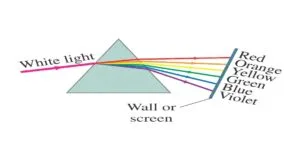
- Red: longest wavelength in air (about 700 × 10-9 m) and deviated least.
- Violet: shortest wavelength in air (about 400 × 10-9 m) and deviated most.
- Other colours: orange, yellow, green, blue and indigo lie in between, in that order.
Why does a glass prism disperse white light?
A glass prism disperses white light because the colours travel at different speeds in glass, so each is deviated by a different amount.
- In a vacuum and in air, all the colours of white light travel at the same speed, or very nearly so.
- White light from a source, such as sunlight, passes through a narrow slit and falls on the prism.
- On entering the glass, each colour slows down by a different amount.
- Red travels fastest in glass and is deviated least.
- Violet travels slowest in glass and is deviated most.
- The colours leave the prism in different directions and form a band of colours on the screen.
| Colour | Wavelength in air | Speed in glass | Deviation |
|---|---|---|---|
| Red | Longest | Greatest | Least |
| Orange to blue | Between the two | Between the two | Between the two |
| Violet | Shortest | Least | Greatest |
How is a pure spectrum produced?
A pure spectrum is a spectrum in which the bands of colour do not overlap, and it is produced with converging lenses and a glass prism.
- Impure spectrum: the spectrum from a prism alone, because the bands of colour overlap.
- Pure spectrum: a spectrum with no overlap between colours.
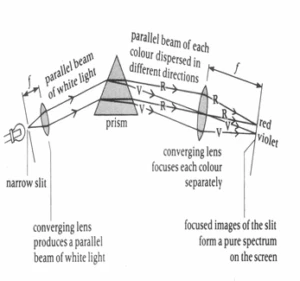
Steps in producing a pure spectrum
- White light from a source passes through a narrow slit.
- The slit is placed at the focus of the first converging lens.
- The lens makes the light parallel after refraction.
- A parallel beam of white light falls on the glass prism.
- Rays of the same colour suffer the same deviation, so each colour leaves as a parallel beam.
- The second converging lens brings each parallel beam to a focus on the screen.
- The colours (red, orange, yellow, green, blue, indigo and violet) focus at different points, so they do not overlap.
- First lens: produces a parallel beam of light for the prism.
- Prism: disperses the light into parallel beams of different colours.
- Second lens: focuses each colour at a separate point on the screen.
How does colour mixing work?
Each colour of light has its own wavelength, and the eye sees a colour according to the light that enters it.
- Single wavelength: light of the yellow wavelength entering the eye is seen as yellow.
- Mixed wavelengths: a mixture of red and green light entering the eye is also seen as yellow.
What are primary colours?
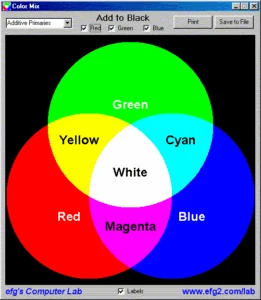
Primary colours are the three basic colours of light that mix to make all the other colours the eye sees.
- Red
- Blue
- Green
What are secondary colours?
Secondary colours are the colours made by mixing any two primary colours of light.
- Red + blue = magenta
- Blue + green = cyan
- Green + red = yellow
What is additive mixing?
Additive mixing is the mixing of coloured lights, and all three primary colours together give white light.
- Result: red + blue + green = white.
- Use: the operation of colour movies is based on additive colour mixing.
What are coloured filters?
A coloured filter is a piece of coloured glass that transmits its own colour and absorbs all other colours that fall on it.
- Red filter: white light passing through it comes out red.
- Green filter: white light passing through it comes out green.
- Two different filters: light passing through a red filter and then a green filter is stopped, because the second filter absorbs the red light.
What is a coloured pigment?
A pigment is the substance that gives an object its colour by absorbing all colours except its own, which it reflects.
- Seeing an object: an object is seen only when light is reflected from it into the eye.
- Red pigment: reflects red light and absorbs the other colours.
- Black pigment: absorbs all colours and reflects none.
- White pigment: reflects all colours.
What is the difference between additive and subtractive mixing?
Additive mixing is the mixing of coloured lights, which adds colours together. Subtractive mixing is the mixing of coloured pigments, such as paints, where each pigment takes colours away by absorbing them.
| Feature | Additive mixing | Subtractive mixing |
|---|---|---|
| What is mixed | Coloured lights | Coloured pigments (paints) |
| What happens | Colours of light are added together | Pigments absorb (subtract) colours |
| Result of mixing red, blue and green | White light | Not white light; the mixture looks dark |
| Example | Colour movies | Painters mixing paints |
Evaluation
- What is dispersion of white light?
- Which colour of white light is deviated least by a glass prism, and which is deviated most?
- Name the three primary colours and state the secondary colour formed by mixing red and blue light.
- Why does a pure spectrum need converging lenses as well as a glass prism?
- What does a black pigment do to the light that falls on it?
Assignment
- Draw a labelled diagram of the arrangement that produces a pure spectrum. State the function of each of the two converging lenses and of the prism.
This term's Physics topics
SS2 Third Term · 5 topics
- Triangular and Rectangular Prisms
- Lenses
- Optical Instruments
- Dispersion of White Light
- Sound Waves
Get Physics as PDF and Word
Every week of SS2 Physics, Third Term, formatted and ready to print. Ad-free, and the copy lock comes off.
Get this term Card, bank transfer, USSD or OPay
SS2 Physics Lesson Notes for Other Topics

Triangular And Rectangular Prisms
Read the full lesson note.
Lenses
Read the full lesson note.
Optical Instruments
Read the full lesson note.
Sound Waves
Read the full lesson note.
Concept Of Position, Distance, And Displacement In Relation To X-Y Plane
Read the full lesson note.

Scalar And Vector Quantities
Read the full lesson note.
Derivation of Equations of Linear Motions
Read the full lesson note.
Projectile And Its Implications
Read the full lesson note.
Newton's Law Of Motion
Read the full lesson note.
Equilibrium Of Forces
Read the full lesson note.
Simple Harmonic Motion
Read the full lesson note.
Machines
Read the full lesson note.
Heat Energy
Read the full lesson note.
Heat Capacity And Specific Heat Capacity
Read the full lesson note.

Evaporation
Read the full lesson note.
Lesson Notes for Other Classes

SS1 Lesson Note
The complete lesson note to guide your studies.

SS3 Lesson Note
The complete lesson note to guide your studies.
