
Triangular and Rectangular Prisms – SS2 Physics Lesson Note (Third Term)
Download this term · ₦1,000Lesson note at a glance
- Subject
- Physics
- Class
- SS2
- Term
- Third Term
- Topic
- Triangular and Rectangular Prisms
- Order
- Topic 1 of 5 this term
- Reading time
- 6 min
Refraction is the change in direction and speed of a ray of light when it passes from one medium to another of different optical density.
Behavioural objectives
By the end of the lesson, students should be able to:
- Define refraction and state what changes and what stays the same when a wave is refracted.
- State the laws of refraction, including Snell’s law.
- Explain refractive index and relate it to the speed of light in two media.
- Describe refraction through a rectangular prism and a triangular prism, including the angle of deviation.
- Explain critical angle and total internal reflection.
- Relate refractive index to real depth and apparent depth.
What is refraction?
Refraction is the bending of a light ray as it passes from one medium to another, caused by a change in the speed of light.
- Cause: light travels at different speeds in different media.
- Optically denser medium: a medium in which light travels more slowly, such as water or glass.
- Optically less dense medium: a medium in which light travels faster, such as air.
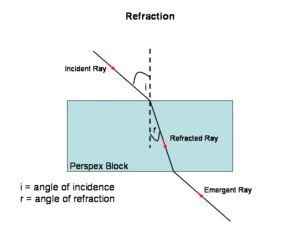
How does the ray bend?
| Direction of travel | Example | Bending |
|---|---|---|
| Less dense to denser medium | Air to water or glass | Towards the normal |
| Denser to less dense medium | Water or glass to air | Away from the normal |
What changes when a wave is refracted?
| Quantity | Effect |
|---|---|
| Direction of travel | Changes |
| Velocity (speed) | Changes |
| Wavelength | Changes |
| Frequency | Stays the same |
What are the laws of refraction?
There are two laws of refraction, and the second is known as Snell’s law.
- First law: the incident ray, the refracted ray and the normal at the point of incidence lie in the same plane, with the two rays on opposite sides of the normal.
- Second law (Snell’s law): the ratio of the sine of the angle of incidence to the sine of the angle of refraction is a constant for a given pair of media.
sin i ÷ sin r = n
What is refractive index?
Refractive index (n) is the constant in Snell’s law, and it measures how much a medium bends light.
- Symbol ang: refractive index of glass with respect to air.
- Air to glass: ang = sine of angle of incidence in air ÷ sine of angle of refraction in glass.
- Glass to air: gna = sine of angle of incidence in glass ÷ sine of angle of refraction in air.
- Reversibility of light: ang = 1 ÷ gna.
- Speed of light: ang = speed of light in air ÷ speed of light in glass.
Worked example
- Glass has a refractive index of 1.5 with respect to air.
- Take the speed of light in air as 3.0 × 10⁸ m/s.
- Speed in glass = (3.0 × 10⁸) ÷ 1.5.
- Speed in glass = 2.0 × 10⁸ m/s.
How does light refract through a rectangular prism?
A ray passing through a rectangular glass block bends twice and leaves parallel to its original direction.
- The ray enters the glass from air and bends towards the normal.
- The ray travels in a straight line through the glass.
- The ray leaves the glass into air and bends away from the normal.
- The emergent ray is parallel to the incident ray but shifted sideways.
- Lateral displacement: the sideways distance between the incident ray and the emergent ray.
What are the effects of refraction?
Refraction makes objects in or behind a transparent medium look displaced or bent.
- Shallow pond: the bottom of a clear river or pond appears shallower than it really is.
- Bent spoon: a spoon looks bent or broken when partly immersed in water or any liquid.
- Raised print: letters seem nearer when a thick block of glass is placed over them.
How does light refract through a triangular prism?
A triangular prism bends a ray towards its base, because the ray is refracted at two faces that are not parallel.

- Angle of the prism (A): the angle between the two faces through which light enters and leaves.
- Angle of deviation (D): the angle between the incident ray and the emergent ray.
- Angle of minimum deviation: the smallest value of D.
How does the angle of deviation change?
- As the angle of incidence increases, the angle of deviation decreases.
- The angle of deviation reaches a minimum value.
- If the angle of incidence keeps increasing, the angle of deviation rises again.
What is the refractive index of a prism?
n = sin[(A + D) ÷ 2] ÷ sin(A ÷ 2)
- n: refractive index of the prism material.
- A: angle of the prism.
- D: angle of minimum deviation.
What is total internal reflection?
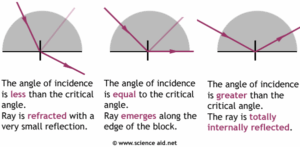
Total internal reflection is the complete reflection of light back into a denser medium when the angle of incidence is greater than the critical angle.
What is the critical angle?
The critical angle (c) is the angle of incidence in the denser medium for which the angle of refraction in the less dense medium is 90°.
How does total internal reflection occur?
- Light passes from a denser to a less dense medium, for example glass to air.
- At a small angle of incidence, there is a strong refracted ray and a weak reflected ray.
- As the angle of incidence increases, the angle of refraction also increases.
- At the critical angle, the angle of refraction is 90°.
- Above the critical angle, the refracted ray disappears and all the light is reflected into the denser medium.
What are the conditions for total internal reflection?
- Direction: light must travel from a denser to a less dense medium.
- Angle: the angle of incidence must be greater than the critical angle.
Example: how does a mirage form on a hot road?
- The hot road warms the air just above it, making it optically less dense than the cooler air higher up.
- Light from the sky travels downwards into the warmer, less dense layers.
- The angle of incidence at a layer of warm air reaches the critical angle.
- The light suffers total internal reflection and travels upwards to the eye.
- The driver sees an image of the sky on the road, which looks like a pool of water.
What are real depth and apparent depth?
Real depth is the actual depth of an object in a medium, and apparent depth is the shallower depth at which it seems to be.
- Rays from a coin at the bottom of a bucket of water reach the water surface.
- The rays are refracted away from the normal as they leave the water and enter the eye.
- The rays seem to come from a virtual image nearer the surface.
- The depth of this image is the apparent depth.
- The actual depth does not change and is the real depth.
Refractive index = real depth ÷ apparent depth
- Glass slab: viewed from directly above, it appears to be about two-thirds of its real thickness.
- Pond water: viewed from directly above, it appears to be about three-quarters of its real depth.
Evaluation
- Define refraction.
- State what changes and what stays the same when a light wave is refracted.
- State Snell’s law.
- What is the critical angle? State what happens when the angle of incidence is greater than the critical angle.
- Write the formula for refractive index in terms of real depth and apparent depth.
Assignment
- Explain why the bottom of a clear pond appears shallower than it really is.
- Explain how a mirage forms on a hot road.
- Describe how the angle of deviation changes in a triangular prism as the angle of incidence increases.
This term's Physics topics
SS2 Third Term · 5 topics
- Triangular and Rectangular Prisms
- Lenses
- Optical Instruments
- Dispersion of White Light
- Sound Waves
Get Physics as PDF and Word
Every week of SS2 Physics, Third Term, formatted and ready to print. Ad-free, and the copy lock comes off.
Get this term Card, bank transfer, USSD or OPay
SS2 Physics Lesson Notes for Other Topics
Lenses
Read the full lesson note.
Optical Instruments
Read the full lesson note.
Dispersion Of White Light
Read the full lesson note.
Sound Waves
Read the full lesson note.
Concept Of Position, Distance, And Displacement In Relation To X-Y Plane
Read the full lesson note.

Scalar And Vector Quantities
Read the full lesson note.
Derivation of Equations of Linear Motions
Read the full lesson note.
Projectile And Its Implications
Read the full lesson note.
Newton's Law Of Motion
Read the full lesson note.
Equilibrium Of Forces
Read the full lesson note.
Simple Harmonic Motion
Read the full lesson note.
Machines
Read the full lesson note.

Heat Energy
Read the full lesson note.
Heat Capacity And Specific Heat Capacity
Read the full lesson note.

Evaporation
Read the full lesson note.
Lesson Notes for Other Classes

SS1 Lesson Note
The complete lesson note to guide your studies.

SS3 Lesson Note
The complete lesson note to guide your studies.
