
Lenses – SS2 Physics Lesson Note (Third Term)
Download this term · ₦1,000Lesson note at a glance
- Subject
- Physics
- Class
- SS2
- Term
- Third Term
- Topic
- Lenses
- Order
- Topic 2 of 5 this term
- Reading time
- 5 min
A lens is a piece of transparent material, usually glass, with curved surfaces that bends light by refraction.
Behavioural objectives
By the end of the lesson, students should be able to:
- Name the two types of lenses and describe how each affects light rays.
- Define the principal axis, principal focus, optical centre and focal length of a lens.
- Describe the two rays used to locate the image formed by a converging lens.
- State the nature and position of the image when an object is at infinity and when it is beyond 2F1.
- State the formula for the power of a lens and use the lens formula.
- Describe how a simple microscope works and what it is used for.
Where are lenses used?
Lenses are used in many instruments, and the human eye has a natural lens.
- Magnifying glass: a single converging lens that enlarges small objects.
- Microscope: lenses that magnify very small specimens.
- Telescope: lenses that make distant objects look nearer.
- Camera: a lens that forms an image on film or a sensor.
- Projector: a lens that throws an enlarged image on a screen.
- Human eye: a natural converging lens that focuses light on the retina.
What are the types of lenses?
There are two types of lenses: converging (convex) lenses and diverging (concave) lenses.
Converging (convex) lens
- Shape: bulges at the centre, thicker in the middle than at the edges.
- Effect on light: brings parallel light rays together at a point.
- Principal focus: real.
Diverging (concave) lens
- Shape: thinner at the centre than at the edges.
- Effect on light: spreads parallel light rays apart.
- Principal focus: virtual.
How do the two lenses compare?
| Feature | Converging lens | Diverging lens |
|---|---|---|
| Other name | Convex | Concave |
| Thickness | Thicker at the centre | Thinner at the centre |
| Effect on parallel rays | Brings them together | Spreads them apart |
| Principal focus | Real | Virtual |
What terms are used with lenses?
The four common terms used with lenses are the principal axis, principal focus, optical centre and focal length.
- Principal axis: the line joining the centres of curvature of the two surfaces of the lens, passing through the middle of the lens.
- Principal focus: the point on the principal axis to which all rays parallel and close to the axis converge or diverge, after refraction by the lens.
- Optical centre: the centre of the lens, a point on the principal axis. Rays of light passing through it are undeviated.
- Focal length: the distance between the optical centre and the principal focus of the lens.
How are images formed in lenses?
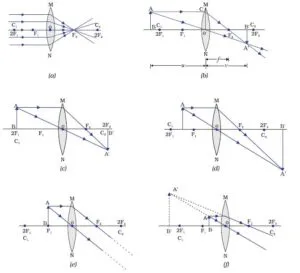
An image is formed where refracted rays from a point on an object meet, or appear to meet.
Which rays locate the image in a converging lens?
Two major rays from the top of the object are used to locate the image.
- A ray from the top of the object is incident on the middle, C, of the lens and passes through undeviated.
- A ray from the top of the object, parallel to the principal axis, is incident on the lens and is refracted through the principal focus, F.
- Position of the image: the point where these two rays intersect.
What image forms when the object is at infinity?
When an object is very far from the lens (at infinity), the image is real, inverted and formed at the principal focus.
- Size: the image is very small (highly diminished).
What image forms when the object is beyond 2F1?
When an object is placed beyond 2F1, the image is formed between F and 2F and is real, inverted and smaller than the object (diminished).
What images does a converging lens form at other positions?
| Object position | Image position | Nature of image |
|---|---|---|
| At infinity | At F | Real, inverted, very small |
| Beyond 2F | Between F and 2F | Real, inverted, diminished |
| At 2F | At 2F | Real, inverted, same size |
| Between F and 2F | Beyond 2F | Real, inverted, magnified |
| At F | At infinity | Image formed very far away |
| Between F and the lens | Same side as the object | Virtual, upright, magnified |
What image does a diverging lens form?
- Nature: virtual, upright and diminished for any object position.
- Position: on the same side of the lens as the object.
What is the lens formula?
The lens formula relates the focal length f of a lens to the object distance u and the image distance v.
1/f = 1/u + 1/v
- Sign convention used here (real is positive): distances to real objects, real images and real foci are positive.
- Virtual distances: distances to virtual images and virtual foci are negative.
- Converging lens: f is positive.
- Diverging lens: f is negative.
Worked example
An object is 30 cm from a converging lens of focal length 10 cm. Find the image distance.
- Write the formula: 1/v = 1/f – 1/u.
- Substitute: 1/v = 1/10 – 1/30 = 3/30 – 1/30 = 2/30.
- Invert: v = 15 cm.
- Meaning: the image is real and lies between F and 2F, as expected.
What is the power of a lens?
The power of a lens is the reciprocal of the focal length of the lens in metres.
P = 1/f
- Unit: the dioptre (D).
- Converging lens: positive power.
- Diverging lens: negative power.
- Example: a lens of focal length 0.5 m has power 1/0.5 = 2 D.
What is a simple microscope or magnifying glass?
A simple microscope is a single converging lens that gives an enlarged, upright, virtual image of an object placed inside its principal focus.
- Object position: between the principal focus and the lens.
- Image: virtual, upright and magnified.
- Uses: reading small print and studying biological specimens.
Evaluation
- Name the two types of lenses and state how each affects light rays.
- Define the principal focus and the focal length of a lens.
- Which rays are used to locate the image formed by a converging lens?
- State the nature and position of the image formed when an object is placed beyond 2F1 of a converging lens.
- Write the formula for the power of a lens and state its unit.
Assignment
- A converging lens of focal length 15 cm forms a virtual image at a point 10 cm from the lens. Calculate the distance of the object from the lens.
This term's Physics topics
SS2 Third Term · 5 topics
Get Physics as PDF and Word
Every week of SS2 Physics, Third Term, formatted and ready to print. Ad-free, and the copy lock comes off.
Get this term Card, bank transfer, USSD or OPay
SS2 Physics Lesson Notes for Other Topics

Triangular And Rectangular Prisms
Read the full lesson note.
Optical Instruments
Read the full lesson note.
Dispersion Of White Light
Read the full lesson note.
Sound Waves
Read the full lesson note.
Concept Of Position, Distance, And Displacement In Relation To X-Y Plane
Read the full lesson note.

Scalar And Vector Quantities
Read the full lesson note.
Derivation of Equations of Linear Motions
Read the full lesson note.
Projectile And Its Implications
Read the full lesson note.
Newton's Law Of Motion
Read the full lesson note.
Equilibrium Of Forces
Read the full lesson note.
Simple Harmonic Motion
Read the full lesson note.
Machines
Read the full lesson note.

Heat Energy
Read the full lesson note.
Heat Capacity And Specific Heat Capacity
Read the full lesson note.

Evaporation
Read the full lesson note.
Lesson Notes for Other Classes

SS1 Lesson Note
The complete lesson note to guide your studies.

SS3 Lesson Note
The complete lesson note to guide your studies.
