
Receipts and Payment Accounts – SS2 Financial Accounting Lesson Note (Second Term)
Lesson note at a glance
- Class
- SS2
- Subject
- Financial Accounting
- Term
- Second Term
- Reading time
- 8 min

A receipts and payments account is a summary of all the cash and bank receipts and payments of a not-for-profit organisation for a period.
- Nature: it is a real account and a classified summary of the Cash Book.
- Basis: it is kept on a cash basis, so only money actually received or paid is recorded.
- Coverage: it includes capital and revenue items, whether they relate to the current, previous or next year.
- Not accrual based: it does not include income or expenses that are only due or owing.
Behavioural objectives
By the end of the lesson, students should be able to:
- define a receipts and payments account;
- state the features of a receipts and payments account;
- list the steps in preparing a receipts and payments account;
- state the differences between a receipts and payments account and a cash book;
- prepare a receipts and payments account from given information.
What is a not-for-profit organisation?
A not-for-profit organisation is a body formed to serve its members or the public, not to make profit.
- Clubs and societies: sports clubs, social clubs and old students’ associations.
- Religious bodies: churches and mosques.
- Charities: foundations and voluntary groups that raise money for a cause.
- Why it matters: such bodies often keep only a cash book, so the receipts and payments account is their first final account.
How does a receipts and payments account record cash?
It records all receipts on the debit side and all payments on the credit side.
- Debit side (receipts): all cash and bank money received during the period.
- Credit side (payments): all cash and bank money paid out during the period.
- Opening balances: Cash in Hand and Cash at Bank at the start of the period, shown on the debit side.
- Closing balances: Cash in Hand and Cash at Bank at the end of the period, shown on the credit side.
- Result: the account shows the cash position of the organisation.
What are the features of a receipts and payments account?
There are six main features of a receipts and payments account.
- Nature: it is a real account and a classified summary of cash receipts and cash payments.
- Basis of recording: all transactions settled in cash are recorded on a cash basis.
- Type of items: it records both capital and revenue items and does not separate them.
- Period: it is prepared for a specific period, such as a month or a year.
- Time of items: cash and bank items are recorded without separating current, previous or later periods.
- Adjustments: it is not based on accrual, so only cash transactions are recorded.
- Purpose: it gives a fair idea of the cash position through the opening and closing balances.
What items appear in a receipts and payments account?
Receipts are cash or bank inflows, and payments are cash or bank outflows, whatever their nature.
| Side | Revenue items | Capital items |
|---|---|---|
| Receipts (debit) | Subscriptions, entrance fees, interest, sale of old newspapers | Donation for a building, sale of furniture |
| Payments (credit) | Salaries, printing and stationery, insurance, audit fees, taxes | Purchase of furniture, purchase of library books, purchase of investments |
How do you prepare a receipts and payments account?
You prepare it in five steps, starting from the opening balances and ending with the closing balances.
- Step 1: Write the opening balances of cash in hand and cash at bank on the receipts (debit) side. If there is a bank overdraft at the start, write it on the payments (credit) side.
- Step 2: Write all cash or bank money received on the debit side, whether capital or revenue.
- Step 3: Write all cash or bank payments made on the credit side, whether capital or revenue.
- Step 4: Leave out accrued incomes and outstanding expenses, because they bring no cash inflow or outflow.
- Step 5: Compare both sides. Write the difference on the credit side as the closing balance of cash in hand and cash at bank.
What is the format of a receipts and payments account?
The format has a receipts (debit) side on the left and a payments (credit) side on the right.
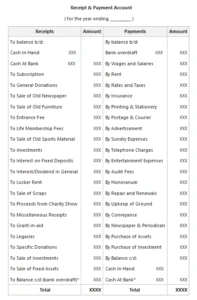
| Receipts (Dr) | Payments (Cr) |
|---|---|
| To Balance b/d: Cash in Hand, Cash at Bank* | By Bank Overdraft (if any, at the start) |
| To Subscriptions, Donations, Entrance fees, Interest and other receipts | By Salaries, Rent, Stationery and other payments |
| To Sale of assets | By Purchase of assets |
| By Balance c/d: Cash in Hand, Cash at Bank* |
- Asterisk (*): the Cash at Bank balance may be positive or negative.
- Positive balance: when the receipts side is greater than the payments side, the difference is Cash at Bank.
- Bank overdraft: when the payments side is greater than the receipts side, the difference is a Bank Overdraft, a negative Cash at Bank.
How does a receipts and payments account differ from a cash book?
A receipts and payments account is a classified summary of the cash book, prepared by a not-for-profit organisation at the end of the year.
A cash book is the book of original entry that records every cash and bank receipt and payment, in date order.
| SN | Basis | Receipts and payments account | Cash book |
|---|---|---|---|
| 1 | Recording | It is a classified summary of the Cash Book. The transactions and events which have been settled in cash are recorded. | The Cash Book records each receipt and payment. |
| 2 | Period | It is prepared at the end of the accounting year. | The Cash Book records transactions daily. |
| 3 | Date | Dates are not recorded. | Transactions are recorded date-wise. |
| 4 | Ledger folio | There is no column for Ledger Folio. | There is a separate column for Ledger Folio. |
| 5 | Entity | It is prepared by a non-profit organisation. | It is generally prepared by any commercial organisation. |
| 6 | Format of account | All the receipts are written on the debit side and all the payments made are written on the credit side. | The Cash Book has debit and credit sides with date, particulars, cash and bank amount columns, and ledger folio columns. |
What are the limitations of a receipts and payments account?
A receipts and payments account shows cash movements only, so it gives an incomplete picture of the organisation.
- No surplus or deficit: it does not show whether the organisation earned more than it spent.
- No accruals: it ignores income due and expenses owing.
- No assets and liabilities: it does not show what the organisation owns or owes.
- Mixed items: capital and revenue items appear together.
Worked example: how do you prepare a receipts and payments account?
From the following information, prepare a Receipts and Payment account of Nisha Foundation for the year ended 31st March 2021:
Balance at the beginning of the year:
- Cash in Hand $5,500
- Cash at Bank $24,000
Other information:
- Subscription for the year is $92,000.
- Petty Cash Payment of $870.
- Sundry Expenses:
- a) Printing and Stationery expenses $2,300.
- b) Advertisement expenses $1,700.
- c) Audit fees of $10,500.
- Purchase of furniture $21,000.
- Sale of old newspaper $1,200.
- Entrance fees received $80,000.
- Donation received from Mr. Rajesh Kumar for building $30,000.
- Insurance paid $37,000.
- Taxes paid by the organisation are $1,400.
The closing balance of Cash in Hand for the year ended 31st March 2021 was $7,000. Find the closing balance of Cash at the Bank also.
Solution

Steps to find the closing Cash at Bank
- Add all receipts, including both opening balances: $232,700.
- Add all payments made during the year: $74,770.
- Deduct the payments and the closing Cash in Hand from the receipts: $232,700 − $74,770 − $7,000.
- The closing Cash at Bank is $150,930.
Receipts side (debit)
| Item | Amount ($) |
|---|---|
| To Balance b/d: Cash in Hand | 5,500 |
| To Balance b/d: Cash at Bank | 24,000 |
| To Subscriptions | 92,000 |
| To Sale of old newspaper | 1,200 |
| To Entrance fees | 80,000 |
| To Donation for building | 30,000 |
| Total | 232,700 |
Payments side (credit)
| Item | Amount ($) |
|---|---|
| By Petty cash payment | 870 |
| By Printing and stationery | 2,300 |
| By Advertisement | 1,700 |
| By Audit fees | 10,500 |
| By Furniture | 21,000 |
| By Insurance | 37,000 |
| By Taxes | 1,400 |
| By Balance c/d: Cash in Hand | 7,000 |
| By Balance c/d: Cash at Bank | 150,930 |
| Total | 232,700 |
Evaluation
- Define a receipts and payments account.
- On which side of the account are receipts written, and on which side are payments written?
- State three differences between a receipts and payments account and a cash book.
- Why are accrued incomes and outstanding expenses not included in a receipts and payments account?
- When does the account show a bank overdraft as the closing balance?
Assignment
Question 1. From the following information of GG Organisation, calculate cash at the bank at the end of the year and prepare a Receipts and Payment Account for the year ending 2021-22:
Balance at the beginning of the year, 1-4-2021:
- Cash at Bank $43,200
- Cash in Hand $17,940
- Subscriptions received $6,750
Sundry payments:
- Rent and Taxes $1,900
- Printing and Stationery $3,160
- Salaries $14,700
Sundry receipts:
- Interest on Investment $5,500
- Sale of Furniture $11,400
- Bank Interest $800
- Entrance fees received for the year 2021-22 $9,700
Balance at the end of the year, 31-3-2022:
- Cash at the Bank?
- Cash in Hand $21,870
Question 2. From the following information of GFG Club, prepare a Receipts and Payments Account for the year ending on 31st March 2022. Cash at the Bank at the end of the year was $197,300. Find Cash in Hand at the year ending.
Balance on 1st April 2021:
- Cash at Bank $83,200
- Cash in Hand $27,000
- Subscriptions received $64,200 (including $11,100 for 2020-21 and $16,300 for 2022-23)
- Special Subscriptions for Governor’s Party $49,000
Sundry receipts:
- Locker rent $31,500
- Sale of Old Newspapers $1,750
- Profit from Entertainment $22,800
- Rent realised from Club Hall $35,500
- Interest received from Investment $8,000
- Life Membership Fees received $12,630
- Entrance fees received $1,590
Sundry payments:
- Salaries $28,000 (including $6,500 for 2020-21)
- Postage and Stationery $2,020
- Electricity charges $1,765
- Purchase of Library Books $30,200
- Expenses on Dance and Socials $1,980
- Investments purchased by the Organisation worth $20,000
- Honorarium paid by the Organisation $3,050
This term's Financial Accounting topics
SS2 Second Term · 5 topics
SS2 Financial Accounting Lesson Notes for Other Topics

Single Entry And Incomplete Records
Read the full lesson note.
Accounts Of Non Profit Making Organisations
Read the full lesson note.
Partnership Accounts
Read the full lesson note.
Partnership Accounts II - Partnership Capital Accounts & How to Calculate it
Read the full lesson note.

Suspense Account
Read the full lesson note.
Suspense Account II - Correction of Errors
Read the full lesson note.
Manufacturing Accounts
Read the full lesson note.
Control Account And Self-Balancing Ledger
Read the full lesson note.
Introduction To Single Entry And Incomplete Records
Read the full lesson note.
Dissolution Of Partnership
Read the full lesson note.
Company Accounts
Read the full lesson note.
Balance Sheet
Read the full lesson note.
Issues & Classes of Shares
Read the full lesson note.
Interpretation Of Financial Statement Using Simple Ratio
Read the full lesson note.
Lesson Notes for Other Classes

SS1 Lesson Note
The complete lesson note to guide your studies.

SS3 Lesson Note
The complete lesson note to guide your studies.
