
Introduction to Single Entry and Incomplete Records – SS2 Financial Accounting Lesson Note (First Term)
Lesson note at a glance
- Class
- SS2
- Subject
- Financial Accounting
- Term
- First Term
- Reading time
- 6 min
Single entry, also called one-leg entry or incomplete records, is a system of accounting in which transactions are recorded without following the rule of double entry.
Behavioural objectives
- State the meaning of single entry and incomplete records.
- List the features of single entry records.
- Identify places where single entry accounting is used.
- Prepare opening and closing statements of affairs and compute profit from them.
- List the steps for converting single entry records to double entry and preparing final accounts.
What is single entry or incomplete records?
Single entry is a method of bookkeeping in which only one aspect of most transactions is recorded, usually in the cash book.
- Inadequate records: the books are not enough to prepare a normal accounting report directly.
- Role of the accountant: experience and ingenuity are used to build the accounts from the available information.
- Other names: one-leg entry, incomplete records.
What is the difference between single entry and double entry?
Double entry records every transaction twice, as a debit in one account and a credit in another. Single entry records most transactions once, often only in the cash book.
| Point | Single entry | Double entry |
|---|---|---|
| Recording | One aspect of a transaction | Debit and credit aspects |
| Books kept | Loose sheets or cash book only | Full set of books and ledgers |
| Trial balance | Cannot be drawn directly | Can be drawn to test accuracy |
| Profit | Found by comparing two statements of affairs | Found from the trading, profit and loss account |
| Information | Inadequate | Adequate and complete |
What are the features of single entry and incomplete records?
The main features of single entry are inadequate information and poor or missing books.
- Comparison of years: final accounts are prepared by comparing financial data of two or more years.
- Inadequate information: accounting information is grossly inadequate.
- Poor books: accounting records or books are not in existence or not well organised.
- Loose sheets: mostly, records are kept on loose sheets or only cash books are kept.
- No system: there is no accounting system in such an organisation.
- Flexibility: record keeping is flexible.
Where is single entry accounting used?
Single entry accounting is used by organisations that have no proper accounting unit or system.
- Schools: many keep only a cash book of fees and expenses.
- Government parastatals and agencies: some keep limited records.
- Clubs, associations and unions: these are not-for-profit organisations.
- Sole traders and small-scale businesses: for example, a petty trader in a local market.
- Organisations with no finance or accounting unit: no one is employed to keep full books.
- Victims of disasters: businesses hit by artificial or natural disasters, such as fire or flood, may lose their books.
- Businesses with loose-sheet records: papers are kept but not organised into books.
What are the advantages and disadvantages of single entry?
Advantages
- Simple: it is easy to keep and needs little training.
- Cheap: no accountant is needed for daily recording.
- Flexible: the owner records only what he or she finds useful.
Disadvantages
- No trial balance: arithmetical accuracy cannot be tested directly.
- Errors and fraud: mistakes and theft are hard to detect.
- Profit is an estimate: it is found by comparing capital, not by recording income and expenses.
- Weak for outsiders: banks and tax authorities may not accept such records.
What is a statement of affairs?
A statement of affairs is a summary of a business’s assets, liabilities and owner’s capital at a given date.
- When it is drawn: at the beginning or the end of an accounting year or period.
- Purpose: to ascertain any growth or increase in capital between two dates.
- Difference from a balance sheet: it is built from estimates and incomplete records, not from a trial balance.
What information is needed to prepare a statement of affairs?
- Fixed assets: for example, vehicles, machinery and buildings.
- Debtors and creditors: the total owed to and by the business.
- Expenses owing and prepaid: amounts unpaid or paid in advance.
- Cash in hand and at the bank: the balances on the date.
Comparing two statements of affairs for different dates gives the profit or loss for the period.
Format of the statement of affairs
a) Opening statement of affairs
| Item | ₦ |
|---|---|
| Fixed assets | XXX |
| Current assets | XXX |
| Total assets | XXX |
| Less: Liabilities | (XXX) |
| Opening capital | XXX |
Opening capital = Total assets – Liabilities
b) Closing statement of affairs
| Item | ₦ |
|---|---|
| Fixed assets | XXX |
| Current assets | XXX |
| Less: Liabilities | (XXX) |
| Closing capital | XXX |
c) Computation of profit between the two statements of affairs
| Item | ₦ | ₦ |
|---|---|---|
| Closing capital | XXX | |
| Add: Drawings | XX | |
| Less: Opening capital | XX | |
| Additional capital | XX | (XX) |
| Net profit | XX/(XX) |
What are the other ways to compute profit or loss?
- Closing capital formula: Opening capital + Profit – Drawings + Additional capital = New or closing capital.
- Profit formula: Profit = New capital + Drawings – Opening capital – Additional capital.
Illustration of profit from two statements of affairs
- Opening capital: ₦500,000.
- Closing capital: ₦650,000.
- Drawings: ₦40,000.
- Additional capital introduced: ₦30,000.
- Profit: 650,000 + 40,000 – 500,000 – 30,000 = ₦160,000.
- Check: 500,000 + 160,000 – 40,000 + 30,000 = ₦650,000, which equals the closing capital.
How are final accounts prepared from incomplete records?
Final accounts are prepared from incomplete records by converting the single entry records to double entry records, using the information available.
Which books are opened for the conversion?
- Cash book
- Sales ledger
- Purchases ledger
- Assets and liabilities accounts
- Nominal accounts
- Trial balance: if the conversion is done properly, a trial balance can be drawn to test arithmetical accuracy.
What are the steps for the conversion and preparation of final accounts?
- Prepare the opening statement of affairs to ascertain the opening capital.
- Prepare the cash book with the details. It must include both the cash and bank accounts, either separately or in one cash book, as the case may be.
- Prepare the debtors’ and creditors’ ledger control accounts to ascertain the total credit sales and total credit purchases.
- Prepare a schedule or summary of total sales and purchases by adding the total credit sales and purchases to the cash sales and cash purchases.
- Prepare control accounts for the nominal items that have amounts outstanding or prepaid at the beginning or the end of the period in question.
- Prepare any other required working schedules.
- Prepare the trading, profit and loss account from steps 1 to 6.
- Prepare the balance sheet.
What are the working rules for the control accounts?
- Credit sales: Opening debtors + Credit sales – Cash received from debtors = Closing debtors. Credit sales is the missing figure.
- Total sales: Credit sales + Cash sales.
- Credit purchases: Opening creditors + Credit purchases – Payments to creditors = Closing creditors. Credit purchases is the missing figure.
- Expense for the year: Cash paid + Closing amount owing – Opening amount owing (adjust also for prepaid amounts).
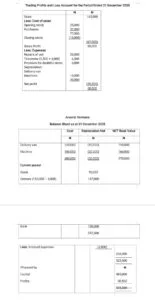
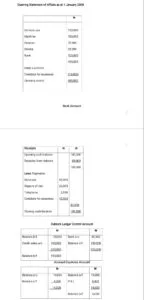
Worked example: Arsenal Ventures
Arsenal Ventures had the following assets and liabilities as of 1 January 2008.
| Item | ₦ |
|---|---|
| Delivery van | 120,000 |
| Machine | 180,000 |
| Debtors | 70,000 |
| Bank | 100,000 |
| Stocks | 25,000 |
| Creditors for expenses | 10,000 |
They do not keep proper records of their business transactions, but the following were extracted from sketchbooks.
| Item | ₦ |
|---|---|
| Opening cash balance | 100,000 |
| Receipt from debtors | 85,000 |
| Payments | |
| Materials | 52,000 |
| Repairs of van | 20,000 |
| Telephones | 2,500 |
| Creditors for expenses | 10,000 |
On 31 December 2008, debtors owed ₦150,000 and the closing stock was valued at ₦10,000.
The following additional information was available:
| Item | ₦ |
|---|---|
| Provision for depreciation: delivery van | 10,000 |
| Provision for depreciation: machine | 20,000 |
| Accrued telephone expenses | 4,000 |
| Provision for doubtful debts | 3,000 |
You are required to prepare:
- Statement of affairs as of 1 January 2008.
- Trading, profit and loss account for the year ended 31 December 2008 and the balance sheet as of that date.
Evaluation
- What is single entry?
- State four features of incomplete records.
- Give four places where single entry accounting is used.
- What is a statement of affairs, and how is opening capital calculated from it?
- List the books that must be opened to convert single entry records to double entry.
Assignment
- A trader’s opening capital was ₦400,000 and closing capital was ₦520,000. He withdrew ₦50,000 and introduced additional capital of ₦20,000. Write the profit formula and compute his profit for the year.
This term's Financial Accounting topics
SS2 First Term · 5 topics
- Suspense Account
- Suspense Account II: Correction of Errors
- Manufacturing Accounts
- Control Account and Self-Balancing Ledger
- Introduction to Single Entry and Incomplete Records
SS2 Financial Accounting Lesson Notes for Other Topics

Suspense Account
Read the full lesson note.
Suspense Account II - Correction of Errors
Read the full lesson note.
Manufacturing Accounts
Read the full lesson note.
Control Account And Self-Balancing Ledger
Read the full lesson note.

Single Entry And Incomplete Records
Read the full lesson note.
Accounts Of Non Profit Making Organisations
Read the full lesson note.
Partnership Accounts
Read the full lesson note.
Partnership Accounts II - Partnership Capital Accounts & How to Calculate it
Read the full lesson note.

Receipts And Payment Accounts
Read the full lesson note.
Dissolution Of Partnership
Read the full lesson note.
Company Accounts
Read the full lesson note.
Balance Sheet
Read the full lesson note.
Issues & Classes of Shares
Read the full lesson note.
Interpretation Of Financial Statement Using Simple Ratio
Read the full lesson note.
Lesson Notes for Other Classes

SS1 Lesson Note
The complete lesson note to guide your studies.

SS3 Lesson Note
The complete lesson note to guide your studies.
