
Manufacturing Accounts – SS2 Financial Accounting Lesson Note (First Term)
Lesson note at a glance
- Class
- SS2
- Subject
- Financial Accounting
- Term
- First Term
- Reading time
- 5 min
A manufacturing account is an account prepared to identify all the manufacturing costs incurred in bringing a product to a marketable state.
Behavioural objectives
By the end of the lesson, students should be able to:
- define a manufacturing account;
- distinguish between direct costs, indirect costs and non-manufacturing costs;
- list items that are included in factory overheads;
- explain terms such as prime cost, total factory cost, inventory and total cost;
- name the three sections of the accounts of a manufacturing concern.
What costs are involved in manufacturing?
Manufacturing is the process of making goods by hand or by machine, and its costs fall into two main divisions.
- Cost of raw materials: the materials from which the goods are made.
- Cost of converting raw materials into finished goods: this has two categories, manufacturing costs and non-manufacturing costs.
- Manufacturing costs: costs of running the factory and making the product.
- Non-manufacturing costs: administrative and marketing costs outside the factory.
What are manufacturing costs?
There are two types of manufacturing costs: direct costs and indirect costs (also called factory overheads).
What are direct costs?
Direct costs are costs that can be readily traced to the products.
There are three types of direct costs:
- Direct material cost: the cost of the basic substances from which a product is made, such as soya beans for vegetable oil, palm oil for soaps and animal skin for shoes.
- Direct labour cost: the wages of factory workers who change direct materials into finished goods, such as the wage of a machine operator.
- Direct expenses: expenses other than direct materials and direct labour that are incurred solely in producing the goods, such as the cost of special designs or specialised equipment for a particular job.
What are indirect costs?
Indirect costs are costs that cannot be traced directly to the product but are still part of its cost.
- Indirect materials: items such as lubricants and supplies used for repairs and maintenance.
- Indirect labour: wages of people such as factory foremen and supervisors.
- Other indirect expenses: rent, power and depreciation of the factory.
- Materiality: when deciding which costs to treat as direct, the size (materiality) of the item must be considered.
Which items are included in factory overheads?
Factory overheads (manufacturing overheads) are all indirect costs of running the factory.
- Indirect wages: pay of foremen, supervisors and other non-production factory staff.
- Heat and power: fuel and electricity used in the factory.
- Lubricants: oils used to keep machines running smoothly.
- Grease and oil: used for servicing machines.
- General factory expenses: small running costs of the factory.
- Rent and rates on factory: charges for the factory premises.
- Depreciation of plant and machinery: yearly fall in the value of factory equipment.
- Depreciation of factory buildings and tools: yearly fall in the value of the factory premises and tools.
- Factory consumables or supplies: items used up in the factory.
- Indirect materials: materials that are not easily traced to a product.
- Small tools used: cost of small tools consumed in production.
- Other utilities: other services paid for by the factory.
What are non-manufacturing costs?
Non-manufacturing costs are administrative and marketing costs that are not part of the cost of making the product.
- Treatment: they are not shown in the manufacturing section of the account.
- Where they appear: they are charged in the profit and loss section.
- Examples: office salaries, advertising and delivery costs.
What is the difference between direct, indirect and non-manufacturing costs?
Direct costs are traced to the product, indirect costs are shared across products in the factory, and non-manufacturing costs sit outside the factory.
| Type of cost | Traced to product? | Where it is shown | Example |
|---|---|---|---|
| Direct cost | Yes, readily | Manufacturing account, as prime cost | Wage of a machine operator |
| Indirect cost | No, not directly | Manufacturing account, as factory overheads | Wages of a foreman |
| Non-manufacturing cost | No | Profit and loss section | Advertising |
Which terms are used in manufacturing accounts?
- Prime cost: the total of direct materials, direct wages and direct expenses.
- Total factory cost: prime cost plus indirect factory costs (manufacturing overheads).
- Cost of production: total factory cost adjusted for opening and closing work-in-progress.
- Consumables: supplies and components bought for the final products and for maintenance of machines.
- Financial charges: expenses and interest on servicing loans, such as interest on overdraft and interest on loan.
- Total cost: all costs of bringing the finished goods to consumers, including prime cost, factory overheads, administrative, selling and distribution expenses and financial charges.
What is inventory in a manufacturing concern?
Inventory means stock, and a manufacturing concern has three categories of it.
- Stock of raw materials: the quantity of unused raw materials bought.
- Stock of work-in-progress: partly finished or semi-manufactured goods not completed in the factory when the final accounts are prepared.
- Stock of finished goods: the quantity of completed goods.
- Opening and closing values: work-in-progress and finished goods are valued at the start and the end of the trading period.
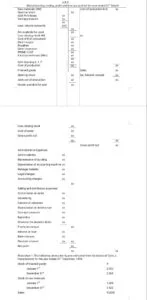
How is the manufacturing account prepared?
The accounts of a manufacturing concern are divided into three main sections.
- Manufacturing (production) account section: shows the cost of goods manufactured at a glance and is used to find the cost of production for the period.
- Trading account section: used to find the gross profit from trading during the period.
- Profit and loss account section: used to find the net profit of the enterprise for the period.
What are the steps in the manufacturing section?
- Find the cost of raw materials used: opening stock of raw materials plus purchases (and carriage inwards), less closing stock.
- Add direct wages and direct expenses to get the prime cost.
- Add the factory overheads to get the total factory cost.
- Add opening work-in-progress and deduct closing work-in-progress.
- The result is the cost of production, which is transferred to the trading account.
Format of the manufacturing account
Evaluation
- What is a manufacturing account?
- State the difference between direct costs and indirect costs.
- Name the three types of direct costs.
- What is prime cost?
- Name the three categories of inventory in a manufacturing concern.
Assignment
- List five items that are included in factory overheads.
- Explain the three sections of the accounts of a manufacturing concern.
This term's Financial Accounting topics
SS2 First Term · 5 topics
SS2 Financial Accounting Lesson Notes for Other Topics

Suspense Account
Read the full lesson note.

Suspense Account II - Correction of Errors
Read the full lesson note.

Control Account And Self-Balancing Ledger
Read the full lesson note.

Introduction To Single Entry And Incomplete Records
Read the full lesson note.

Single Entry And Incomplete Records
Read the full lesson note.

Accounts Of Non Profit Making Organisations
Read the full lesson note.

Partnership Accounts
Read the full lesson note.

Partnership Accounts II - Partnership Capital Accounts & How to Calculate it
Read the full lesson note.

Receipts And Payment Accounts
Read the full lesson note.

Dissolution Of Partnership
Read the full lesson note.
Company Accounts
Read the full lesson note.

Balance Sheet
Read the full lesson note.

Issues & Classes of Shares
Read the full lesson note.

Interpretation Of Financial Statement Using Simple Ratio
Read the full lesson note.
Lesson Notes for Other Classes

SS1 Lesson Note
The complete lesson note to guide your studies.

SS3 Lesson Note
The complete lesson note to guide your studies.
