
Grassland Habitats – SS2 Biology Lesson Note (Third Term)
Lesson note at a glance
- Class
- SS2
- Subject
- Biology
- Term
- Third Term
- Reading time
- 6 min
Grassland (savanna) is a plant community in which grasses dominate, with a few trees and shrubs.
Behavioural objectives
- Define grassland (savanna) and arid land (desert).
- List the characteristics of grassland and of a desert.
- Name the four major types of savanna in Nigeria.
- Describe how plants and animals adapt to grassland and desert habitats.
- Write food chains found in grassland and arid lands.
What are the key terms in this topic?
These terms are used throughout the note.
- Habitat: the place where a plant or animal lives.
- Transpiration: the loss of water vapour from plant leaves.
- Deciduous plant: a plant that sheds its leaves in the dry season.
- Xerophyte: a plant adapted to live where water is scarce.
- Camouflage: body colour or pattern that helps an animal blend into its surroundings.
- Food chain: the order in which living things feed on one another, starting from a green plant.
What is grassland (savanna)?
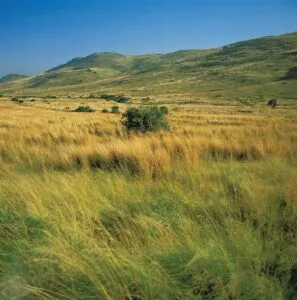
Grassland is a plant community in which grass species are dominant, but trees and shrubs may be present.
What are the characteristics of grassland?
- High temperature: the weather is hot and the sunshine is intense.
- Low humidity: the air is dry, and annual rainfall is about 60 to 150 cm.
- Abundant grasses: grasses cover the ground, with few short trees widely scattered.
- Frequent bush fires: the trees are fire resistant.
- Deciduous plants: some plants shed their leaves in the dry season.
- Underground stems and deep roots: these help plants search for water.
- Modified leaves: trees have leaves adapted to the environment.
What are the types of savanna in Nigeria?
There are four major types of savanna in Nigeria: Southern Guinea, Northern Guinea, Sudan and Sahel savanna.
- Southern Guinea savanna: the southernmost type, nearest the forest zone, and the largest biome in Nigeria.
- Northern Guinea savanna: lies north of the Southern Guinea savanna.
- Sudan savanna: drier than the Guinea savannas, with fewer trees.
- Sahel savanna: the northernmost type, nearest the desert, and the driest of the four.
- Pattern: from south to north, rainfall decreases and trees become fewer and shorter.
How do plants adapt to grassland?
Grassland plants are adapted to survive bush fire, heat and a long dry season.
- Common plants: acacia, elephant grass, guinea grass, spear grass, palms and baobab trees.
- Thick corky bark: trees resist severe fire.
- Underground stems: grasses escape fire and drought, then sprout again.
- Waxy leaf surface: the wax adds to the cuticle and reduces transpiration.
- Reduced or small leaves: less leaf surface means less water lost.
- Curly leaves: curling conserves water.
- Leaf fall: deciduous trees drop their leaves in the dry season to conserve water.
- Baobab trees: they shed their leaves in the dry season and store water in a thick, swollen trunk.
How do animals adapt to grassland?
Grassland animals are adapted to heat, fire, open ground and predators.
- Common animals: antelopes, elephants, giraffes, zebras, goats, cattle, grasshoppers, lizards, birds, lions, leopards, rats, snakes and grass cutters.
- Termites: they live in air-conditioned nests called anthills (termite mounds), which keep them cool.
- Rats: they burrow into the soil to avoid excessive heat and fire.
- Zebras and giraffes: their colours and patterns help them camouflage.
- Lions and leopards: they have powerful claws and teeth for attacking other animals.
- Kangaroos (Australian grasslands): long legs help them escape danger, and pouches shield their young from hot weather and attacks.
- Elephants and lions: they move in groups or herds, so there is strength in numbers.
What are the food chains in grassland?
A food chain shows who eats whom, and the arrow points from the food to the feeder.
- Grass → grasshoppers → lizards → snakes
- Grass → grasshoppers → toads → birds
- Grass → zebras → lions
| Feeding level | Example in Grass → grasshoppers → lizards → snakes |
|---|---|
| Producer | Grass |
| Primary consumer | Grasshoppers |
| Secondary consumer | Lizards |
| Tertiary consumer | Snakes |
What are arid lands (deserts)?
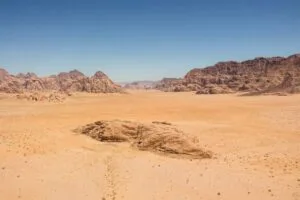
Arid lands are areas of very low rainfall and high evaporation rates, and they are the driest habitats.
- Rainfall: less than 25 cm a year.
What are the types of arid land?
There are two types of arid land: hot deserts and cold deserts.
- Hot deserts: very hot by day, as in the Sahara desert (North Africa) and the Kalahari desert (southern Africa).
- Cold deserts: dry with low temperatures, as in a desert in North America.
What are the characteristics of a desert?
- Scarce water: rain is very little and rarely falls.
- Extreme temperatures: very high during the day and very low at night.
- Scanty vegetation: few plants grow.
- Poor soils: the soils are sandy or rocky.
- Strong winds: they occur frequently, and the sunshine is very intense.
- Xerophytes: drought-resistant plants are present.
How do plants adapt to deserts?
Desert plants are adapted to store water, find water and lose very little of it.
- Common plants: thorny bushes, cacti, scattered dwarf acacia, date palms, wiring grasses and euphorbia species.
- Small or reduced leaves: less leaf surface reduces transpiration.
- Cacti: they have no true leaves, have thorns, and store water in thick succulent stems.
- Acacia: its deep roots absorb underground water.
- Waxy, hairy or needle-shaped leaves: these reduce the rate of transpiration in some desert plants.
- Wiring grass: narrow, slender leaves reduce transpiration.
How do animals adapt to deserts?
Desert animals are adapted to save water and avoid the heat of the day.
- Common animals: camels, rodents, lizards, snakes, desert tortoises, grasshoppers, wasps and ants.
- Dry waste: most desert animals pass out very dry faeces and little urine to conserve water.
- Burrows: rats and other small rodents stay underground by day to avoid excessive heat.
- Scales: reptiles have dry scaly skin that reduces water loss.
- Camels: they survive several days without drinking and withstand a wide range of body temperature, up to 40°C.
- Locusts: they have water-proof bodies and impervious cuticles.
What are the food chains in arid lands?
Desert food chains are short because few plants grow there.
- Plants → desert rats → snakes
- Plants → ants → scorpions → snakes
What is the difference between grassland and desert?
Grassland is a grass-dominated habitat with moderate seasonal rain, while a desert is a very dry habitat with scanty plants.
| Feature | Grassland | Desert |
|---|---|---|
| Annual rainfall | About 60 to 150 cm | Less than 25 cm |
| Main vegetation | Grasses with scattered trees | Scanty xerophytes such as cacti |
| Bush fire | Frequent | Not a major feature |
| Soil | Supports grass cover | Sandy or rocky |
| Examples of animals | Zebras, lions, giraffes | Camels, rodents, reptiles |
| Water conservation | Leaf fall, waxy and small leaves | Succulent stems, deep roots, burrowing |
Evaluation
- Define grassland (savanna).
- Name the four major types of savanna in Nigeria.
- State four characteristics of a desert.
- Describe two ways in which grassland plants are adapted to bush fire and dry seasons.
- Write one food chain found in grassland and one found in arid lands.
Assignment
Describe three adaptations of desert plants and three adaptations of desert animals, then write two food chains found in grassland.
This term's Biology topics
SS2 Third Term · 9 topics
SS2 Biology Lesson Notes for Other Topics
Reproductive System In Flowering Plants
Read the full lesson note.
Pollination In Plants
Read the full lesson note.
Fruits
Read the full lesson note.
Habitat - Marine Habitat
Read the full lesson note.
Estuarine And Freshwater Habitat
Read the full lesson note.
Terrestrial Habitat
Read the full lesson note.
Ecology Of Population
Read the full lesson note.

Food Storage
Read the full lesson note.
Reproduction - Asexual Reproduction
Read the full lesson note.

Reproduction II - Sexual Reproduction
Read the full lesson note.
Reproductive Health
Read the full lesson note.
Cellular Respiration
Read the full lesson note.

Respiratory System
Read the full lesson note.

Excretory System
Read the full lesson note.

Tissues And Supporting Systems In Animals
Read the full lesson note.
Lesson Notes for Other Classes

SS1 Lesson Note
The complete lesson note to guide your studies.

SS3 Lesson Note
The complete lesson note to guide your studies.
