
Food Storage – SS2 Biology Lesson Note (Third Term)
Download this term · ₦1,000Lesson note at a glance
- Subject
- Biology
- Class
- SS2
- Term
- Third Term
- Topic
- Food Storage
- Order
- Topic 9 of 9 this term
- Reading time
- 3 min
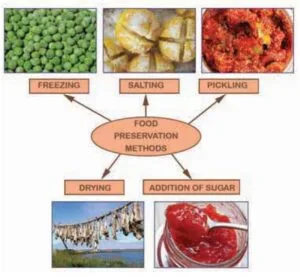
Food storage, or food preservation, is the keeping of food in a way that stops microorganisms from spoiling it. The methods include salting, drying, smoking, refrigeration, pasteurisation, canning, irradiation and the use of chemicals. They work by removing water, lowering temperature, or killing microbes, so that food stays safe for future use.
Behavioural objectives
By the end of the lesson, students should be able to:
- List the methods of food preservation.
- Explain the principle behind each method.
- Give examples of foods preserved by each method.
- State the effects of food storage on the population.
What are the methods of food preservation (storage)?
1. Salting
This involves coating the food with table salt or common salt (NaCl). It can be used for fresh meat, fish etc.
Principle: The salt on the surface of the food dehydrates it, i.e. it removes water from the food. This forms a highly concentrated solution which has more osmotic pressure than the cytoplasm of the microorganisms that cause decay. The salt inhibits the growth of the microbes or kills them.
2. Drying
Food such as vegetables, maize, cassava, fish and meat can be preserved by drying under the sun.
Principle: Drying reduces the water content of the food. This makes the food unsuitable for the growth of spoilage microorganisms because of the increased osmotic concentration of the food.
3. Smoking
This involves placing the food over a naked fire to dry it. Food preserved this way includes meat, fish, groundnut and plantain.
Principle: The smoke creates an oxygen-deficient environment that kills microorganisms. The smoke also contains chemicals that are poisonous to the organisms.
4. Refrigeration/freezing
This involves keeping food in a refrigerator or freezer at low temperatures. Such food includes fruit, vegetables, milk, bread, fish and meat.
Principle: Low temperature reduces the metabolic rate of microbes. Some microbes are even killed, so spoilage is reduced considerably.
5. Pasteurisation
This is the heating of some food products to a high temperature (72°C) for about 10 minutes, followed by immediate cooling for storage. The high temperature destroys the spoilage microbes. Milk, cheese and beef can be preserved this way. Pasteurisation usually comes before canning or bottling.
6. Canning/bottling
This is the sealing of processed, consumable food in cans or bottles under special conditions for future consumption. It is used for food such as fruit, meat, fish and beans.
Principle: Microbes in the food are gradually killed and the entrance of new ones is prevented, so long storage is ensured.
7. Irradiation
This is the exposure of some foods, e.g. milk, canned food, tubers and fruit juices, to high radiation such as ultraviolet rays.
Principle: The irradiation kills the microbes in the food and also prevents the entrance of new ones.
8. Chemicals
This is the addition of harmless chemicals to food, e.g. soft drinks and vegetables.
Principle: The chemicals suffocate the spoilage organisms in the food. They also dehydrate the microbes or poison them.
What are the effects of food storage on the population?
- Prevention of hunger and famine: Hunger or famine that would have resulted from food shortage is averted by the preservation of food.
- Maintenance of stable prices: During harvest, food is cheap. Food storage ensures the availability of food throughout the year, which helps to keep prices stable.
- Reduction of the effects of natural disasters: Floods, earthquakes, pest attacks and even war can cause crop failure or disrupt farm activities. Food stored from an earlier harvest saves people from starvation in the period of scarcity.
- Provision of employment: Food storage employs workers, especially in food processing companies.
Evaluation
- List the methods of food preservation.
- Explain the principle of salting.
- Name four foods that can be preserved by smoking or drying.
- Why does low temperature reduce food spoilage?
- State two effects of food storage on the population.
Assignment
- Describe how canning/bottling preserves food.
- Explain how food storage helps to maintain stable prices.
This term's Biology topics
SS2 Third Term · 9 topics
Get Biology as PDF and Word
Every week of SS2 Biology, Third Term, formatted and ready to print. Ad-free, and the copy lock comes off.
Get this term Card, bank transfer, USSD or OPay
SS2 Biology Lesson Notes for Other Topics
Reproductive System In Flowering Plants
Read the full lesson note.
Pollination In Plants
Read the full lesson note.
Fruits
Read the full lesson note.
Habitat - Marine Habitat
Read the full lesson note.
Estuarine And Freshwater Habitat
Read the full lesson note.
Terrestrial Habitat
Read the full lesson note.

Grassland Habitats
Read the full lesson note.
Ecology Of Population
Read the full lesson note.
Reproduction - Asexual Reproduction
Read the full lesson note.
Reproduction II - Sexual Reproduction
Read the full lesson note.
Reproductive Health
Read the full lesson note.
Cellular Respiration
Read the full lesson note.

Respiratory System
Read the full lesson note.

Excretory System
Read the full lesson note.

Tissues And Supporting Systems In Animals
Read the full lesson note.
Lesson Notes for Other Classes

SS1 Lesson Note
The complete lesson note to guide your studies.

SS3 Lesson Note
The complete lesson note to guide your studies.
