
Micro Organisms Around Us – SS1 Biology Lesson Note (Third Term)
Lesson note at a glance
- Class
- SS1
- Subject
- Biology
- Term
- Third Term
- Reading time
- 7 min
Micro-organisms are living things too small to be seen with the unaided eye, so a microscope is needed to see them.
Behavioural objectives
By the end of the lesson, students should be able to:
- define micro-organisms and state where they are found;
- name the groups of micro-organisms and give examples of each;
- describe the shapes of bacteria and name diseases that some of them cause;
- explain what a culture medium, a pure culture and a mixed culture are;
- state how pathogens enter the body and how carriers spread microbes;
- match common vectors with the micro-organisms and diseases they carry.
What are micro-organisms?
Micro-organisms, also called microbes or germs, are living things which can be seen only with a microscope.
- Other names: microbes and germs.
- Where they live: water, air, soil, the surface of objects, and on and inside living organisms.
- Where they are most abundant: places with food, moisture and a suitable temperature for growth.
- Spread by air: air currents carry them from the earth’s surface to the upper atmosphere.
- Harmful effects: some cause diseases and spoil food.
- First observer: Antonie van Leeuwenhoek (1632 to 1723), a Dutchman, used a simple microscope and found rainwater from pools full of tiny organisms.
What are the groups of micro-organisms?
There are five main groups of micro-organisms: bacteria, viruses, protists, fungi and algae.
| Group | Main feature | Examples |
|---|---|---|
| Bacteria | Unicellular, no well-defined nucleus | Vibrio cholerae, Escherichia coli, Rhizobium |
| Viruses | DNA or RNA inside a protein coat | Yellow fever virus |
| Protists | Mostly single-celled | Paramecium, Plasmodium |
| Fungi | Feed saprophytically, form moulds | Mucor, Rhizopus |
| Algae | Have chlorophyll | Chlamydomonas, Protococcus |
The cyanobacteria are also counted among micro-organisms.
What are bacteria?
Bacteria are minute unicellular organisms, or simple associations of similar cells, which multiply by binary fission.
- Size: most cells are between 0.2 µm and 2 µm in diameter.
- Structure: each cell has a cell wall and cytoplasm.
- Nucleus: there is no well-defined nucleus, so bacteria are prokaryotic.
- Movement: some have long thread-like flagella that help them move.
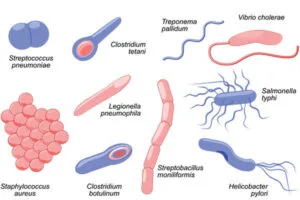
What are the shapes of bacteria?
Bacteria have seven main forms, based on shape and arrangement.
Spherical bacteria are called cocci (singular: coccus). The other forms are rods and spirals.
- Streptococci: cocci arranged in chains. They cause sore throat.
- Staphylococci: cocci that stick together in irregular bunches. They cause boils.
- Diplococci: cocci that occur in pairs, for example pneumococci, which cause pneumonia.
- Bacilli: rod-shaped bacteria. They cause typhoid fever.
- Spirilla (singular: spirillum): rod-shaped bacteria twisted into a spiral.
- Spirochaetes: slender, flexible, helically coiled spirals, for example Treponema pallidum, which causes syphilis.
- Vibrios: comma-shaped bacteria, for example Vibrio cholerae, which causes cholera.
What are viruses?
Viruses are very small pathogens that show signs of life only when they are inside living cells.
- Size: they vary between 0.1 µm and 0.25 µm in diameter.
- Structure: nuclear material, either DNA or RNA, enclosed in a protein coat.
- Outside a living host: they behave like complex chemicals.
- Why they count as living: they carry hereditary characters that can be passed on.

What are protists?
Protists are mostly single-celled organisms, including the animal-like protozoa, and most can be seen only with a microscope.
- Habitat: common in fresh water and moist soils.
- Free-living examples: Euglena and Paramecium.
- Disease-causing examples: Trypanosoma (sleeping sickness) and Plasmodium (malaria).
What are fungi?
Fungi are a varied group of organisms that mostly feed saprophytically, that is, on dead organic matter.
- Signs of fungal growth: blue or green growth on oranges, lemons and cheese, and white or grey growth on bread.
- Examples: Mucor, Rhizopus, Penicillium and Aspergillus.

What are algae?
Algae are simple organisms with chlorophyll, and the microscopic ones are mostly unicellular.
- Habitat: water, moist soils, tree bark, stones and similar places.
- Phytoplankton: free-floating microscopic algae, which are the major food of aquatic animals.
- Examples: Chlamydomonas and Protococcus.
What is culturing?
Culturing is growing micro-organisms under laboratory conditions so that they can be studied.
- Why it is needed: the nutrients and physical conditions the organisms need must be known first.
- Culture medium: the material on or in which microbes grow in the laboratory.
- Culture: the population of organisms grown in a medium.
- Source of media: some media are made from complex extracts of plant or animal tissues.
- Agar: a dried polysaccharide extract of red algae, used to make a medium solid. Microbes do not break it down.
- Organisms grown: bacteria, fungi and algae grow easily in suitable media.
What is a pure culture?
A pure (axenic) culture contains only one species of organism, whatever the number of individuals.
What is a mixed culture?
A mixed culture contains two or more species growing together.
| Feature | Pure culture | Mixed culture |
|---|---|---|
| Number of species | One | Two or more |
| Other name | Axenic culture | None |
How are micro-organisms identified?
Micro-organisms are identified by their stains, colonies and growth needs.
- Microscope stains: different stains show the cell type and shape.
- Colony type: each kind of microbe forms its own kind of colony.
- Food requirements: the nutrients the microbe needs.
- Oxygen requirements: whether the microbe needs oxygen to grow.
How can we show that microbes are around us?
- Sterilise petri dishes by heating them in a pressure cooker, an autoclave or an oven.
- Put a suitable medium, such as nutrient agar, into the dishes.
- Expose the medium to the air, or add a sample of water or soil.
- Cover the dishes and keep them warm for a few days.
- Observe the colonies that grow.
Where are micro-organisms found around us?
Micro-organisms are found in the air, in water, soil and sewage, and in and on the body.
Microbes in the air
- Growth: microbes cannot grow in the air itself.
- Evidence: nutrient agar exposed to the air grows colonies of different bacteria.
- Common air microbes: viruses, bacteria and fungi.
Microbes in water, soil and sewage
- Natural water: protists, algae, some fungi and bacteria.
- Soil: Rhizobium, Nitrosomonas and Nitrobacter.
- Sewage: Entamoeba histolytica and Escherichia coli.
Microbes in and on the body
- Normal microflora: microbes in our bodies form normal populations that cause no harm.
- When they become harmful: pathogens cause disease when body resistance is low.
- Effect of antibiotics: the normal microflora can be disturbed, which also lets disease develop.
- Food spoilage: any food left unpreserved for a long time is spoilt by microbes.
How do pathogens enter the body?
A pathogen is a micro-organism that causes disease. Pathogens enter the body in four main ways.
- Through the air: microbes are breathed in.
- Through food and water: contaminated food or drink is swallowed, as in cholera and typhoid.
- Through contact: touching an infected person (direct) or an object they used (indirect).
- Through insect bites and cuts: microbes enter the blood, as in malaria.
What are carriers of micro-organisms?
A carrier is any agent that carries microbes from one place to another.
- Non-living carriers: air, water and food.
- Living carriers: animals such as houseflies, mosquitoes, rats and cats.
How do animal vectors carry pathogens?
Animal vectors carry pathogens in two ways: mechanically or biologically.
- Mechanical carriage: the animal carries pathogens on its body, where they cannot grow or multiply.
- Biological carriage: the vector becomes infected by feeding on the body fluid of infected persons or animals.
| Feature | Mechanical carriage | Biological carriage |
|---|---|---|
| Where the pathogen is | On the body surface of the vector | In the body of the vector |
| Pathogen growth | Does not grow or multiply | Vector is infected through feeding on body fluid |
| Example | Housefly and Vibrio cholerae | Anopheles mosquito and Plasmodium |
Which vectors carry which micro-organisms?
| S/N | Vector/carrier | Micro-organism | Disease caused |
|---|---|---|---|
| 1 | Anopheles (female) mosquito | Plasmodium | Malaria fever |
| 2 | Tse-tse fly | Trypanosoma | Sleeping sickness |
| 3 | Housefly | Vibrio cholerae | Cholera |
| 4 | Aedes mosquito | Virus | Yellow fever |
What is the difference between a pathogen and a vector?
- Pathogen: a micro-organism that causes disease.
- Vector: an animal that carries a pathogen from one place or host to another.
| Feature | Pathogen | Vector |
|---|---|---|
| What it is | A micro-organism | An animal |
| Role | Causes the disease | Carries the pathogen |
| Example | Plasmodium | Anopheles mosquito |
Evaluation
- Define micro-organisms and state three places where they are found.
- List the five groups of micro-organisms and give one example of each.
- Name three shapes of bacteria and state a disease caused by each.
- Distinguish between a pure culture and a mixed culture.
- Explain the difference between mechanical and biological carriage of pathogens by vectors.
Assignment
- Differentiate between a pathogen and a vector, giving one example of each. Then describe the structure of a virus.
This term's Biology topics
SS1 Third Term · 8 topics
SS1 Biology Lesson Notes for Other Topics
Microoraganisms In Action
Read the full lesson note.
Towards Better Health - How to Control Harmful Microorganisms
Read the full lesson note.
Aquatic And Estuarine Habibat
Read the full lesson note.
Freshwater Habitat
Read the full lesson note.
Terrestial Habitat
Read the full lesson note.
Arid Land/Deserts
Read the full lesson note.
Reproduction In Unicellular Organisms And Invertebrates
Read the full lesson note.
Grassland
Read the full lesson note.
Science Of Living Things
Read the full lesson note.
Recognizing Living Things
Read the full lesson note.
Classification Of Living Things I
Read the full lesson note.
The Cell
Read the full lesson note.
The Cell And It's Environment
Read the full lesson note.
Some Properties And Functions Of The Cell
Read the full lesson note.
Some Properties And Functions Of The Cell II
Read the full lesson note.
Lesson Notes for Other Classes

SS2 Lesson Note
The complete lesson note to guide your studies.

SS3 Lesson Note
The complete lesson note to guide your studies.
