
Arid Land/Deserts – SS1 Biology Lesson Note (Third Term)
Lesson note at a glance
- Class
- SS1
- Subject
- Biology
- Term
- Third Term
- Reading time
- 6 min
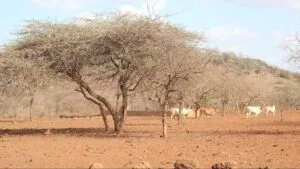
Arid land, or desert, is a habitat that receives less than 25 cm of rainfall a year.
Behavioural objectives
- Define arid lands and name the two types, with examples.
- State the characteristics of a desert.
- Describe how desert plants are adapted to their habitat.
- Describe how desert animals are adapted to their habitat.
- Write food chains found in arid lands.
- State the causes and control of desert encroachment in Nigeria.
What are the key terms used in this topic?
Key terms are the words a student must know before studying deserts.
- Habitat: the place where an organism lives.
- Adaptation: a feature of structure or behaviour that helps an organism survive in its habitat.
- Evaporation: the change of liquid water to vapour, which dries the soil and air.
- Transpiration: the loss of water vapour from a plant through its leaf surface.
- Xerophyte: a drought-resistant plant adapted to dry places.
- Succulent: a plant with thick, fleshy parts that store water.
- Burrow: a hole or tunnel dug in the ground by an animal for shelter.
What are arid lands (deserts)?
Arid lands are the driest habitats on Earth, where water is so scarce that only specially adapted organisms can live.
- Rainfall: very low, less than 25 cm a year.
- Evaporation: high, so more water is lost to the air than falls as rain.
- Limit to life: water is scarce, so only organisms with special adaptations survive.
- In Nigeria: the far north, close to the Sahara, is affected by desert encroachment.
What are the types of arid land?
There are two types of arid land: hot deserts and cold deserts.
Hot deserts
- Temperature: very hot days and cool or cold nights.
- Rainfall: almost none.
- Examples: Sahara Desert (North Africa) and Kalahari Desert (southern Africa).
Cold deserts
- Temperature: low for much of the year.
- Rainfall: low.
- Examples: deserts in North America and the Gobi Desert (Asia).
Comparison of the two types
| Type | Main feature | Examples |
|---|---|---|
| Hot deserts | Very hot days, cool or cold nights, almost no rain | Sahara Desert, Kalahari Desert |
| Cold deserts | Low rainfall and low temperatures for much of the year | Deserts in North America, Gobi Desert |
What are the characteristics of a desert?
A desert is characterised by scarce water, extreme temperatures, scanty vegetation and poor soil.
- Water: very scarce.
- Temperature: in hot deserts, very high by day and very low at night, because the dry, clear air holds little heat after sunset.
- Vegetation: very scanty.
- Soil: sandy or rocky, with little humus.
- Weather: strong winds occur often and sunshine is very intense.
- Plants: drought-resistant plants (xerophytes) are present.
Which plants live in deserts and how are they adapted?
Desert plants are xerophytes, which have features that help them collect and store water and reduce water loss.
Plants found in arid lands
- Cacti: thorny plants with thick, fleshy stems.
- Thorny bushes: small woody plants with spines.
- Dwarf acacia: small, scattered trees with deep roots.
- Date palms: palms that grow where underground water is within reach.
- Wiry grasses: tough grasses with narrow leaves.
- Euphorbia species: plants with fleshy, water-storing stems.
- Baobab: a tree of the dry edges of arid regions.
How are desert plants distributed?
- Wide spacing: plants grow far apart.
- Reason: each plant has a large area of soil from which to collect water.
What are the adaptations of desert plants?
| Plant | Adaptation | How it helps |
|---|---|---|
| Most desert plants | Small leaves | Reduce transpiration |
| Cactus | Thorns instead of leaves, thick succulent stem | Thorns reduce transpiration, the stem stores water |
| Euphorbia | Fleshy stem | Stores water |
| Acacia | Deep roots | Absorb underground water |
| Some plants | Waxy, hairy or needle-shaped leaves | Cut down the rate of transpiration |
| Baobab | Thick, swollen trunk, leaves shed in dry season | Trunk stores water, leaf fall reduces water loss |
| Wiry grass | Narrow, slender leaves | Reduce transpiration |
Which animals live in deserts and how are they adapted?
Desert animals have body features and habits that save water and help them avoid heat.
Animals found in arid lands
- Mammals: camel and rodents such as desert rats.
- Reptiles: lizards, snakes and desert tortoises.
- Insects: grasshoppers, locusts, wasps and ants.
What are the adaptations of desert animals?
- Little water loss in waste: many animals pass very little, concentrated urine and dry faeces.
- Burrowing: rodents such as desert rats stay in burrows by day to avoid heat and come out at night.
- Night activity: many animals are active mainly at night, when the air is cooler.
- Dry, scaly skin: reptiles lose very little water through the skin.
- Water-proof body: locusts and other insects have impervious cuticles that stop water loss.
How is the camel adapted to the desert?
- Water: survives several days without drinking.
- Body temperature: withstands a wide range of body temperature, up to about 40 °C.
- Hump: stores fat as a food reserve.
- Feet: broad, padded feet stop it sinking into loose sand.
- Eyes and nostrils: long eyelashes and closable nostrils keep out blown sand.
What food chains are found in arid lands?
A food chain is the order in which energy passes from a producer to consumers.
- Arrow: means “is eaten by”.
- Producers: desert plants, since they make food by photosynthesis.
- Consumers: animals that feed on plants or on other animals.
What are examples of desert food chains?
- Plants → desert rats → snakes
- Plants → ants → scorpions → snakes
What are the feeding levels in the second chain?
| Organism | Level |
|---|---|
| Plants | Producer |
| Ants | Primary consumer |
| Scorpions | Secondary consumer |
| Snakes | Tertiary consumer |
What is desert encroachment?
Desert encroachment is the spread of desert conditions into nearby dry land that was once covered with vegetation.
What causes desert encroachment?
- Cutting of trees: felling trees for firewood and timber leaves the soil bare.
- Overgrazing: too many animals eat the grass cover.
- Bush burning: fire destroys plants and the humus in the soil.
- Drought: long periods of low rainfall kill plants.
How can desert encroachment be controlled?
- Planting trees: trees and shelter belts reduce wind speed and hold the soil.
- Controlled grazing: limiting the number of animals on grassland.
- Stopping bush burning: protects plant cover.
- Education: teaching farmers and herders to protect vegetation.
Evaluation
- What are arid lands? Name the two types and give one example of each.
- State four characteristics of a desert.
- Explain two ways in which desert plants reduce water loss.
- Describe two ways in which desert animals survive with little water.
- Write one food chain found in arid lands and name the producer in it.
Assignment
- Draw a table with the columns Organism, Adaptation and How it helps. Fill it in for the cactus, the acacia, the camel and the desert rat.
This term's Biology topics
SS1 Third Term · 8 topics
SS1 Biology Lesson Notes for Other Topics

Micro Organisms Around Us
Read the full lesson note.

Microoraganisms In Action
Read the full lesson note.

Towards Better Health - How to Control Harmful Microorganisms
Read the full lesson note.
Aquatic And Estuarine Habibat
Read the full lesson note.
Freshwater Habitat
Read the full lesson note.
Terrestial Habitat
Read the full lesson note.
Reproduction In Unicellular Organisms And Invertebrates
Read the full lesson note.
Grassland
Read the full lesson note.
Science Of Living Things
Read the full lesson note.
Recognizing Living Things
Read the full lesson note.
Classification Of Living Things I
Read the full lesson note.

The Cell
Read the full lesson note.

The Cell And It's Environment
Read the full lesson note.
Some Properties And Functions Of The Cell
Read the full lesson note.
Some Properties And Functions Of The Cell II
Read the full lesson note.
Lesson Notes for Other Classes

SS2 Lesson Note
The complete lesson note to guide your studies.

SS3 Lesson Note
The complete lesson note to guide your studies.
