
Some Properties and Functions of the Cell II – SS1 Biology Lesson Note (First Term)
Lesson note at a glance
- Class
- SS1
- Subject
- Biology
- Term
- First Term
- Reading time
- 4 min
Cellular respiration is the oxidation of glucose in living cells to release energy as ATP.
Behavioural objectives
By the end of the lesson, students should be able to:
- define cellular respiration;
- distinguish between aerobic and anaerobic respiration and write their equations;
- state where glycolysis takes place and the ATP it yields;
- describe the main steps of the Krebs cycle;
- state the total ATP produced from one glucose molecule in aerobic respiration.
What is cellular respiration?
Cellular respiration is the oxidation of glucose in the cell to release energy in the form of ATP.
- Other names: internal respiration or tissue respiration.
- ATP: adenosine triphosphate, the molecule that supplies energy for cell activities.
- Where it happens: glycolysis is in the cytoplasm, and the later aerobic stages are in the mitochondria.
- Main stages: glycolysis, then the Krebs cycle (with oxygen) or fermentation (without oxygen).
What are the types of cellular respiration?
There are two types of cellular respiration: aerobic respiration and anaerobic respiration.
What is aerobic respiration?
Aerobic respiration is cellular respiration that takes place in the presence of oxygen.
- Glucose breakdown: complete, so the most energy is released.
- ATP yield: the largest amount possible from one glucose molecule.
- By-products: carbon (iv) oxide and water.
C6H12O6 + 6O2 → 6CO2 + 6H2O + 38ATP
What is anaerobic respiration?
Anaerobic respiration is the breakdown of glucose in the absence of oxygen, which releases a smaller amount of ATP.
- Organisms: bacteria, fungi (such as yeast) and endoparasites.
- Glucose breakdown: incomplete, so less energy is released.
- In plants: pyruvic acid is converted to alcohol and carbon (iv) oxide (alcoholic fermentation).
- In animals: pyruvic acid is converted to lactic acid, which leads to muscle fatigue in athletes.
In plants
C6H12O6 → 2CH3COCOOH → 2C2H5OH + 2CO2 + 2ATP
In animals
C6H12O6 → 2CH3COCOOH → 2CH3CHOHCOOH + 2ATP
What are the uses of alcoholic fermentation?
- Baking: yeast releases carbon (iv) oxide that makes dough rise.
- Brewing: yeast converts sugars to alcohol in beer and wine.
- Palm wine: yeasts in the sap ferment its sugar to alcohol.
What is the difference between aerobic and anaerobic respiration?
| Feature | Aerobic respiration | Anaerobic respiration |
|---|---|---|
| Oxygen | Needed | Not needed |
| Place | Cytoplasm and mitochondria | Cytoplasm |
| Glucose breakdown | Complete | Incomplete |
| Products | Carbon (iv) oxide and water | Alcohol and carbon (iv) oxide, or lactic acid |
| ATP per glucose | 38 | 2 |
What is the mechanism of cellular respiration?
Cellular respiration has two main stages: glycolysis, then the Krebs cycle.
What is glycolysis?
Glycolysis is the breakdown of one 6-carbon glucose molecule into two 3-carbon pyruvic acid molecules in the cytoplasm.
- Glucose is phosphorylated by the enzyme hexokinase, which adds a phosphate group to form glucose-6-phosphate.
- Ten steps in the pathway, controlled by enzymes in the cytoplasm, split glucose into two pyruvic acid molecules.
- 2 ATP are used and 4 ATP are made (2 ATP from each pyruvic acid).
- The net gain is 2 ATP, made by substrate-level phosphorylation.
- Oxygen: not required for glycolysis.

What is the Krebs cycle?
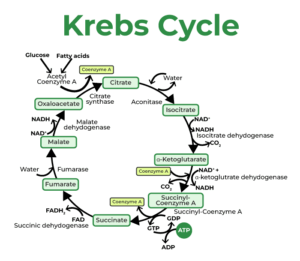
The Krebs cycle is the series of reactions in the mitochondrion that oxidises pyruvic acid completely to carbon (iv) oxide and water.
- Other names: citric acid cycle (CAC) and tricarboxylic acid cycle (TCA).
- Place: the matrix of the mitochondrion.
- Oxygen: required.
Main steps
- Each pyruvic acid loses one molecule of CO2 and is converted to acetic acid.
- Co-enzyme A carries the acetic acid into the cycle, forming acetyl-CoA.
- Acetyl-CoA combines with oxaloacetic acid to form citric acid, the start of the cycle.
- Citric acid is oxidised step by step, releasing CO2 and regenerating oxaloacetic acid.
- Oxidative phosphorylation produces 36 ATP (18 ATP from each pyruvic acid).
How much ATP is made from one glucose molecule?
Aerobic respiration of one glucose molecule gives a total of 38 ATP.
| Stage | Place | Oxygen needed | ATP |
|---|---|---|---|
| Glycolysis | Cytoplasm | No | 2 (net) |
| Krebs cycle and oxidative phosphorylation | Mitochondrion | Yes | 36 |
| Total | 38 |
Why is the Krebs cycle important?
- ATP source: most of the ATP from glucose is generated at this stage.
- Link between food types: it is a key pathway that connects the breakdown of proteins, fats and carbohydrates.
Evaluation
- Define cellular respiration.
- Name the two types of cellular respiration.
- Where does glycolysis take place, and what is the net ATP gain from it?
- Name the product of anaerobic respiration in animals that leads to muscle fatigue.
- State the name of the compound formed when acetyl-CoA combines with oxaloacetic acid.
Assignment
Answer all the questions below in your exercise book.
- The organelle involved in tissue respiration is the
- A. endoplasmic reticulum
- B. Golgi body
- C. mitochondrion
- D. ribosome
- In the absence of oxygen, the pyruvic acid produced during glycolysis is converted to
- A. CO2 and water
- B. glycerol
- C. ethanol
- D. citric acid
- Glycolysis takes place in the
- A. lysosome
- B. mitochondrion
- C. nucleus
- D. ribosome
- The starting substance in the Krebs cycle is
- A. citric acid
- B. acetic acid
- C. oxalic acid
- D. malic acid
- A total of __ ATP is produced from one glucose molecule during aerobic respiration.
- A. 34
- B. 36
- C. 38
- D. 40
- In a tabular form, differentiate between aerobic and anaerobic respiration.
- State three uses of alcoholic fermentation.
This term's Biology topics
SS1 First Term · 11 topics
SS1 Biology Lesson Notes for Other Topics
Grassland
Read the full lesson note.
Science Of Living Things
Read the full lesson note.
Recognizing Living Things
Read the full lesson note.
Classification Of Living Things I
Read the full lesson note.
The Cell
Read the full lesson note.
The Cell And It's Environment
Read the full lesson note.
Some Properties And Functions Of The Cell
Read the full lesson note.
Some Properties And Functions Of The Cell III
Read the full lesson note.
Movement
Read the full lesson note.
Reproduction
Read the full lesson note.
Tissues And Supporting Systems
Read the full lesson note.
Nutrition In Mammals
Read the full lesson note.
Basic Ecological Concepts
Read the full lesson note.
Basic Ecological System II
Read the full lesson note.
Basic Ecological Systems III
Read the full lesson note.
Lesson Notes for Other Classes

SS2 Lesson Note
The complete lesson note to guide your studies.
SS3 Lesson Note
The complete lesson note to guide your studies.
