
Aquatic and Estuarine Habibat – SS1 Biology Lesson Note (Third Term)
Download this term · ₦1,000Lesson note at a glance
- Subject
- Biology
- Class
- SS1
- Term
- Third Term
- Topic
- Aquatic and Estuarine Habibat
- Order
- Topic 4 of 8 this term
- Reading time
- 8 min
A habitat is the place where plants, microorganisms and animals are naturally found. Aquatic habitats are in or around water and are of three kinds: marine (salt water), brackish or estuarine (salt and fresh water mixed) and freshwater. This lesson covers the characteristics, zones, organisms and adaptations of marine and estuarine habitats.
Behavioural objectives
By the end of the lesson, students should be able to:
- define a habitat and name the three kinds of aquatic habitat;
- state the characteristics of marine habitats;
- describe the horizontal and vertical zones of the marine habitat;
- name organisms found in marine and estuarine habitats and state their adaptive features;
- state the characteristics of estuaries;
- give examples of food chains in marine and estuarine habitats.
What is a habitat?
A habitat is a place where organisms (plants, microorganisms and animals) are naturally found, e.g. the habitat of a tadpole is the bottom of freshwater ponds or streams.
There are three main types of habitat:
- Aquatic habitat: in or around water.
- Terrestrial habitat: in or on land.
- Arboreal habitat: in or on trees.
There are three kinds of aquatic habitat:
- Marine or saltwater habitat, e.g. oceans and seas.
- Brackish water habitat (where salt and fresh water mix), e.g. deltas, lagoons and bays.
- Freshwater habitat (contains little or no salt), e.g. lakes, rivers and streams.
What are marine habitats?
Characteristics of marine habitats
- Marine habitats are the largest habitat in the biosphere (70% of the earth’s area).
- They do not undergo sudden or rapid changes in physical factors such as temperature, pH and specific gravity. Hence they show the greatest stability of all habitats.
- Chemical composition: marine water consists of many kinds of dissolved ions, including Na+, K+, Mg2+, Ca2+, PO43-, I– and NO3–.
- Hydrogen ion (H+) concentration (pH): salt water is alkaline in nature, with a pH of about 8.0 to 9.0 near the surface.
- Salinity (salt concentration of water): seawater has a high salinity. The average salinity of seawater is 35 parts per thousand.
- The density of marine water is high. It is about 1.028, while that of fresh water is 1.0. This allows many organisms to float in it.
- The temperature of the sea changes less quickly than that of the land. However, the temperature falls with an increase in the depth of the sea.
- Oxygen concentration is highest at the surface, where atmospheric oxygen dissolves in the water. The concentration of oxygen decreases with depth.
- Waves are temporary movements of surface water of the sea which occur in any direction. They are caused by wind blowing against the surface of the water. They also bring about the mixing of seawater. Waves can also beat against the shore and sometimes cause it to be eroded.
- Tides are the alternate rise and fall of the surface of the sea at least twice daily. They are caused by the combined gravitational pull of the sun and moon on the earth, which redistributes the water.
Horizontal zonation of the marine habitat
The marine habitat is made up of the seashore and the open sea. The major zones are generally as follows:
- Supratidal or splash zone: the exposed zone with occasional moisture. It is the area where water splashes when waves break at the shore.
- Intertidal or neritic zone: the planktonic zone, which is exposed at low tide and covered by water at high tide. It has high photosynthetic activity because of abundant sunshine. Water temperature fluctuates.
- Subtidal or littoral zone: about 200 m deep and constantly underwater, with abundant sunlight and nutrients.
- Benthic zone: about 500 m deep, with low light penetration and low nutrients. The water is dark, cold and has little oxygen. Hence it is unfavourable for life.
- Abyssal or pelagic zone: about 7000 m deep, with low light penetration, low temperature and high pressure. The low light leads to low photosynthetic activity. Hence food production is primarily by chemosynthesis.
- Hadal or aphotic zone: the deepest zone, over 7000 m deep. It forms the floor or bed of the ocean. There is no light penetration and no photosynthesis.
Vertical zonation of the marine habitat
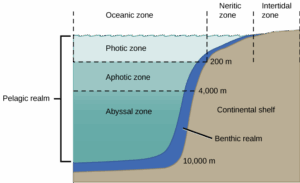
Based on light penetration or depth, the marine habitat can be divided into three zones:
- Euphotic zone: the area in direct contact with sunshine. There is enough light penetration for photosynthesis. Therefore producers, consumers and decomposers are all present.
- Disphotic zone: a region of dim light. Light penetrates the water at too low an intensity for photosynthesis to take place. Consumers and decomposers are found in this zone.
- Aphotic zone: the bottom or bed of the seas and oceans. It is characterised by cold, dark water without light penetration, and very few living organisms.
Which organisms live in marine habitats and how are they adapted?
Distribution of organisms in the marine habitat
- Splash zone: periwinkles, crustaceans (e.g. ghost crabs), seaweeds and sargassum (algae).
- Intertidal zone: starfish, sea anemones, sponges, sea urchins, annelids, molluscs and barnacles.
- Subtidal zone: snails, crabs, lobsters and crayfish.
- Benthic zone: unfavourable for life. Producers are absent and only a few saprophytic animals are present.
- Neritic zone: plankton (microscopic floating organisms, e.g. diatoms, algae, protozoa, crustaceans and worms) and nekton (e.g. fishes, crabs, prawns and whales).
- Oceanic water: sharks, croakers, sea catfish, mackerel, bonga fish and others.
Adaptation of animals to the marine habitat
Animals such as barnacles, fishes and crustaceans survive in marine habitats because of the following adaptive features.
Barnacles have:
- a protective mantle for attachment to rock shores and water retention;
- cilia for feeding;
- a shell that prevents desiccation (drying up).
Fishes possess:
- reduced or no kidney, to retain urea in the body to cope with high salinity, e.g. cartilaginous fishes such as shark and dogfish;
- salt-secreting glands in the gills or eyes for maintaining osmoregulation (salt balance), e.g. bony fishes such as tilapia and herring.
Starfish have tube feet, which enable them to hold on to rock shores, and hard shells to prevent desiccation.
Whales have:
- fins for stability in water;
- an organ in front of the nostril for detecting pressure changes in water;
- a thick layer of dermal fat for insulation and as a food reservoir.
Other animals:
- Shrimps possess powerful claws for holding food or prey.
- Periwinkles possess lungs for breathing and feet for attachment.
- Crabs burrow fast into the mud to protect themselves against predators and strong waves, or to hide.
Adaptation of plants to the marine habitat
Plants such as seaweeds, algae, Vesuvius and diatoms are naturally found in marine habitats. They have the following adaptive features.
Seaweeds have:
- a hold-fast for attachment;
- a mucilaginous cover to prevent desiccation;
- divided leaves or floating devices for buoyancy.
Algae (e.g. sargassum) have:
- chlorophyll for photosynthesis;
- small size or large surface area for floating in water.
Plankton (e.g. diatoms) possess:
- air spaces in their tissues;
- rhizoids for attachment to rocks;
- an air bladder for buoyancy (floating).
Food chains in a marine habitat
- Diatom → crabs → tilapia
- Diatom → zooplankton → tilapia → shark
What are estuarine (brackish water) habitats?
An estuary is a body of water formed at the coast where freshwater flowing towards the sea mixes with the sea (salt water) flowing inland. Estuarine habitats include deltas, lagoons and bays.
Characteristics of estuaries
- The salinity fluctuates.
- The specific gravity is less than that of the sea.
- They have high turbidity due to frequent disturbances. Hence the rate of photosynthesis and respiration by organisms is reduced.
- The water is shallow.
- They have a low diversity of species compared to marine habitats.
- They have high levels of nutrients.
- They have low oxygen content, hence anaerobic activities are common.
Plant distribution and adaptation in estuaries
Plants found in estuaries include plankton, algae, and red and white mangroves. They have the following adaptive features.
Plankton (diatoms) have:
- air spaces in their tissues;
- rhizoids for attachment to rock shores;
- an air bladder for buoyancy.
Algae have:
- chlorophyll for photosynthesis;
- small size or large surface area for floating in water.
Red mangrove has:
- stilt roots with rootlets that have air spaces for conducting air to the root tissues, and for support to prevent the plant from being washed away by the tide;
- seeds which germinate while still on the parent plant, thus preventing the seedlings from being carried away by water currents.
White mangrove has pneumatophores (breathing roots) for gaseous exchange.
Animal distribution and adaptation in estuaries
Animals such as mosquitoes, crustaceans, molluscs, worms and fishes are found in estuaries. They survive by possessing the following features:
- Mosquito larvae and pupae possess breathing trumpets for gaseous exchange.
- Crustaceans and water snails burrow into the mud to protect themselves against predators, strong waves or tides.
- Worms have a strong, protective and impermeable covering against high salinity.
- Mudskippers have fins for crawling on land and swimming in water.
- Fishes have fins for movement and swimming bladders for buoyancy.
Food chains in estuarine habitats
- Detritus → worms → snails → birds
- Diatoms → shrimps → fishes
- Diatoms → small fish → sharks → man
Evaluation
- Define a habitat and name the three kinds of aquatic habitat.
- State four characteristics of marine habitats.
- Name the three vertical zones of the marine habitat and state one feature of each.
- State two adaptive features of the red mangrove.
- Give one example of a food chain in an estuarine habitat.
Assignment
- Buoyancy in salt water is ensured by the following except
A. divided leaves
B. chlorophyll
C. floating devices
D. air bladder - The mucilaginous cover in seaweed and spirogyra is mainly for
A. protection
B. osmoregulation
C. avoiding desiccation
D. feeding - Which of the following is not a freshwater habitat?
A. puddle
B. swamp
C. stream
D. sea - Which of these is not an adaptive feature in a marine habitat?
A. bladder for floating
B. hold-fast for attachment
C. fur to prevent water loss
D. rhizoid for attachment to rock - The following are characteristics of freshwater habitats except
A. low salt content
B. high salinity
C. shallow water
D. can be stagnant or running water - In a tabular form, state five differences between fresh water and a marine habitat.
- State three adaptive features of each of the plants and animals in the freshwater habitat.
This term's Biology topics
SS1 Third Term · 8 topics
Get Biology as PDF and Word
Every week of SS1 Biology, Third Term, formatted and ready to print. Ad-free, and the copy lock comes off.
Get this term Card, bank transfer, USSD or OPay
SS1 Biology Lesson Notes for Other Topics

Micro Organisms Around Us
Read the full lesson note.
Microoraganisms In Action
Read the full lesson note.

Towards Better Health - How to Control Harmful Microorganisms
Read the full lesson note.
Freshwater Habitat
Read the full lesson note.
Terrestial Habitat
Read the full lesson note.

Arid Land/Deserts
Read the full lesson note.
Reproduction In Unicellular Organisms And Invertebrates
Read the full lesson note.

Grassland
Read the full lesson note.
Science Of Living Things
Read the full lesson note.
Recognizing Living Things
Read the full lesson note.
Classification Of Living Things I
Read the full lesson note.

The Cell
Read the full lesson note.

The Cell And It's Environment
Read the full lesson note.
Some Properties And Functions Of The Cell
Read the full lesson note.
Some Properties And Functions Of The Cell II
Read the full lesson note.
Lesson Notes for Other Classes

SS2 Lesson Note
The complete lesson note to guide your studies.

SS3 Lesson Note
The complete lesson note to guide your studies.
