
Pulley Basic 6 Basic Technology Lesson Note
Download Lesson NoteTopic: Pulley
LEARNING OBJECTIVES By the end of the lesson, pupils should be able to:
- Explain and identify pulley
- Examine different uses of pulley in everyday life
- Distinguish between fixed and moveable pulley
- Make and use pulley to do everyday work
DEFINITION OF PULLEY

A pulley is a simple machine made up of a wheel with a groove around its edge and a rope or chain that runs through the groove. It is used to lift or move loads more easily by changing the direction of force.
PARTS OF A PULLEY
- Wheel (Sheave): The circular part with a groove
- Groove: The channel where the rope sits
- Rope/Chain/Cable: Runs through the groove
- Axle: The rod through the center of the wheel
- Frame/Block: Holds the wheel in place
- Hook: Attaches the load
TYPES OF PULLEYS
- FIXED PULLEY
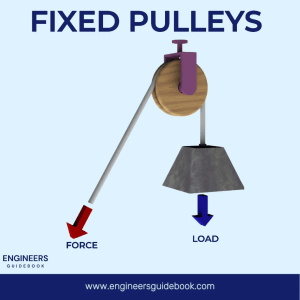
The wheel is attached to a fixed point (ceiling, beam, or pole). The wheel does not move up or down. It only changes the direction of force. You pull down to lift the load up.
Examples:
- Well pulley (for drawing water)
- Flagpole pulley
- Window blinds
- Lifting curtains
- Clothesline pulley
Advantages:
- Changes direction of force (easier to pull down than lift up)
- Simple to construct and use
- Requires less skill to operate
Disadvantages:
- Does not reduce the effort needed
- You must pull with force equal to the weight of the load
- MOVEABLE (MOVING) PULLEY

The wheel moves up and down with the load. One end of the rope is fixed. It reduces the effort needed by half. You pull up to lift the load up.
Examples:
- Construction cranes
- Lifting engines in garages
- Elevators
- Cargo lifting systems
Advantages:
- Reduces effort needed (mechanical advantage)
- Can lift heavier loads with less force
- More efficient than fixed pulley
Disadvantages:
- More complex to set up
- Does not change direction of force
- Requires more rope length
- COMPOUND PULLEY (COMBINATION)
Combines fixed and moveable pulleys. Uses multiple wheels. Provides greatest mechanical advantage. Both changes direction and reduces effort.
Examples:
- Ship cranes
- Large construction cranes
- Theater stage curtains
- Complex lifting systems
USES OF PULLEYS IN EVERYDAY LIFE
At Home:
- Drawing water from wells
- Opening and closing curtains
- Window blinds
- Garage doors
- Clotheslines
In Construction:
- Cranes for lifting heavy materials
- Elevators in buildings
- Hoisting equipment
In Transportation:
- Ship sails and rigging
- Cable cars
- Ski lifts
- Escalators
In Farming:
- Lifting hay and farm produce
- Barn doors
- Irrigation systems
In Industries:
- Factory machinery
- Assembly line systems
- Cargo handling
- Mining operations
In Exercise:
- Gym equipment (weight machines)
- Resistance training systems
Others:
- Flagpoles
- Theater stages
- Zip lines
ADVANTAGES OF PULLEYS
- Makes lifting heavy objects easier
- Changes the direction of force
- Can reduce effort needed
- Simple and inexpensive to make
- Requires no fuel or electricity
- Easy to maintain
- Can be combined for greater advantage
MAKING A SIMPLE PULLEY
Materials Needed: Thread spool or small wheel, strong string or rope, hook or rod for support, small container (for load), scissors
Steps:
- Find a fixed support point (hook, rod, or beam)
- Attach the spool/wheel to the support using the axle
- Thread the rope through the groove in the wheel
- Attach a small container to one end of the rope (load)
- Hold the other end of the rope (effort)
- Pull down on the rope to lift the container up
EVALUATION
- Define pulley
- Name the parts of a pulley
- What is the difference between fixed and moveable pulley?
- Give three examples of pulleys used at home
- State three advantages of using pulleys
MULTIPLE CHOICE QUESTIONS
- A pulley is a simple machine that uses ________
- a) A wheel and rope
- b) A screw
- c) A wedge
- d) An axle only
The groove in a pulley holds the ________
- a) Load
- b) Rope
- c) Wheel
- d) Hook
In a fixed pulley, the wheel is ________
- a) Moving up and down
- b) Attached to a fixed point
- c) Rotating freely
- d) On the ground
- A flagpole uses a ________ pulley
- a) Moveable
- b) Compound
- c) Fixed
- d) Double
- Which pulley reduces the effort needed?
- a) Fixed pulley
- b) Moveable pulley
- c) Simple pulley
- d) Static pulley
- A compound pulley combines ________
- a) Two wheels only
- b) Fixed and moveable pulleys
- c) Three ropes
- d) Two hooks
Pulleys are used in ________ to lift heavy materials
- a) Schools
- b) Construction sites
- c) Churches
- d) Markets
The center rod of a pulley is called ________
- a) Groove
- b) Wheel
- c) Axle
- d) Frame
Drawing water from a well uses a ________ pulley
- a) Moveable
- b) Fixed
- c) Compound
- d) Double
- An elevator uses a ________ pulley system
- a) Simple
- b) Fixed
- c) Moveable or compound
- d) Single
ANSWERS: 1.a 2.b 3.b 4.c 5.b 6.b 7.b 8.c 9.b 10.c
HOMEWORK
- Draw and label the parts of a pulley
- Explain the difference between fixed and moveable pulleys with diagrams
- List five places where pulleys are used in your community
- Describe how to make a simple pulley at home
- Why is a compound pulley more effective than a simple pulley?
Third Term Basic Technology Lesson Notes for Other Topics

Health and Hygiene
Explore lesson notes covering all topics.

Simple Machines
Explore lesson notes covering all topics.

Booting
Explore lesson notes covering all topics.

Teeth Brushing
Explore lesson notes covering all topics.

Simple Machines - The Safe Use of Simple Machines
Explore lesson notes covering all topics.

Care of the Nails and Hair
Explore lesson notes covering all topics.

Concept of Technology
Explore lesson notes covering all topics.

Steps of Booting
Explore lesson notes covering all topics.

Cleanliness
Explore lesson notes covering all topics.

Technology in Home - Electric Gadgets
Explore lesson notes covering all topics.

First Aid
Explore lesson notes covering all topics.

Technology in Transportation - Land and Air
Explore lesson notes covering all topics.

First Aid (Continued)
Explore lesson notes covering all topics.

What Is Water Transportation?
Explore lesson notes covering all topics.

My Desktop (Review)
Explore lesson notes covering all topics.
Lesson Notes for Other Classes

Basic 1 Lesson Note
The complete lesson note to guide your studies.

Basic 2 Lesson Note
The complete lesson note to guide your studies.

Basic 3 Lesson Note
The complete lesson note to guide your studies.

Basic 4 Lesson Note
The complete lesson note to guide your studies.
Basic 5 Lesson Note
The complete lesson note to guide your studies.

JSS1 Lesson Note
The complete lesson note to guide your studies.