
Forces – Basic 6 Basic Technology Lesson Note (Third Term)
Lesson note at a glance
- Class
- Basic 6
- Subject
- Basic Technology
- Term
- Third Term
- Reading time
- 7 min
LEARNING OBJECTIVES By the end of the lesson, pupils should be able to:
- Develop a definition for force
- Mention some examples of force
- State the types of force
- Analyze the effects of force on materials
Definition of force
Force is a push or pull that can change the motion, shape, or direction of an object. Force is measured in units called Newtons (N), named after Sir Isaac Newton, the scientist who studied forces.
Simple Definition: Force is any push or pull on an object.
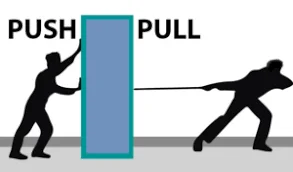
Key Points:
- Force has both magnitude (size/strength) and direction
- Force cannot be seen, but its effects can be observed
- Force can make things start moving, stop moving, or change direction
- Multiple forces can act on an object at the same time
Examples of force in everyday life
Push Forces:
- Pushing a door open
- Pushing a shopping cart
- Pushing a car that won’t start
- Pressing a doorbell
- Pushing a swing
- Typing on a keyboard
- Kicking a football
Pull Forces:
- Pulling a door to close it
- Pulling a rope in tug-of-war
- Opening a drawer
- Pulling a suitcase
- Drawing water from a well
- Pulling a cart
- Opening a bottle cap
Other Examples: 8. Gravity pulling objects downward 9. Magnetic force attracting metals 10. Wind pushing against buildings 11. Water pushing a boat forward 12. Friction stopping a moving car 13. Stretching a rubber band 14. Squeezing a sponge 15. Throwing a ball
Types of forces
- CONTACT FORCES Forces that require physical contact between objects.
- APPLIED FORCE Force applied to an object by a person or another object.
- Example: Pushing a wheelbarrow, kicking a ball, lifting a book
- FRICTIONAL FORCE Force that opposes motion between two surfaces in contact.
- Example: Brakes stopping a bicycle, rubbing hands together, walking on ground
- Effects: Produces heat, slows down motion, causes wear and tear
- TENSION FORCE Force transmitted through a string, rope, cable, or wire when pulled tight.
- Example: Rope in tug-of-war, guitar string, clothesline
- NORMAL FORCE Force that surfaces exert to prevent solid objects from passing through each other.
- Example: Book resting on table, person standing on floor
- AIR RESISTANCE (DRAG) Force of air pushing against moving objects.
- Example: Parachute slowing fall, wind resistance on cars
- SPRING FORCE Force exerted by compressed or stretched spring.
- Example: Trampoline, pen spring, mattress
- NON-CONTACT FORCES (ACTION-AT-A-DISTANCE FORCES) Forces that can act on objects without physical contact.
- GRAVITATIONAL FORCE (GRAVITY) Force of attraction between objects with mass. Earth’s gravity pulls everything toward its center.
- Example: Objects falling to ground, planets orbiting sun, tides in oceans
- Discoverer: Sir Isaac Newton
- Effect: Makes things fall down, gives us weight
- MAGNETIC FORCE Force of attraction or repulsion between magnetic materials.
- Example: Magnets attracting iron, compass needle pointing north
- Properties:
- Like poles repel (North-North or South-South)
- Unlike poles attract (North-South)
- ELECTROSTATIC FORCE (STATIC ELECTRICITY) Force between electrically charged objects.
- Example: Rubbing balloon on hair and sticking to wall, lightning, static shock from door handle
- Properties:
- Like charges repel (positive-positive or negative-negative)
- Unlike charges attract (positive-negative)
Balanced vs. unbalanced forces
Balanced Forces:
- Equal forces acting in opposite directions
- Object remains at rest or moves at constant speed
- Example: Two people pushing a box with equal force from opposite sides
Unbalanced Forces:
- Unequal forces acting on an object
- Object accelerates (speeds up, slows down, or changes direction)
- Example: One person pushing harder than the other
Effects of force on materials
Forces can produce different effects on objects:
- CHANGE IN MOTION
- Starting Motion (From Rest to Movement)
- A stationary car starts moving when pushed
- A football at rest moves when kicked
- A swing starts moving when pushed
- Stopping Motion (From Movement to Rest)
- Brakes stop a moving bicycle
- Catching a thrown ball stops its motion
- Friction stops a rolling ball
- Increasing Speed (Acceleration)
- Pushing a swing harder makes it go faster
- Pressing car accelerator increases speed
- Throwing a ball harder makes it travel faster
- Decreasing Speed (Deceleration)
- Applying brakes slows down a car
- Friction slows down a sliding object
- Air resistance slows down a falling parachute
- Changing Direction
- Hitting a ball with a bat changes its direction
- Turning a car’s steering wheel changes direction
- Wind changing direction of a flying kite
- CHANGE IN SHAPE
- Compression (Squeezing/Compressing)
- Squeezing a sponge makes it smaller
- Sitting on a cushion compresses it
- Pressing clay changes its shape
- Stepping on soft ground leaves footprints
- Extension (Stretching)
- Pulling a rubber band stretches it
- Stretching a spring makes it longer
- Pulling dough stretches it
- Stretching a balloon when blowing it up
- Bending
- Bending a wire changes its shape
- Flexing a ruler bends it
- Bending a tree branch
- Folding paper
- Twisting
- Twisting a towel to squeeze out water
- Turning a door knob
- Wringing wet clothes
- Opening a bottle cap
- Breaking/Tearing
- Excessive force breaks objects
- Tearing paper
- Breaking a stick
- Shattering glass
- NO VISIBLE EFFECT
- Pushing against a wall (wall doesn’t move but you feel the force)
- Pressing a solid rock
- Pulling an extremely heavy object
Factors affecting the effect of force
- Magnitude of Force: Stronger forces produce greater effects
- Direction of Force: Forces in same direction add up; opposite directions cancel
- Point of Application: Where force is applied matters
- Nature of Material: Some materials change shape easily (plastic), others don’t (steel)
- Duration: How long force is applied affects result
Measuring force
Instrument: Spring Balance or Force Meter (Dynamometer)
Unit: Newton (N)
- 1 Newton is approximately the force needed to hold a 100-gram apple
How It Works:
- Force stretches or compresses a spring
- The amount of stretch indicates the magnitude of force
- Scale shows measurement in Newtons
PRACTICAL APPLICATIONS OF FORCES
In Sports:
- Kicking football (applied force)
- Throwing javelin (applied force)
- Swimming (pushing water backward)
- Archery (spring force in bow)
In Transportation:
- Engine force moves vehicles
- Brakes use friction to stop
- Steering changes direction
- Gravity pulls vehicles down hills
In Construction:
- Cranes lift heavy materials (tension force)
- Hammers drive nails (applied force)
- Compression in building foundations
- Tension in suspension bridges
In Nature:
- Gravity keeps us on Earth
- Wind (air force) moves things
- Water flow (fluid force)
- Magnetic force in Earth’s core
EVALUATION
- Define force in your own words
- Give three examples each of push and pull forces
- What are the two main categories of forces?
- List five effects force can have on objects
- Name the instrument used to measure force
Multiple choice questions
- Force is a ________ or ________ on an object
- a) Push or pull
- b) Touch or feel
- c) See or hear
- d) Smell or taste
- The unit for measuring force is ________
- a) Meter
- b) Kilogram
- c) Newton
- d) Liter
- Which is an example of contact force?
- a) Gravity
- b) Magnetism
- c) Friction
- d) Static electricity
- The force that pulls everything toward Earth is ________
- a) Magnetic force
- b) Gravitational force
- c) Applied force
- d) Spring force
- Stretching a rubber band is an example of force causing ________
- a) Motion
- b) Extension
- c) Compression
- d) Breaking
- Which force does NOT require contact?
- a) Friction
- b) Applied force
- c) Tension
- d) Magnetic force
- The force that opposes motion is called ________
- a) Applied force
- b) Friction
- c) Tension
- d) Spring force
- When you squeeze a sponge, you are applying ________ force
- a) Tension
- b) Compression
- c) Magnetic
- d) Gravitational
- A spring balance is used to ________
- a) Tell time
- b) Measure force
- c) Measure length
- d) Weigh objects only
- Like magnetic poles ________
- a) Attract each other
- b) Repel each other
- c) Have no effect
- d) Stick together
ANSWERS: 1.a 2.c 3.c 4.b 5.b 6.d 7.b 8.b 9.b 10.b
HOMEWORK
- Define force and give five examples from your home
- Draw and explain three effects of force on objects
- What is the difference between contact and non-contact forces? Give two examples of each
- Explain how friction can be both helpful and harmful. Give three examples each
- Conduct a simple experiment: Drop different objects (feather, stone, paper) and observe the effect of gravity. Write your observations
This term's Basic Technology topics
Basic 6 Third Term · 19 topics
- Pulley
- Food and Nutrition (Cont’d)
- Social Media
- Inclined Planes
- Martial Art (History of Judo)
- Forces
- Martial Art: Rules of Judo and Skills
- Career Opportunities in Computer
- Frictional Force
- Swimming Strokes
- Scratch in the Environment
Get Basic Technology as PDF and Word
Every week of Basic 6 Basic Technology, Third Term, formatted and ready to print. Ad-free, and the copy lock comes off.
Get this term Card, bank transfer, USSD or OPay
Instant PDF and Word download · Secure Paystack payment · Questions? WhatsApp us
Basic 6 Basic Technology Lesson Notes for Other Topics
Simple Machine (Lever)
Read the full lesson note.
Food and Nutrition
Read the full lesson note.
Pulley
Read the full lesson note.
Food and Nutrition (Cont'd)
Read the full lesson note.
Social Media
Read the full lesson note.
Inclined Planes
Read the full lesson note.
Martial Art (History of Judo)
Read the full lesson note.
Martial Art - Rules of Judo and Skills
Read the full lesson note.
Career Opportunities in Computer
Read the full lesson note.

Frictional Force
Read the full lesson note.
Swimming Strokes
Read the full lesson note.
Scratch in the Environment
Read the full lesson note.
Water Project
Read the full lesson note.

Pathogens, Diseases and Prevention
Read the full lesson note.

Scratch Project
Read the full lesson note.
Lesson Notes for Other Classes

Basic 1 Lesson Note
The complete lesson note to guide your studies.

Basic 2 Lesson Note
The complete lesson note to guide your studies.

Basic 3 Lesson Note
The complete lesson note to guide your studies.

Basic 4 Lesson Note
The complete lesson note to guide your studies.

Basic 5 Lesson Note
The complete lesson note to guide your studies.
