
Major Centralised States in Pre-Colonial Nigeria – JSS1 Nigerian History Lesson Note (Third Term)
Download Lesson NoteLesson note at a glance
- Subject
- Nigerian History
- Class
- JSS1
- Term
- Third Term
- Topic
- Major Centralised States in Pre-Colonial Nigeria
- Order
- Topic 1 of 2 this term
- Reading time
- 5 min
Pre-colonial Nigeria is the period before European colonial rule. Many centralised states existed in that period. Each had a powerful ruler, such as an Emir, a Mai or an Etsu, who governed with the help of officials. This lesson covers the Hausa States, Kanem Borno and the Nupe Kingdom.
Behavioural objectives
By the end of the lesson, students should be able to:
- State the meaning of pre-colonial Nigeria.
- List examples of centralised states in pre-colonial Nigeria.
- Describe how the Hausa States were organised after the jihad of Usman Dan Fodio.
- Name the officials who assisted the Emirs and state their duties.
- Describe the political organisation of the Kanem Borno Empire.
- Describe the people and the government of the Nupe Kingdom.
What were the major centralised states in pre-colonial Nigeria?
Pre-colonial Nigeria refers to the period before the rule of the white men, that is, before colonialism. Examples of pre-colonial centralised states were:
- Hausa States
- Kanem Borno
- Nupe Kingdom
- Oyo Empire
- Igala Kingdom
- Benin Empire
- Niger Delta City States
- Calabar
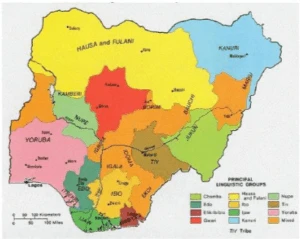
How were the Hausa States organised?
The caliphates
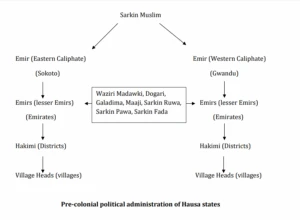
There was a jihad war led by Usman Dan Fodio from 1804 to 1810. After the war, fourteen Hausa states were merged and then split into two sections, Eastern and Western. The sections were called caliphates.
The Eastern Caliphate had Sokoto as its capital. It included states like present-day Gombe, Kano, Katsina, Yola and Zaria. The Western Caliphate had Gwandu as its capital and included states like Argungun, Ilorin and Kontagora.
Usman Dan Fodio made himself the head of the whole Hausa land. He was referred to as the Sarkin Muslim. His son, Bello, was made the ruler of the Eastern Caliphate. Usman’s brother, Abdullah, was made the ruler of the Western Caliphate. They were both referred to as Emirs.
Emirates and their officials
The two caliphates were also sub-divided into smaller segments called emirates, so that administration would be easy. Each emirate was headed by an emir (a lesser emir), who was chosen only with the approval of the Emir of Sokoto or Gwandu.
The Emirs in each emirate had assistance from some officials. The officials were:
- Waziri: the prime minister or administrative officer
- Madawki: the commander of the army
- Dogari: the head of the police
- Galadima: in charge of the capitals
- Maaji: the keeper of money and the treasury (treasurer)
- Sarkin Ruwa: the river-fishing official
- Sarkin Pawa: the head of the butchers
- Sarkin Fada: the person in charge of the administration of the palace
Districts and the Hakimi
Each emirate was also divided into districts. An official called the Hakimi headed each district. The emir also appointed him. The duties of the Hakimi included:
- Overseeing the affairs of the district.
- Maintaining peace and order in the district.
- Collecting taxes. The taxes included Zakat, Jizyah (a tax paid by non-Muslims) and Jangali (cattle tax).
The Hakimi appointed village heads, who helped him in carrying out his duties.
Power and law
The Emirs of the caliphates had almost unlimited powers. The judiciary system was based on Sharia law, and Alkali judges administered the laws.
What was the Kanem Borno Empire?
Origin and peoples
The Kanem Borno Empire was founded by a prince called Kisra and his followers, who were migrants from Eastern Africa to the east of Lake Chad. The empire existed in a region which today includes the modern-day countries of Niger, Chad, Cameroon and Nigeria.
The empire consisted of different people. Some of them are:
- The So: the original inhabitants of the empire.
- The Zaghawa: nomadic people who emigrated from eastern Africa and settled to the east of the lake.
- The Kanuri: also an important group of people in the empire.
- The Bulala: they arrived late in the region but were also part of the kingdom.
Rulers of the empire
The Zaghawa were the first rulers of the empire before they were driven out and the Saifawa rulers took over. The Saifawas enlarged their territories by conquest and by marriage into the ruling families of subordinate states.
Later, between the 12th and 14th centuries, the Saifawas were forced to move across Lake Chad into the town of Borno in Nigeria. This is why it is known as the Kanem-Borno empire.
The Mai and the state council
The king of Kanem was referred to as Mai. Twelve members of the royal family (maina) and dignitaries (kaigana), who formed the state council, assisted the Mai.
The dignitaries included:
- Kaigama: the commander-in-chief of the army and warden of the south
- Mestrema: the keeper of the royal household and the warden of the east
- Yerima: the warden of the north
- Galadima: the warden of the west
The members of the royal household included:
- The Mai: the king
- The Gumsu: the head of his wives
- The Magira: the official mother
- The Magara: his sister
- The Groma: his eldest son and official heir
- The Maina and Mairam: the other sons and daughters
- The Maidugu: the grandson
- The Chima Kura: the fiefholder
- The Chima Kura: the controller of the administration
The political administration of Kanem-Borno was a centralised one, as the Mai had absolute power in the empire.
What was the Nupe Kingdom?
The people
The people of Nupe are mainly found in Niger State in Nigeria. They are divided into different subgroups, including Batau, Kyedye, Eghagi, Ebe and Benu. Some Nupe also live outside the group’s boundaries, scattered over several states in West-Central and Northern Nigeria.
The people of Nupe live in a large village called Ezi. They are mostly farmers of staple crops like millet, guinea corn, yams, groundnuts and rice. They are also hunters.
Political organisation
In the pre-colonial political organisation, the Etsu was the head of government. He carried out measures of administration and was responsible for law and order. The Etsu was chosen from within any of the sub-sections into which the inner city (Bida) was divided.
The Etsu (or Etsuzhi) was very powerful. His words were law. His powers were checked or restricted by some traditions and laws.
Evaluation
- What is meant by pre-colonial Nigeria?
- Name five examples of centralised states in pre-colonial Nigeria.
- Name the two caliphates of the Hausa States and their capitals.
- State three duties of the Hakimi.
- Who assisted the Mai of Kanem Borno in running the empire?
Assignment
Write short notes on the Nupe Kingdom. Include where the Nupe people live, what they do for a living and the role of the Etsu.
This term's Nigerian History topics
JSS1 Third Term · 2 topics
- Major Centralised States in Pre-Colonial Nigeria
- Non-Centralised States in Pre-Colonial Nigeria
Third Term Nigerian History Lesson Notes for Other Topics
History Of Lagos State III - Division of Lagos State
Read the full lesson note.
History Of Lagos State IV - Governors of Lagos State Since Creation
Read the full lesson note.
Major Title -Holders In The State: Idejo Chief, White Cap Chief
Read the full lesson note.
History Of Lagos State II
Read the full lesson note.
History Of Lagos State
Read the full lesson note.

Adjective And Adverb Puzzles
Read the full lesson note.

Nigerian Independence Republic And Federation
Read the full lesson note.
Christianity In Nigeria
Read the full lesson note.
Traditional Occupations In The Locality-Lagos State
Read the full lesson note.
Traditional Occupations Of Nigerian People Northern Nigeria
Read the full lesson note.

Traditional Religion In Nigeria
Read the full lesson note.
Islam In Nigeria
Read the full lesson note.
Traditional Occupations Of Nigerian People Southern Nigeria
Read the full lesson note.

Nigerian Independence
Read the full lesson note.
Heroes in Nigeria Environment
Read the full lesson note.
Lesson Notes for Other Classes

Basic 1 Lesson Note
The complete lesson note to guide your studies.

Basic 2 Lesson Note
The complete lesson note to guide your studies.

Basic 3 Lesson Note
The complete lesson note to guide your studies.

Basic 4 Lesson Note
The complete lesson note to guide your studies.

Basic 5 Lesson Note
The complete lesson note to guide your studies.

Basic 6 Lesson Note
The complete lesson note to guide your studies.

