
Satellites, Basic Electronics & Semiconductors – SS3 Physics Lesson Note (First Term)
Download this term · ₦1,000Lesson note at a glance
- Subject
- Physics
- Class
- SS3
- Term
- First Term
- Topic
- Satellites, Basic Electronics & Semiconductors
- Order
- Topic 8 of 10 this term
- Reading time
- 5 min
A satellite is a body that orbits a larger body, and a semiconductor is a solid whose resistance lies between that of a conductor and an insulator.
Behavioural objectives
- Define a satellite and give examples of natural and artificial satellites.
- State the functions of communication, global positioning and meteorological satellites.
- List the systems and other components of a satellite.
- Describe a semiconductor and explain doping.
- Distinguish between n-type and p-type semiconductors and name common donor and acceptor elements.
- Describe a p-n junction and state where it is used.
What is a satellite?
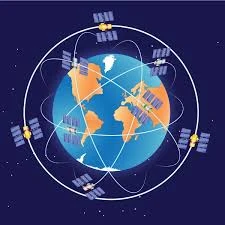
A satellite is a body that orbits a larger body.
What are the types of satellite?
There are two types of satellite: natural and artificial.
- Natural satellite: a body that orbits a larger body in nature, as the Moon orbits the Earth.
- Planets: the Earth and other planets are also natural satellites because they orbit the Sun.
- Artificial satellite: a man-made body launched into orbit, usually by a rocket.
What are the functions of artificial satellites?
Artificial satellites are used for communication, location finding and weather monitoring.
- Communication satellites: they transmit telecommunication signals.
- Global Positioning satellites: they allow the identification of locations on the Earth.
- Meteorological satellites: they monitor weather and climate patterns.
What are examples of Nigerian satellites?
- NigeriaSat-1: a disaster-monitoring microsatellite.
- NICOMSAT-1: used for mobile phone and internet services. It has ceased to function because its solar cells system failed.
What are the components of a satellite?
All satellites have five basic systems that work together.
- Power generation and distribution system: captures solar energy, converts it to electrical energy and supplies it to all parts.
- Command and data handling system: receives commands, controls the satellite and handles the data it collects.
- Payload: the equipment that does the main job of the satellite, such as cameras or communication equipment.
- Protective shielding: protects the equipment from the harsh conditions of space.
- Rocket thruster system: adjusts the position of the satellite and keeps it in its orbit.
What are the other components of a satellite?
- Solar cells: change sunlight into electrical energy.
- Batteries: store electrical energy for use when sunlight is not available.
- Command antenna: receives instructions from the ground station.
- Communication antenna: sends and receives signals.
- Radio receivers and transmitters: receive and send radio signals.
- Rocket fuel, rocket motor and rocket thrusters: supply the push needed to move or adjust the satellite.
- Cameras: take pictures of the Earth or space.
What is a semiconductor?
A semiconductor is a solid with a resistance higher than that of a conductor but lower than that of an insulator.
- Structure: semiconductors may be crystalline or amorphous solids.
- Effect of heat: the resistance of a semiconductor decreases as temperature rises, the opposite of the behaviour of metals.
- Common materials: silicon, germanium and compounds of gallium.
- Position in the periodic table: semiconductor elements are usually found where the metalloids are placed.
How do conductors, semiconductors and insulators compare?
- Conductor: a material that allows current to pass easily, such as copper.
- Semiconductor: a material that conducts better than an insulator but worse than a conductor, such as silicon.
- Insulator: a material that does not allow current to pass easily, such as rubber or glass.
| Material | Resistance | Example |
|---|---|---|
| Conductor | Low | Copper |
| Semiconductor | Between conductor and insulator | Silicon, germanium |
| Insulator | High | Rubber, glass |
What is doping?
Doping is the deliberate addition of impurities to a semiconductor crystal to change its conducting properties.
- Effect: doping greatly increases the number of charge carriers (holes and electrons) in the crystal.
- Result: doping lowers the resistance of the semiconductor.
- Use: doping also allows the creation of a semiconductor junction.
What are the types of impurity?
There are two types of impurity: donor and acceptor.
- Donor: an impurity that supplies extra free electrons. Examples are antimony, arsenic and phosphorus.
- Acceptor: an impurity that creates holes by accepting electrons. Examples are aluminium, boron and gallium.
What are n-type and p-type semiconductors?
An n-type semiconductor is doped with a donor and has excess free electrons, while a p-type semiconductor is doped with an acceptor and has free holes.
- n-type: the “n” stands for negative, because electrons carry negative charge.
- p-type: the “p” stands for positive, because a hole behaves like a positive charge.
| Type | Impurity added | Examples of impurity | Charge carriers |
|---|---|---|---|
| n-type | Donor | Antimony, arsenic, phosphorus | Excess free electrons |
| p-type | Acceptor | Aluminium, boron, gallium | Free holes (missing electrons in the bonds) |
What is a p-n junction?
A p-n junction is the boundary where p-type material meets n-type material in the same semiconductor.
- Formation: a single semiconductor doped under precise conditions can have p-type and n-type regions.
- Junction: the boundary between these regions is the p-n junction.
- Use: the behaviour of charge carriers at the junction makes semiconductors useful in diodes, transistors and modern electronics.
Evaluation
- Define a satellite and give one natural and one artificial example.
- State one function each of a communication satellite, a global positioning satellite and a meteorological satellite.
- Most satellites depend on ….. for the generation of their electrical energy supply. (a) d.c. generators (b) Leclanché cells (c) solar cells (d) hydroelectricity.
- What is doping? Name two donor elements and two acceptor elements.
- Distinguish between an n-type and a p-type semiconductor.
Assignment
- Draw a satellite and label at least five parts. State the function of each part you label.
This term's Physics topics
SS3 First Term · 10 topics
- Introduction to Lasers
- Fibre Optics
- Semiconductor(Electronics) Electrical Conduction Through Solid Materials
- Electric Field, Laws of Electrostatics, Capacitor & Capacitance
- Electrolysis: Electrical Conduction Through Liquid, and Gases.
- Electromagnetic Wave and Capacitance
- Gravitational Field
- Satellites, Basic Electronics & Semiconductors
- Energy and Society
- Magnet and Magnetic Field
Get Physics as PDF and Word
Every week of SS3 Physics, First Term, formatted and ready to print. Ad-free, and the copy lock comes off.
Get this term Card, bank transfer, USSD or OPay
SS3 Physics Lesson Notes for Other Topics
Introduction to Lasers
Read the full lesson note.

Fibre Optics
Read the full lesson note.
Semiconductor(Electronics) Electrical Conduction through Solid Materials
Read the full lesson note.
Electric Field, Laws of Electrostatics, Capacitor & Capacitance
Read the full lesson note.

Electrolysis: Electrical Conduction through Liquid, and Gases.
Read the full lesson note.
Electromagnetic Wave and Capacitance
Read the full lesson note.
Gravitational Field
Read the full lesson note.
Energy and Society
Read the full lesson note.
Magnet and Magnetic Field
Read the full lesson note.
Electromagnetic Field
Read the full lesson note.
Electromagnetic Induction
Read the full lesson note.
Simple AC Circuit
Read the full lesson note.

Models of an Atom
Read the full lesson note.
Nucleus & Radioactivity, Nuclear Reaction.
Read the full lesson note.
Energy Quantization
Read the full lesson note.
Lesson Notes for Other Classes

SS1 Lesson Note
The complete lesson note to guide your studies.

SS2 Lesson Note
The complete lesson note to guide your studies.
