
Electric Field, Laws of Electrostatics, Capacitor & Capacitance – SS3 Physics Lesson Note (First Term)
Download this term · ₦1,000Lesson note at a glance
- Subject
- Physics
- Class
- SS3
- Term
- First Term
- Topic
- Electric Field, Laws of Electrostatics, Capacitor & Capacitance
- Order
- Topic 4 of 10 this term
- Reading time
- 8 min
An electric field is a region of space around electric charges, where any other charge placed in it experiences a force.
A capacitor is a device that stores electrical charge and energy, and its capacitance is the charge on either conductor divided by the potential difference between them (C = Q/V).
Behavioural objectives
By the end of the lesson, students should be able to:
- state the fundamental law of electrostatics and Coulomb’s law;
- define electric field intensity, electric potential, potential difference and the electron volt, and solve simple problems on them;
- define a capacitor and capacitance, and list the factors that affect capacitance;
- find the net capacitance of capacitors connected in series and in parallel;
- calculate the energy stored in a capacitor.
What is an electric field?
An electric field is a region of space around a system of electric charges, in which electrical forces act on any charge placed there.

- Type of quantity: the electric field is a vector quantity, so it has size and direction.
- Test charge: a small positive charge used to find the direction of the field.
- Direction: the field points the way a positive test charge would be pushed.
What is the fundamental law of electrostatics?
The fundamental law of electrostatics states that like charges repel and unlike charges attract.
- Positive and positive: repel.
- Negative and negative: repel.
- Positive and negative: attract.
What is Coulomb’s law?
Coulomb’s law states that the force between two point charges is directly proportional to the product of the charges and inversely proportional to the square of the distance between them.
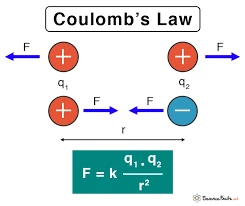
- Proportionality: F ∝ q1q2 / r2
- Equation: F = kq1q2 / r2
- Constant: k = 1/(4πε0) = 8.99 × 10⁹ N m2 C-2
- Full form: F = q1q2 / (4πε0r2)
- Symbols: F is force in newtons, q is charge in coulombs and r is distance in metres.
What is electric field intensity (E)?
Electric field intensity, E, at a point is the force experienced by a unit positive test charge placed at that point.
- Formula: E = F/q
- Symbols: E is field intensity (N C-1), F is force (N) and q is charge (C).
- Unit: newton per coulomb (N/C).
- Type of quantity: vector.

Field intensity at distance r from a charge Q (Q and test charge q as in the diagram):
- The force between Q and q is F = Qq / (4πε0r2).
- E = F/q = Qq / (4πε0r2) × 1/q.
- Therefore E = Q / (4πε0r2).
What is electric potential?
Electric potential (V) at a point is the work done in bringing a unit positive charge from infinity to that point against the electrical forces of the field.
- Formula: V = W/q, where W is work done (J) and q is charge (C).
- Unit: volt (V).
- Type of quantity: scalar.
- Potential at distance r from a charge Q: V = Q / (4πε0r).
- Work against the field: the potential is positive.
- Work done by the field: the potential is negative.
- Zero potential: infinity and the earth are both at zero potential.
- Higher and lower potential: positive points are at higher potential and negative points are at lower potential.
How is the potential of a body tested with the earth?
The potential of a body is tested by joining it to the earth with a wire, which is called earthing the body.
- Electrons flow from the body to the earth: the body is at a negative potential.
- Electrons flow from the earth to the body: the body is at a positive potential.
What is potential difference?
The potential difference between two points in an electric field is the work done in taking a unit positive charge from one point to the other.
- Work done on a charge Q: W = Q(V1 – V2), when Q moves from potential V1 to V2.
- Unit: volt (V).

Relation between field intensity and p.d. when Q moves from A to B, a distance x:
- Work done W = force × distance = F × x.
- Since E = F/Q, the force is F = EQ.
- Therefore W = EQx.
- Also W = Q(Va – Vb), so Q(Va – Vb) = EQx.
- Therefore Va – Vb = Ex.
- So E = V/x, that is, E = p.d. / distance, and V = Ex.
What is the difference between electric field intensity and electric potential?
Electric field intensity is the force on a unit positive charge at a point. Electric potential is the work done per unit positive charge in bringing it from infinity to that point.
| Feature | Electric field intensity (E) | Electric potential (V) |
|---|---|---|
| Measures | Force per unit charge | Work done per unit charge |
| Formula | E = F/q | V = W/q |
| Unit | N C-1 | volt (V) |
| Type of quantity | Vector | Scalar |
| Value from a charge Q at distance r | Q / (4πε0r2) | Q / (4πε0r) |
What is an electron volt (eV)?
The electron volt is the energy gained by an electron accelerated through a potential difference of one volt.
- Electronic charge: e = 1.6 × 10⁻¹⁹ C.
- Value of 1 eV: 1.6 × 10-19 × 1 = 1.6 × 10⁻¹⁹ J.
- Energy gained in a vacuum: it depends only on the charge and the p.d. through which the particle falls.
- Kinetic energy of a moving electron: ½mv2.
What happens when an electron moves in a circle?
An electron moving in a circle of radius r is held in orbit by the electrical force of attraction, which supplies the centripetal force.
- Centripetal force = mv2/r.
- Electrical force = e2 / (4πε0r2).
- Equate them: mv2/r = e2 / (4πε0r2).
- Therefore ½mv2 = ½ × e2 / (4πε0r).
Worked example 1: energy of an α particle
Calculate the energy in eV and in joules of an α particle (helium nucleus) accelerated through a p.d. of 4 × 10⁶ V.
- The charge on an α particle is 2e.
- KE = work done = charge × p.d. = qV.
- KE = 2 × 4 × 106 = 8 × 10⁶ eV = 8 MeV.
- Convert using 1 eV = 1.6 × 10⁻¹⁹ J.
- KE = 8 × 106 × 1.6 × 10-19 = 1.28 × 10⁻¹² J.
Worked example 2: speed of an electron
An electron gun releases an electron. The p.d. between the gun and the collector plate is 100 V. Find the speed of the electron just before it reaches the plate (e = 1.6 × 10⁻¹⁹ C, me = 9.1 × 10⁻³¹ kg).
- Kinetic energy = QV = 100 × 1.6 × 10-19 = 1.6 × 10⁻¹⁷ J.
- Also kinetic energy = ½mev2.
- So ½(9.1 × 10⁻³¹)v2 = 1.6 × 10⁻¹⁷.
- v2 = (3.2 × 10⁻¹⁷) / (9.1 × 10⁻³¹) = 0.35 × 10¹⁴.
- Therefore v ≈ 6 × 10⁶ m s-1.
What is a capacitor?
A capacitor is a device for storing electrical charge and energy.
- Structure: any two conductors that are electrically insulated from their surroundings.
- Common type: two parallel plates separated by a very small distance, d.
- Charging: connecting the plates across a battery gives them equal and opposite charges.
- Potential difference: the p.d. across the plates is V, the battery voltage.
What is capacitance?
Capacitance is the ratio of the charge Q on either conductor to the potential difference V between the two conductors.
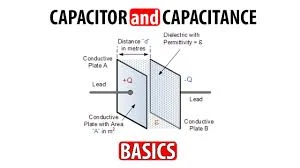
- Formulae: C = Q/V, and Q = CV.
- SI unit: the farad (F), equal to one coulomb per volt (C V-1).
- Parallel plate capacitor: C = εA/d.
- Symbols: A is plate area, d is plate separation and ε is permittivity of the dielectric (F m-1).
What are the factors that affect capacitance?
Three factors affect the capacitance of a parallel plate capacitor: plate area, plate separation and the dielectric between the plates.
- Area of the plates: a larger area gives a larger capacitance.
- Separation of the plates: a smaller separation gives a larger capacitance.
- Dielectric substance: a dielectric of higher permittivity gives a larger capacitance.
Worked example: finding capacitance
A capacitor holds a charge of 4.0 × 10⁻⁴ C when a p.d. of 400 V is applied. Calculate its capacitance.
- C = Q/V.
- C = (4.0 × 10⁻⁴) / 400.
- C = 10-6 F = 1.0 μF.
How are capacitors connected in series and in parallel?
Capacitors in series are joined end to end in one path, while capacitors in parallel are joined across the same two points.
What is the net capacitance of capacitors in series?
- Rule: 1/C = 1/C1 + 1/C2 + …
- Effect: the net capacitance is smaller than the smallest capacitor.
- Charge: each capacitor carries the same charge.
What is the net capacitance of capacitors in parallel?
- Rule: C = C1 + C2 + …
- Effect: the net capacitance is larger than the largest capacitor.
- Potential difference: each capacitor has the same p.d.
How do capacitors and resistors compare in combinations?
The rules for capacitors are the opposite of the rules for resistors.
| Connection | Capacitors | Resistors |
|---|---|---|
| Series | 1/C = 1/C1 + 1/C2 + … | R = R1 + R2 + … |
| Parallel | C = C1 + C2 + … | 1/R = 1/R1 + 1/R2 + … |
How much energy is stored in a capacitor?
The energy stored in a capacitor is W = ½QV, which is also ½CV2 or ½Q2/C.
- A charge is a store of electrical energy.
- When charge q is moved through a p.d., work done = average p.d. × charge = ½qV = ½QV.
- Since V = Q/C, W = ½ × (Q/C) × Q = ½Q2/C.
- Since Q = CV, W = ½CV2.
- This work is stored in the capacitor as electrical potential energy.
Evaluation
- (a) State Coulomb’s law. (b) Calculate the electric field intensity in vacuum at a distance of 5 cm from a charge of 5.0 × 10⁻⁴ C (1/4πε0 = 9.0 × 10⁹ N m2 C-2).
- (a) Define electric field intensity. (b) Two similar but opposite point charges, -q and +q, each of magnitude 6 µC, are separated by a distance of 12 cm in vacuum as shown below. Calculate the magnitude and direction of the resultant electric field intensity at p.

- Calculate the electric potential due to a positive charge of 10-12 C at a point 10 cm away (1/4πε0 = 9.0 × 10⁹ m/F).
- (a) Explain the term capacitor. (b) Give three factors that can affect the capacitance of a capacitor. (c) A capacitor is charged to a p.d. of 200 V and holds a net charge of 1.0 × 10⁻⁴ C. What is its capacitance and the energy stored in it?
- A point, A, has a potential of 120 V. Determine the work done in moving an electric charge of 25 C from A to B.
Assignment
A capacitor stores 8 × 10⁻⁴ C of charge when the potential difference between its plates is 100 V. (a) What is its capacitance? (b) Calculate the energy stored in it.
This term's Physics topics
SS3 First Term · 10 topics
- Introduction to Lasers
- Fibre Optics
- Semiconductor(Electronics) Electrical Conduction Through Solid Materials
- Electric Field, Laws of Electrostatics, Capacitor & Capacitance
- Electrolysis: Electrical Conduction Through Liquid, and Gases.
- Electromagnetic Wave and Capacitance
- Gravitational Field
- Satellites, Basic Electronics & Semiconductors
- Energy and Society
- Magnet and Magnetic Field
Get Physics as PDF and Word
Every week of SS3 Physics, First Term, formatted and ready to print. Ad-free, and the copy lock comes off.
Get this term Card, bank transfer, USSD or OPay
SS3 Physics Lesson Notes for Other Topics

Introduction to Lasers
Read the full lesson note.

Fibre Optics
Read the full lesson note.

Semiconductor(Electronics) Electrical Conduction through Solid Materials
Read the full lesson note.

Electrolysis: Electrical Conduction through Liquid, and Gases.
Read the full lesson note.
Electromagnetic Wave and Capacitance
Read the full lesson note.

Gravitational Field
Read the full lesson note.

Satellites, Basic Electronics & Semiconductors
Read the full lesson note.

Energy and Society
Read the full lesson note.

Magnet and Magnetic Field
Read the full lesson note.
Electromagnetic Field
Read the full lesson note.
Electromagnetic Induction
Read the full lesson note.

Simple AC Circuit
Read the full lesson note.

Models of an Atom
Read the full lesson note.

Nucleus & Radioactivity, Nuclear Reaction.
Read the full lesson note.
Energy Quantization
Read the full lesson note.
Lesson Notes for Other Classes

SS1 Lesson Note
The complete lesson note to guide your studies.

SS2 Lesson Note
The complete lesson note to guide your studies.
