
Gravitational Field – SS3 Physics Lesson Note (First Term)
Download this term · ₦1,000Lesson note at a glance
- Subject
- Physics
- Class
- SS3
- Term
- First Term
- Topic
- Gravitational Field
- Order
- Topic 7 of 10 this term
- Reading time
- 6 min
A gravitational field is the region around a mass in which its gravitational force can be felt.
Behavioural objectives
- State Newton’s law of universal gravitation and write its mathematical expression.
- Define gravitational field intensity and show the relation between g and G.
- Define gravitational potential and state its unit.
- Define escape velocity and show that Ve = √(2gR).
- State the kinetic, potential and total energy of a satellite in orbit and the conclusions drawn from them.
What is a gravitational field?
A gravitational field is a region or space around a mass in which the gravitational force of the mass can be felt.
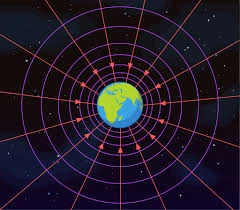
- Gravitation: the force of attraction that every body exerts on all other bodies in the universe.
- Gravitational force: acts between all masses and holds together planets, stars and galaxies.
- Field of a mass: every mass has its own gravitational field around it.
- Dependence of the force: it depends on the masses involved and the distance between them.
What is Newton’s law of universal gravitation?
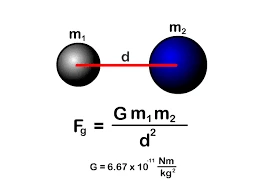
Newton’s law of universal gravitation states that every particle in the universe attracts every other particle with a force that is proportional to the product of their masses and inversely proportional to the square of the distance between them.
How is the law written mathematically?
- F ∝ M1M2
- F ∝ 1/r2
- F ∝ M1M2/r2
- Therefore, F = GM1M2/r2
What do the symbols mean?
| Symbol | Meaning | Unit |
|---|---|---|
| F | Gravitational force between the two particles | N |
| M1, M2 | Masses of the two particles | kg |
| r | Distance between the two particles | m |
| G | Universal gravitational constant, 6.67 × 10⁻¹¹ | N m2 kg-2 |
Worked example
Find the force between masses of 50 kg and 80 kg that are 2 m apart.
- F = GM1M2/r2
- F = (6.67 × 10-11 × 50 × 80) / 22
- F = (6.67 × 10-11 × 4000) / 4
- F = 6.67 × 10⁻⁸ N
What is gravitational field intensity?
Gravitational field intensity at a point is the force per unit mass of an object placed at that point.
- Formula: g = F/m.
- Unit: newton per kilogram (N/kg).
- Type of quantity: vector, because it has direction (towards the centre of the mass).
- Link to acceleration: it is regarded as the acceleration due to gravity at that point.
How are g and G related?
The relation is g = GM/r2, where M is the mass producing the field and r is the distance from its centre.
- Let m be a particle placed at distance r from mass M.
- The force of attraction is F = GMm/r2.
- Field intensity is g = F/m.
- Substitute: g = (GMm/r2) × (1/m).
- The m cancels, so g = GM/r2.
- Effect of distance: g decreases as r increases.
- Effect of mass: g does not depend on the mass m placed in the field.
Worked example
Find g at the earth’s surface. (M = 6.0 × 1024 kg, R = 6.4 × 10⁶ m, G = 6.67 × 10⁻¹¹ N m2 kg-2.)
- g = GM/R2
- g = (6.67 × 10-11 × 6.0 × 1024) / (6.4 × 10⁶)2
- g = 4.0 × 10¹⁴ / 4.1 × 10¹³
- g ≈ 9.8 N/kg
What is gravitational potential?
The gravitational potential at a point is the work done in taking a unit mass from infinity to that point.
- Unit: J kg-1.
- Formula: V = -GM/r.
- M: the mass producing the gravitational field.
- r: the distance of the point from the mass.
- Effect of distance: the magnitude of V decreases as r increases.
- At infinity: the potential is zero when r is infinitely large.
- Negative sign: the potential at infinity (zero) is higher than the potential close to the mass.
How do gravitational field intensity and gravitational potential differ?
Field intensity is the force per unit mass at a point. Potential is the work done per unit mass in bringing a mass from infinity to that point.
| Feature | Field intensity, g | Potential, V |
|---|---|---|
| Meaning | Force per unit mass | Work per unit mass from infinity |
| Formula | g = GM/r2 | V = -GM/r |
| Unit | N/kg | J kg-1 |
| Type | Vector | Scalar |
| Variation with r | Proportional to 1/r2 | Proportional to 1/r |
What is escape velocity?
Escape velocity is the minimum velocity required for an object (for example a satellite or rocket) to just escape or leave the gravitational field of an astronomical body (for example the earth) permanently.
How is Ve = √(2gR) derived?
- Let Me be the mass of the earth and m the mass of the satellite.
- The force between them at distance r from the earth’s centre is F = GMem/r2.
- The work done in carrying m from distance r to a very great distance is W = GMem/r.
- This work must equal the kinetic energy of the body at that point, with velocity Ve.
- Since KE = ½mVe2, we have ½mVe2 = GMem/r.
- Launch from the earth’s surface, where r = R. Then Ve2 = 2GMe/R.
- But g = GMe/R2, so GMe = gR2.
- Substitute: Ve2 = 2gR2/R = 2gR.
- Therefore, Ve = √(2gR).
Worked example
Find the escape velocity from the earth. (g = 9.8 m/s2, R = 6.4 × 10⁶ m.)
- Ve = √(2gR)
- Ve = √(2 × 9.8 × 6.4 × 106)
- Ve = √(1.25 × 10⁸)
- Ve ≈ 1.1 × 10⁴ m/s
What is the energy of a satellite in a gravitational field?
A satellite moving in an orbit around the earth has both kinetic energy and potential energy.
How are the energies of a satellite found?
- The centripetal force equals the gravitational force: mv2/r = GMm/r2.
- Multiply both sides by r: mv2 = GMm/r.
- Kinetic energy: KE = ½mv2 = GMm/2r.
- Potential energy of the mass in orbit: PE = -GMm/r.
- Total energy = PE + KE = -GMm/r + GMm/2r = -GMm/2r.
| Energy | Expression |
|---|---|
| Kinetic energy | +GMm/2r |
| Potential energy | -GMm/r |
| Total energy | -GMm/2r |
What conclusions follow from the equations?
- Total and kinetic energy: the magnitude of the total energy equals the kinetic energy of the satellite.
- Orbit radius: the kinetic energy increases as the radius of the orbit decreases.
- Speed: the kinetic energy increases as the speed of the satellite increases.
- Potential energy: it is twice the kinetic energy and of opposite sign.
Evaluation
- State Newton’s law of universal gravitation and give the mathematical relation.
- Calculate the gravitational potential at a point on the earth’s surface. (Mass of earth = 6.0 × 1024 kg, radius of earth = 6400 km and G = 6.67 × 10⁻¹¹ N m2 kg-2.)
- Calculate the escape velocity of a satellite from the earth’s gravitational field. (g = 9.8 m/s2, R = 6.4 × 10⁶ m.)
- What is escape velocity?
Assignment
- (a) State Newton’s law of universal gravitation. (b) Write the expression for the gravitational force between two masses and explain each term. (c) Two small objects of masses 100 kg and 90 kg are 1.2 m apart. Find the force of attraction between them. (G = 6.67 × 10⁻¹¹ N m2 kg-2.) (d) The mass of the earth is 5.78 × 1024 kg and its radius is 6400 km. Find the gravitational field intensity due to the earth.
This term's Physics topics
SS3 First Term · 10 topics
- Introduction to Lasers
- Fibre Optics
- Semiconductor(Electronics) Electrical Conduction Through Solid Materials
- Electric Field, Laws of Electrostatics, Capacitor & Capacitance
- Electrolysis: Electrical Conduction Through Liquid, and Gases.
- Electromagnetic Wave and Capacitance
- Gravitational Field
- Satellites, Basic Electronics & Semiconductors
- Energy and Society
- Magnet and Magnetic Field
Get Physics as PDF and Word
Every week of SS3 Physics, First Term, formatted and ready to print. Ad-free, and the copy lock comes off.
Get this term Card, bank transfer, USSD or OPay
SS3 Physics Lesson Notes for Other Topics
Introduction to Lasers
Read the full lesson note.

Fibre Optics
Read the full lesson note.
Semiconductor(Electronics) Electrical Conduction through Solid Materials
Read the full lesson note.
Electric Field, Laws of Electrostatics, Capacitor & Capacitance
Read the full lesson note.

Electrolysis: Electrical Conduction through Liquid, and Gases.
Read the full lesson note.
Electromagnetic Wave and Capacitance
Read the full lesson note.

Satellites, Basic Electronics & Semiconductors
Read the full lesson note.
Energy and Society
Read the full lesson note.
Magnet and Magnetic Field
Read the full lesson note.
Electromagnetic Field
Read the full lesson note.
Electromagnetic Induction
Read the full lesson note.
Simple AC Circuit
Read the full lesson note.

Models of an Atom
Read the full lesson note.
Nucleus & Radioactivity, Nuclear Reaction.
Read the full lesson note.
Energy Quantization
Read the full lesson note.
Lesson Notes for Other Classes

SS1 Lesson Note
The complete lesson note to guide your studies.

SS2 Lesson Note
The complete lesson note to guide your studies.
