
Soaps – SS3 Chemistry Lesson Note (First Term)
Download this term · ₦1,000Lesson note at a glance
- Subject
- Chemistry
- Class
- SS3
- Term
- First Term
- Topic
- Soaps
- Order
- Topic 3 of 10 this term
- Reading time
- 5 min
Soap is a salt of a fatty acid, made by saponification, in which fats or oils react with a strong alkali such as sodium hydroxide (NaOH) or potassium hydroxide (KOH) to give soap and glycerol. Each soap molecule has a hydrophilic head and a hydrophobic tail, so it can interact with both water and grease.
Behavioural objectives
By the end of the lesson, students should be able to:
- define soap and saponification.
- describe the preparation of soap, with its equation.
- draw and label the structure of a soap molecule.
- explain the cleansing action of soap using micelles.
- explain why soap forms scum in hard water.
Instructional techniques
- Identification
- Explanation
- Questions and answers
- Demonstration
- Videos from the source
Instructional materials
- Videos
- Loudspeaker
- Textbook
- Pictures
- Vegetable oil
- Caustic soda or potash
- Wood ash
- Containers/reaction vessels
What is saponification?
Saponification is the alkaline hydrolysis of a fat or oil to give soap and glycerol.
- Fats and oils: esters of glycerol (propane-1,2,3-triol) and long-chain fatty acids, called triglycerides.
- Alkali: a strong base such as NaOH (caustic soda) or KOH (potash).
- Products: soap (the sodium or potassium salt of the fatty acid) and glycerol.
How is soap prepared?
Soap is prepared by heating a fat or oil with a strong alkali, which is the saponification reaction.
Word equation
Triglyceride + 3NaOH → Glycerol + 3 soap molecules
Example with coconut oil
Coconut oil (a triglyceride) + 3NaOH → Glycerol (C3H8O3) + 3 sodium fatty acid salts (soap)
- Coconut oil: a triglyceride containing a mixture of fatty acids.
- Sodium hydroxide: three molecules react with each triglyceride molecule.
- Products: one glycerol molecule and three molecules of sodium fatty acid salts, which are the soap.
Steps in making soap
- Measure the oil (vegetable oil or palm oil) into a container.
- Dissolve caustic soda in water. Add the caustic soda to the water, never water to caustic soda. Alternatively, soak wood ash in water and filter to get potash solution.
- Warm the oil and add the alkali solution slowly, stirring all the time.
- Heat and stir until the mixture thickens. Saponification is taking place.
- Add concentrated sodium chloride (common salt) solution. The soap separates and floats. This is called salting out.
- Skim off the soap, wash it, press it into moulds and leave it to dry.
Safety: caustic soda burns the skin and eyes. Wear gloves and eye protection.
What are the types of soap?
There are two types of soap, hard soap and soft soap, depending on the alkali used.
| Feature | Hard soap | Soft soap |
|---|---|---|
| Alkali used | Sodium hydroxide (NaOH) | Potassium hydroxide (KOH) or potash from wood ash |
| Type of salt | Sodium salt of fatty acid | Potassium salt of fatty acid |
| Texture | Solid bar | Soft, paste-like or liquid |
| Example | Bar soap for washing clothes | Local black soap, liquid soap |
What is the structure of a soap molecule?
A soap molecule has two main parts: a hydrophilic (water-attracting) “head” and a hydrophobic (water-repelling) “tail”.
- Head: the ionic carboxylate group (for example –COO–Na+), which dissolves in water.
- Tail: the long hydrocarbon chain, which is repelled by water but attracted to oil and grease.
- Dual nature: this lets soap interact with both water and oils, which makes it effective in cleaning.
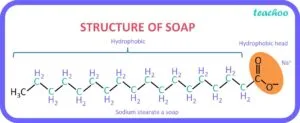
Because of this structure, soap can emulsify and lift away oily or greasy substances in the presence of water.
How does soap act as an emulsifying agent?
An emulsifying agent is a substance that helps oil and water mix and stay mixed. Soap does this because of its molecular structure.
Steps in the cleansing action of soap
- Hydrophilic head interaction: the head is attracted to water molecules, so it dissolves in water.
- Hydrophobic tail interaction: the long tail is repelled by water but attracted to oils and grease.
- Formation of micelles: in water containing grease, soap molecules arrange themselves into micelles.
- Encapsulation of oil: the tails embed into the oil or grease and form a core inside the micelle.
- Dispersion in water: the heads face outward and interact with water, so the whole micelle stays suspended.
- Rinsing: the stable emulsion is washed away, carrying the trapped grease with it.
- Micelle: a cluster of soap molecules with tails pointing inward and heads pointing outward.
- Tails in a micelle: they cluster together in the centre, away from water.
- Heads in a micelle: they face outward, towards water molecules.
Why does soap form scum in hard water?
Soap forms scum in hard water because calcium and magnesium ions react with soap to form an insoluble solid.
- Hard water: water containing dissolved calcium (Ca2+) and magnesium (Mg2+) salts.
- Scum: the insoluble calcium or magnesium salt of the fatty acid, a greyish curd.
- Effect: soap is wasted and little lather forms until all the hardness ions are removed.
2C17H35COO–Na+ + Ca2+ → (C17H35COO)2Ca + 2Na+
What is the difference between soap and a soapless detergent?
Soap is the sodium or potassium salt of a fatty acid, made from fats or oils and alkali.
A soapless detergent is a synthetic cleaning agent, usually made from petroleum-based chemicals, that also has a hydrophilic head and hydrophobic tail.
| Feature | Soap | Soapless detergent |
|---|---|---|
| Source | Fats and oils | Petroleum-based chemicals |
| In hard water | Forms scum | Does not form scum |
| Lather in hard water | Poor | Good |
What are the uses of soap?
Soap is used mainly for cleaning, and it has other uses too.
- Washing: cleaning the body, clothes and dishes.
- Emulsifying: mixing oil and water in some industrial processes.
- By-product use: the glycerol from saponification is used in cosmetics and medicines.
Evaluation
- Define saponification and write the word equation for the preparation of soap.
- State the steps in making soap in the laboratory or at home.
- Describe the functions of soap as an emulsifying agent.
- Why does soap form scum in hard water?
- State two differences between hard soap and soft soap.
Assignment
- Draw a soap molecule and label its hydrophilic head and hydrophobic tail.
- Explain how micelles form when soap is added to water containing grease.
This term's Chemistry topics
SS3 First Term · 10 topics
Get Chemistry as PDF and Word
Every week of SS3 Chemistry, First Term, formatted and ready to print. Ad-free, and the copy lock comes off.
Get this term Card, bank transfer, USSD or OPay
SS3 Chemistry Lesson Notes for Other Topics

Alkanoic Acids/Carboxylic Acid
Read the full lesson note.

Fats And Oils
Read the full lesson note.

Amino Acids
Read the full lesson note.

Polymers, Giants And Macro Molecules
Read the full lesson note.

Polymers, Giants And Macro Molecules II
Read the full lesson note.

Metals And Their Compounds
Read the full lesson note.

Alkaline Earth Metals, Aluminium And Tins
Read the full lesson note.

Transition Metals
Read the full lesson note.

Alloys
Read the full lesson note.

Nuclear Chemistry
Read the full lesson note.

Shapes and Molecules
Read the full lesson note.

Petroleum and Crude Oil
Read the full lesson note.

Volumetric Analysis
Read the full lesson note.

Qualitative Analysis
Read the full lesson note.
Lesson Notes for Other Classes

SS1 Lesson Note
The complete lesson note to guide your studies.

SS2 Lesson Note
The complete lesson note to guide your studies.
