
Shapes and Molecules – SS3 Chemistry Lesson Note (Second Term)
Download this term · ₦1,000Lesson note at a glance
- Subject
- Chemistry
- Class
- SS3
- Term
- Second Term
- Topic
- Shapes and Molecules
- Order
- Topic 2 of 5 this term
- Reading time
- 6 min
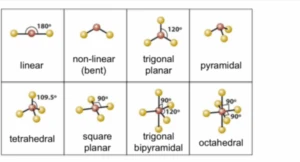
The shape of a simple covalent molecule is the arrangement of its atoms in space, fixed by the electron pairs around the central atom.
Behavioural objectives
By the end of the lesson, students should be able to:
- state the factors that determine the shape of a simple covalent molecule;
- explain the formation and shape of methane using sp3 hybridisation;
- describe the shape of ammonia and say why it differs from that of methane;
- describe the three unit cells based on the cubic structure;
- name the four types of crystalline solids and give examples of each.
What does this lesson cover?
- Covalent molecules: methane, ammonia, water and carbon(IV) oxide.
- Crystalline solids: unit cells and the four types, with network structures such as diamond.
What determines the shape of simple covalent molecules?
The shape of a simple covalent molecule is determined by two factors.
- Orbital overlap: sharing of electrons leads to the overlapping of two atomic orbitals.
- Central atom: the number of valence shell electrons on the central atom decides how many electron pairs surround it.
- Repulsion: electron pairs are negatively charged, so they repel one another and move as far apart as possible.
- Lone pairs: a lone pair repels more strongly than a bond pair, so it changes the shape.
What is the shape of methane?
Methane (CH4) is a tetrahedral molecule with carbon at the centre and a bond angle of 109.5°.
Shape of methane
How is methane formed?
- The central atom is carbon, with the configuration 1s22s22p2, shown in the orbital diagram below.
- One electron is promoted from the 2s orbital to the empty 2p orbital. The configuration becomes 1s22s12p1x2p1y2p1z.
- The 2s orbital and the three 2p orbitals are hybridised (one s and three p combined) to form four identical sp3 orbitals.
- Each sp3 orbital overlaps with the 1s orbital of a hydrogen atom to form a C-H bond.
- The four bond pairs repel one another and move to the corners of a regular tetrahedron.
- Carbon lies at the centre of the tetrahedron and the hydrogen atoms lie at the apices.

- Bond pairs: carbon has four bond pairs in its valence shell, so the octet rule is obeyed.
- Identical bonds: all four C-H bonds are identical.

What is the shape of ammonia?
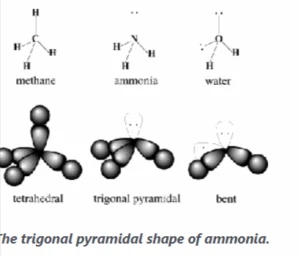
Ammonia (NH3) is a trigonal pyramidal molecule with nitrogen at the centre and one lone pair on nitrogen.
- Central atom: nitrogen has the configuration 1s22s22p3.
- Bonding: the three unpaired 2p electrons each form a covalent bond with an electron from a hydrogen atom.
- Lone pair: one lone pair remains in the outermost shell of nitrogen, and the octet rule is satisfied.
- Four pairs: the four electron pairs spread out as in methane.
Why is ammonia not shaped like methane?
- Lone pair: ammonia has three bond pairs and one lone pair, while methane has four bond pairs.
- Stronger repulsion: the lone pair pushes the three N-H bonds closer together.
- Bond angle: the H-N-H angle is about 107°, a little less than 109.5° in methane.
- Named shape: only the atoms are counted, so the shape is trigonal pyramidal.
Shape of ammonia
What are the shapes of water and carbon(IV) oxide?
Water is bent (V-shaped) and carbon(IV) oxide is linear.
- Water (H2O): oxygen has two bond pairs and two lone pairs, so the molecule is bent with an angle of about 104.5°.
- Carbon(IV) oxide (CO2): carbon forms two double bonds with oxygen and has no lone pair, so the molecule is linear (180°).
- Diatomic molecules: hydrogen, oxygen and hydrogen chloride are linear because they have only two atoms.
Summary of molecular shapes
| Molecule | Bonds on central atom | Lone pairs on central atom | Shape |
|---|---|---|---|
| Methane | 4 single bonds | 0 | Tetrahedral |
| Ammonia | 3 single bonds | 1 | Trigonal pyramidal |
| Water | 2 single bonds | 2 | Bent (V-shaped) |
| Carbon(IV) oxide | 2 double bonds | 0 | Linear |
What are crystalline solids?
A crystalline solid is a solid whose particles are arranged in a regular pattern, giving it a definite geometric shape.
- Particle size: if the particles differ in size, their relative sizes also affect the shape.
- Attraction: the shape depends on the force of attraction between the particles, whether the particles are the same or different.
What are the types of unit cell based on the cubic structure?
There are three types of unit cell based on the cubic structure: simple cubic, face-centred cubic and body-centred cubic.
- Simple cubic: one particle at each corner of the cube.
- Face-centred cubic: a particle at each corner and one in the centre of each face.
- Body-centred cubic: a particle at each corner and one at the centre of the cube.
What are the types of crystalline solids?
There are four types of crystalline solids, grouped by the chemical nature of their particles: covalent, ionic, molecular and metallic.
What is a covalent crystalline solid?
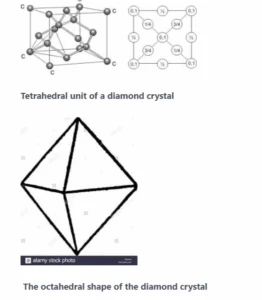
A covalent crystalline solid is a giant network of atoms joined by covalent bonds, and diamond is the best example.
- Crystal shape: the diamond crystal is octahedral.
- Unit cell: the lattice is built from a basic three-dimensional tetrahedral unit cell.
- Bonding: each carbon atom is linked to four other carbon atoms by covalent bonds directed towards the apices of a regular tetrahedron.
- Giant molecule: the unit cell repeats many times to form a giant three-dimensional molecule.
What are ionic crystalline solids?
An ionic crystalline solid is a crystal made of positive and negative ions, such as NaCl and CuSO4.
- Shape: it is decided by how the positive and negative ions are arranged.
- Ion size and charge: the sizes and charges of the ions also affect the shape.
What are molecular crystals?
A molecular crystal is a solid in which whole molecules are arranged in a regular lattice.
- Forces: the molecules are held by weak intermolecular forces, such as van der Waals forces, hydrogen bonds and dipole-dipole forces.
- Examples: naphthalene, iodine and dry ice crystals.
What are metallic solids?
A metallic solid is a crystal in which metal particles are held together in a lattice of closely packed spheres.
- Bond strength: the metallic bond varies in strength among metals.
- Example: iron is stronger than sodium and potassium.
How do the four types compare?
| Type | Particles | Attraction holding them | Examples |
|---|---|---|---|
| Covalent | Atoms | Covalent bonds in a network | Diamond |
| Ionic | Positive and negative ions | Ionic bonds | NaCl, CuSO4 |
| Molecular | Molecules | Weak intermolecular forces | Naphthalene, iodine, dry ice |
| Metallic | Metal atoms (closely packed) | Metallic bonds | Iron, sodium, potassium |
Evaluation
- State two (2) factors that determine the shape of a simple covalent molecule.
- Draw the shape of methane and explain its formation.
- Explain what a crystalline solid is.
- Draw the structure of ammonia and the octahedral shape of diamond.
- What are the types of attractive forces present in each of the following substances at room temperature and pressure: methane, argon, diamond, water and aluminium?
Assignment
Reading assignment
- New School Chemistry by O.Y. Ababio, pages 286 to 294.
Weekend assignment
- A lone pair of electrons is found in (a) ammonia (b) methane (c) water (d) carbon(IV) oxide
- Examples of covalent molecules with linear shapes are (a) oxygen (b) hydrogen (c) water (d) hydrogen chloride
- An example of a compound with double bonds is (a) water (b) carbon(IV) oxide (c) methane (d) ammonia
- The following are types of crystalline solids except (a) covalent (b) ionic (c) metallic (d) methane
- The unit cells based on the cubic structure are the following except (a) simple cubic (b) complex cubic (c) body-centred cubic (d) face-centred cubic
Theory
- State three (3) examples of crystalline solids with their shapes.
- Explain the following simple covalent molecules and draw their shapes: (a) methane (b) water (c) carbon(IV) oxide.
This term's Chemistry topics
SS3 Second Term · 5 topics
- Nuclear Chemistry
- Shapes and Molecules
- Petroleum and Crude Oil
- Volumetric Analysis
- Qualitative Analysis
Get Chemistry as PDF and Word
Every week of SS3 Chemistry, Second Term, formatted and ready to print. Ad-free, and the copy lock comes off.
Get this term Card, bank transfer, USSD or OPay
SS3 Chemistry Lesson Notes for Other Topics

Nuclear Chemistry
Read the full lesson note.

Petroleum and Crude Oil
Read the full lesson note.

Volumetric Analysis
Read the full lesson note.

Qualitative Analysis
Read the full lesson note.

Alkanoic Acids/Carboxylic Acid
Read the full lesson note.

Fats And Oils
Read the full lesson note.

Soaps
Read the full lesson note.

Amino Acids
Read the full lesson note.

Polymers, Giants And Macro Molecules
Read the full lesson note.
Polymers, Giants And Macro Molecules II
Read the full lesson note.

Metals And Their Compounds
Read the full lesson note.

Alkaline Earth Metals, Aluminium And Tins
Read the full lesson note.

Transition Metals
Read the full lesson note.

Alloys
Read the full lesson note.
Lesson Notes for Other Classes

SS1 Lesson Note
The complete lesson note to guide your studies.

SS2 Lesson Note
The complete lesson note to guide your studies.
