
Amino Acids – SS3 Chemistry Lesson Note (First Term)
Download this term · ₦1,000Lesson note at a glance
- Subject
- Chemistry
- Class
- SS3
- Term
- First Term
- Topic
- Amino Acids
- Order
- Topic 4 of 10 this term
- Reading time
- 7 min
Amino acids are organic compounds that contain both a basic amino group (-NH2) and an acidic carboxyl group (-COOH), and they are the basic structural units of proteins.
Behavioural objectives
- State the general structure of an amino acid.
- List the essential and non-essential amino acids.
- Explain how peptide bonds form a dipeptide, a tripeptide and a polypeptide.
- Describe the occurrence and importance of proteins.
- Carry out and describe the Biuret, Millon’s reagent and trioxonitrate (V) acid tests for proteins.
- Explain the denaturation and hydrolysis of proteins.
What is the structure of an amino acid?
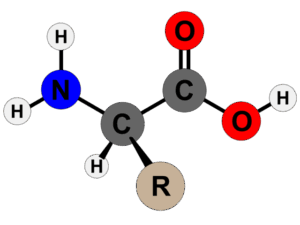
An amino acid is an organic molecule with an amino group and a carboxyl group attached to the same central carbon atom, called the α-carbon.
- Amino group (-NH2): the basic part of the molecule.
- Carboxyl group (-COOH): the acidic part of the molecule.
- Hydrogen atom (H): one of the two remaining bonds of the α-carbon.
- R group (side chain): the other remaining bond of the α-carbon, and the part that changes from one amino acid to another.
The general formula of an amino acid is shown below.
- Glycine: the simplest amino acid, where the R group is a single hydrogen atom.
- Alanine: the R group is a methyl group (-CH3).
- Amphoteric nature: because an amino acid has a basic group and an acidic group, it can react with both acids and bases.
What are the types of amino acids by R group?
Amino acids can be grouped as neutral, acidic or basic, depending on the groups present in the molecule.
| Type | Description | Examples |
|---|---|---|
| Neutral | One amino group and one carboxyl group | Glycine, alanine, valine |
| Acidic | An extra carboxyl group in the R group | Aspartic acid, glutamic acid |
| Basic | An extra basic group in the R group | Lysine, arginine, histidine |
Which amino acids are essential?
Essential amino acids are those the human body cannot make, so they must be supplied in the diet.
- Source of the 20: about 20 naturally occurring amino acids are important in living things.
- Reason they are essential: humans lack some of the enzymes needed to make them.
- Plants: they make all the amino acids they need.
- Good diet: cereals (wheat, maize, rice) combined with legumes (beans, groundnuts) supply the essential amino acids.
What are the non-essential amino acids?
Non-essential amino acids are those the body can make for itself. This lesson lists ten.
- Alanine
- Asparagine
- Aspartic acid
- Cysteine
- Glutamic acid
- Glutamine
- Glycine
- Proline
- Serine
- Tyrosine
- Note on tyrosine: the body makes it from phenylalanine, so if the diet lacks phenylalanine, tyrosine is needed as well.
What are the essential amino acids?
This lesson lists ten essential amino acids.
- Arginine (needed by the young, but not by adults)
- Histidine
- Isoleucine
- Leucine
- Lysine
- Methionine
- Phenylalanine
- Threonine
- Tryptophan
- Valine
What are peptides?
Peptides are compounds formed when amino acids join through their amino and carboxyl groups.
- Peptide bond: the bond joining the α-amino group of one amino acid to the α-carboxyl group of another.
- Dipeptide: two amino acids joined by one peptide bond.
- Tripeptide: three amino acids joined by two peptide bonds.
- Polypeptide: many amino acids linked by peptide bonds.
What are the parts of a polypeptide chain?
- Amino end: one end of the chain carries a free amino group.
- Carboxyl end: the other end carries a free carboxyl group.
- Main chain: the regular repeating part of the chain.
- Side chains: the variable parts, which are the R groups.
How is a dipeptide formed?
A dipeptide forms when two amino acids join with the loss of one molecule of water.
- Place two amino acids, such as glycine and alanine, side by side.
- Remove -OH from the carboxyl group of one amino acid.
- Remove H from the amino group of the other amino acid.
- The -OH and H combine to form a molecule of water.
- The carbon and nitrogen join to form the peptide link (-CO-NH-).
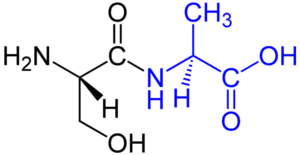
- Peptide link: the linkage shown in blue in the dipeptide structure.
- Tripeptide: adding a third amino acid in the same way gives a tripeptide.
- Polypeptide: repeating the process many times gives a polypeptide, as in a protein chain.
What are proteins?
Proteins are very large, complex molecules made of amino acids joined by peptide bonds, and they are present in all living organisms.
- Size: a protein molecule is very large compared with a molecule of sugar or salt.
- Structure: it is made of one or more polypeptide chains, with amino acids arranged like beads on a string.
- Amino acid sequence: genes specify the order of amino acids in each polypeptide chain.
- Shape: the chain folds into a specific shape, determined by interactions between the side chains.
- Nutritional value: proteins are of great nutritional value and are directly involved in the chemical processes of life.
What happens to proteins we eat?
- Enzymes hydrolyse the protein in the stomach and small intestine.
- The hydrolysis gives a variety of amino acids.
- The bloodstream carries the amino acids to all parts of the body.
- Cells use them to build new proteins for growth and to repair damaged cells.
Where do proteins occur?
Proteins occur in all living systems as structural components and as hormones, enzymes and pigments.
What are first-class and second-class proteins?
Proteins in food are divided into first-class and second-class proteins.
- First-class proteins: they contain the essential amino acids and are mainly of animal origin, such as lean meat, fish, eggs, milk and cheese.
- Second-class proteins: they are mainly vegetable proteins, such as beans and peas.
What are some important proteins?
- Insulin: a hormone.
- Haemoglobin: the oxygen-carrying pigment in the blood.
- Ribonuclease: an enzyme.
- Collagen: a structural protein of connective tissue.
How do we test for proteins?
Proteins are detected by three colour tests: the Biuret test, Millon’s reagent test and the trioxonitrate (V) acid test.
What is the Biuret test?
- Put a solution of the protein, such as egg-white solution, in a test tube.
- Add copper (II) tetraoxosulphate (VI) solution.
- Make the mixture alkaline with sodium hydroxide solution.
- A violet colour shows that protein is present.
What is Millon’s reagent test?
- Put some egg-white solution in a test tube.
- Add a drop or two of Millon’s reagent.
- A white precipitate forms.
- Heat the mixture. The precipitate turns brick red, which shows that protein is present.
What is the trioxonitrate (V) acid test?
- Put 2 cm3 of egg-white solution in a test tube.
- Add three or four drops of concentrated trioxonitrate (V) acid.
- An intense yellow colour shows that protein is present.
What are the results of the three tests?
| Test | Reagent | Positive result |
|---|---|---|
| Biuret | Copper (II) tetraoxosulphate (VI) and sodium hydroxide | Violet colour |
| Millon’s | Millon’s reagent | White precipitate, brick red on heating |
| Trioxonitrate (V) acid | Concentrated trioxonitrate (V) acid | Intense yellow colour |
What are the properties of proteins?
Two important properties of proteins are denaturation and hydrolysis.
What is denaturation?
Denaturation is the irreversible change in the shape of a protein molecule, which makes the protein precipitate or coagulate.
- Colloidal solutions: proteins usually form colloids in water.
- Effect of heat: heating a protein solution makes the protein coagulate, as when egg white sets on boiling.
Proteins are easily denatured by:
- Heat: temperatures above 40°C.
- Chemicals: certain organic solvents and reagents.
- pH changes: variations in pH.
What is hydrolysis of proteins?
Hydrolysis of a protein is the breaking of its peptide bonds by water to give amino acids.
- Boil the protein with hydrochloric acid solution.
- The acid (or a base) catalyses the breaking of the peptide bonds.
- Suitable enzymes can also carry out the hydrolysis.
- Separate and identify the amino acids obtained by paper chromatography.
Evaluation
- Explain the denaturation of protein.
- What is a peptide bond?
- Name the ten essential amino acids listed in this lesson.
- Describe the Biuret test for proteins.
- State the difference between a dipeptide and a polypeptide.
Assignment
- Distinguish between first-class and second-class proteins, giving two examples of each.
- Describe how a protein can be hydrolysed and how the resulting amino acids can be identified.
This term's Chemistry topics
SS3 First Term · 10 topics
Get Chemistry as PDF and Word
Every week of SS3 Chemistry, First Term, formatted and ready to print. Ad-free, and the copy lock comes off.
Get this term Card, bank transfer, USSD or OPay
SS3 Chemistry Lesson Notes for Other Topics

Alkanoic Acids/Carboxylic Acid
Read the full lesson note.

Fats And Oils
Read the full lesson note.

Soaps
Read the full lesson note.
Polymers, Giants And Macro Molecules
Read the full lesson note.
Polymers, Giants And Macro Molecules II
Read the full lesson note.

Metals And Their Compounds
Read the full lesson note.

Alkaline Earth Metals, Aluminium And Tins
Read the full lesson note.
Transition Metals
Read the full lesson note.
Alloys
Read the full lesson note.

Nuclear Chemistry
Read the full lesson note.

Shapes and Molecules
Read the full lesson note.

Petroleum and Crude Oil
Read the full lesson note.
Volumetric Analysis
Read the full lesson note.

Qualitative Analysis
Read the full lesson note.
Lesson Notes for Other Classes

SS1 Lesson Note
The complete lesson note to guide your studies.

SS2 Lesson Note
The complete lesson note to guide your studies.
