
Qualitative Analysis – SS3 Chemistry Lesson Note (Second Term)
Download this term · ₦1,000Lesson note at a glance
- Subject
- Chemistry
- Class
- SS3
- Term
- Second Term
- Topic
- Qualitative Analysis
- Order
- Topic 5 of 5 this term
- Reading time
- 5 min
Qualitative analysis is the identification of the cations (positive ions) and anions (negative ions) present in a substance.
Behavioural objectives
By the end of the lesson, students should be able to:
- define qualitative analysis, cation and anion.
- identify common cations using colour, flame test and sodium hydroxide and ammonia solutions.
- identify common anions using simple confirmatory tests.
- test for gases such as ammonia, oxygen, hydrogen, carbon(IV) oxide and nitrogen(IV) oxide.
Instructional techniques
- Identification
- Explanation
- Questions and answers
- Demonstration
- Videos from the source
Instructional materials
- Videos
- Loudspeaker
- Textbook
- Relevant salts
- Acids
- Bases
- Starch, etc.
What is qualitative analysis?
Qualitative analysis is the process of finding out which ions a substance contains, without measuring how much is present.
- Cation: a positively charged ion, mostly a metal ion, such as Ca2+, Pb2+, Al3+, Cu2+, Fe2+ and Fe3+.
- Anion: a negatively charged ion, such as Cl–, SO42-, CO32- and NO3–.
- Reagent: a chemical added to a sample to produce a visible change.
- Precipitate: an insoluble solid that forms when two solutions react.
What are the stages of qualitative analysis?
- Observe the colour and physical state of the sample.
- Carry out a flame test.
- Heat a small portion and note any change.
- Dissolve the sample in water and add reagents to test for cations.
- Carry out confirmatory tests for anions.
What are the rules in qualitative analysis?
- Dilution: do not dilute the test solution too much.
- Quantity: use only a small quantity of reagent.
- Addition: add the reagent drop by drop, then in excess.
- Apparatus: use clean test tubes.
- Records: write down every observation and inference.
What are the colours and physical states of some common substances?
The colour and state of a sample give the first clue to its identity.
| Substance | Colour | Physical state |
|---|---|---|
| Sulphur | Yellow | Solid |
| Copper(II) oxide | Black | Solid |
| Iodine | Grey-black | Solid |
| Nitrogen(IV) oxide | Reddish-brown | Gas |
| Mercury | Silvery | Liquid |
What colour do cations give in solution?
- Cu2+: blue solution.
- Fe2+: pale green solution.
- Fe3+: yellow or brown solution.
- Ca2+, Zn2+, Al3+, Pb2+, NH4+: colourless solutions.
What does the flame test show?
A flame test identifies some metal ions by the colour they give a non-luminous Bunsen flame.
| Ion present | Flame colour |
|---|---|
| Copper | Deep green (blue-green) |
| Sodium | Deep yellow |
| Calcium | Brick red |
| Potassium | Lilac |
What is the effect of heat on some solids?
Heating a solid can change its colour or release a gas, which helps to identify it.
- Zinc oxide: yellow when hot, white when cold.
- Lead(II) oxide: reddish-brown when hot, yellow when cold.
- Carbonates: most give off carbon(IV) oxide on heating.
- Ammonium salts: give off ammonia on heating with an alkali.
How do we test for cations?
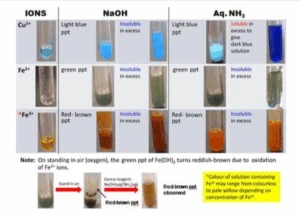
Cations are tested by adding sodium hydroxide solution and ammonia solution, first a few drops, then in excess.
The cations tested are Ca2+, Zn2+, Al3+, Pb2+, Fe2+, Fe3+, Cu2+ and NH4+.
| Cation | NaOH(aq), few drops then excess | NH3(aq), few drops then excess |
|---|---|---|
| Ca2+ | White precipitate, insoluble in excess | No precipitate or very slight |
| Zn2+ | White precipitate, soluble in excess | White precipitate, soluble in excess |
| Al3+ | White gelatinous precipitate, soluble in excess | White precipitate, insoluble in excess |
| Pb2+ | White precipitate, soluble in excess | White precipitate, insoluble in excess |
| Fe2+ | Dirty green precipitate, insoluble in excess | Dirty green precipitate, insoluble in excess |
| Fe3+ | Reddish-brown precipitate, insoluble in excess | Reddish-brown precipitate, insoluble in excess |
| Cu2+ | Pale blue precipitate, insoluble in excess | Pale blue precipitate, dissolves in excess to a deep blue solution |
| NH4+ | No precipitate. Warming gives ammonia gas | No precipitate |
How do we test for an alkaline gas?
- Warm the sample with sodium hydroxide solution.
- Hold moist red litmus paper at the mouth of the tube. It turns blue.
- Bring a glass rod dipped in concentrated HCl near the gas. White fumes form.
- Conclusion: the gas is NH3, so the sample contains NH4+.
How do we test for anions?
Anions are identified by adding a specific reagent and observing a gas or a precipitate.
| Anion | Test | Observation |
|---|---|---|
| Carbonate, CO32- | Add dilute HCl | Effervescence. The gas turns limewater milky |
| Sulphate, SO42- | Add BaCl2 solution, then dilute HCl | White precipitate that does not dissolve in the acid |
| Chloride, Cl– | Add dilute HNO3, then AgNO3 solution | White precipitate that dissolves in dilute ammonia solution |
| Sulphite, SO32- | Warm with dilute HCl | Gas that turns acidified potassium dichromate(VI) from orange to green |
| Nitrate, NO3– | Brown ring test: add iron(II) sulphate solution, then pour concentrated H2SO4 down the tube | Brown ring at the junction of the two liquids |
How do we test for common gases?
Each common gas has a simple test that identifies it.
| Gas | Test | Result |
|---|---|---|
| Hydrogen, H2 | Lighted splint | Burns with a ‘pop’ sound |
| Oxygen, O2 | Glowing splint | Splint relights |
| Carbon(IV) oxide, CO2 | Bubble through limewater | Limewater turns milky |
| Ammonia, NH3 | Moist red litmus paper | Turns blue. White fumes with concentrated HCl |
| Chlorine, Cl2 | Damp blue litmus paper | Turns red, then is bleached |
| Sulphur(IV) oxide, SO2 | Acidified potassium dichromate(VI) | Orange turns green |
| Nitrogen(IV) oxide, NO2 | Observe colour | Reddish-brown gas |
Evaluation
- State ten (10) examples of cations.
- Give the colour of the following substances: distilled water, iron filings, manganese(IV) oxide and benzoic acid.
- Give the common reagents used for the confirmatory test for cations.
- State the colour of the solution when a sample that contains the following dissolves in water: (a) Fe2+ (b) Cu2+ (c) Fe3+
- Describe how you would show that a salt contains NH4+.
Assignment
Weekend assignment
- All of the following give a white gelatinous precipitate in NaOH except: (a) Al3+ (b) Pb2+ (c) Cu2+ (d) Zn2+
- One of the following gives a ‘pop’ sound when in contact with a lighted splint: (a) O2 (b) H2 (c) NH3 (d) CO2
- An example of an ion that gives a gas during its confirmatory test is: (a) SO32- (b) SO42- (c) CO32- (d) NH4+
- A deep green colour of the flame indicates the presence of: (a) sodium (b) calcium (c) copper (d) iron
- The only alkaline gas that changes moist red litmus paper to blue is: (a) NH3 (b) HCl (c) NaOH (d) NH4OH
Theory
- Explain the confirmatory test for the following cations: Ca2+, Al3+, Zn2+, Pb2+, Cu2+ and NH4+.
- State the flame test for the following: (a) calcium (b) copper (c) sodium (d) iron
Reading assignment
- School Chemistry by O.Y. Ababio, pages 165-183
- Practical Chemistry by R. I. Makanjuola, pages 31-36
- Practical Chemistry for Schools and Colleges by Godwin O. Ojokuku, pages 30-98
This term's Chemistry topics
SS3 Second Term · 5 topics
- Nuclear Chemistry
- Shapes and Molecules
- Petroleum and Crude Oil
- Volumetric Analysis
- Qualitative Analysis
Get Chemistry as PDF and Word
Every week of SS3 Chemistry, Second Term, formatted and ready to print. Ad-free, and the copy lock comes off.
Get this term Card, bank transfer, USSD or OPay
SS3 Chemistry Lesson Notes for Other Topics

Nuclear Chemistry
Read the full lesson note.

Shapes and Molecules
Read the full lesson note.

Petroleum and Crude Oil
Read the full lesson note.
Volumetric Analysis
Read the full lesson note.

Alkanoic Acids/Carboxylic Acid
Read the full lesson note.
Fats And Oils
Read the full lesson note.

Soaps
Read the full lesson note.

Amino Acids
Read the full lesson note.
Polymers, Giants And Macro Molecules
Read the full lesson note.
Polymers, Giants And Macro Molecules II
Read the full lesson note.

Metals And Their Compounds
Read the full lesson note.

Alkaline Earth Metals, Aluminium And Tins
Read the full lesson note.
Transition Metals
Read the full lesson note.
Alloys
Read the full lesson note.
Lesson Notes for Other Classes

SS1 Lesson Note
The complete lesson note to guide your studies.

SS2 Lesson Note
The complete lesson note to guide your studies.
