
Graph of Linear Inequality in Two Variables – SS2 Mathematics Lesson Note (Third Term)
Download this term · ₦1,000Lesson note at a glance
- Subject
- Mathematics
- Class
- SS2
- Term
- Third Term
- Topic
- Graph of Linear Inequality in Two Variables
- Order
- Topic 1 of 5 this term
- Reading time
- 2 min
A linear inequality in one variable is an inequality in which the highest power of x is one, for example 3x – 1 > x + 1. Like an equation, it has solutions. You find them by adding, subtracting, multiplying or dividing both sides, and you reverse the inequality sign when you multiply or divide by a negative number.
Behavioural objectives
By the end of the lesson, students should be able to:
- State what a linear inequality in one variable is.
- Apply the rules for solving inequalities.
- Solve linear inequalities in one variable.
- Represent the solution of a linear inequality on a number line.
What is a linear inequality?
The term inequality applies to any statement involving one of the symbols <, >, ≤ or ≥. Similar to ordinary equations, inequalities have solutions.
The expression 3x – 1 > x + 1 is a linear inequality in one variable x. Thus, a linear inequality in x is an inequality in which the highest power of x is one (unity).
What are the rules for finding the solutions to inequalities?
- Add or subtract the same expression or number to both sides of the inequality and preserve the inequality sign.
- Multiply or divide both sides of the inequality by the same positive number and preserve the inequality sign.
- Multiply or divide both sides of the inequality by the same negative number and reverse the inequality sign.
How do you show an inequality on a number line?
A number line is used to illustrate linear inequalities in one variable. A point x = a divides the number line into two parts, x < a and x > a.

When x = a is included, the number line becomes:

A line segment from a to b is shown below.

Worked examples
Solve the following linear inequalities and represent them on a number line.
Example 1: 4x + 8 < 3x + 16
Subtract 8 from both sides:
4x + 8 – 8 < 3x – 8 + 16
4x < 3x + 8
Subtract 3x from both sides:
4x – 3x < 3x + 8 – 3x
x < 8
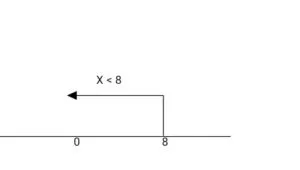
Example 2: 3(x – 6) < 9(x – 1)
Open the brackets:
3x – 18 < 9x – 9
Collect like terms:
3x – 9x < -9 + 18
-6x < 9
Divide through by -6 and change the sign:
-6x/-6 > 9/-6
x > -3/2 (that is, x > -1½)
Evaluation
- State the three rules for solving inequalities.
- What is a linear inequality in one variable?
- How does a point x = a divide the number line?
- Solve 3x – 1 > x + 1 and represent the answer on a number line.
Assignment
Solve the following linear inequalities and represent each answer on a number line.
- 5x + 4 < 2x + 13
- -2x < 8
This term's Mathematics topics
SS2 Third Term · 5 topics
- Graph of Linear Inequality in Two Variables
- Application of Linear Inequality in Real Life
- Bearings
- Statistics
- Probability
Get Mathematics as PDF and Word
Every week of SS2 Mathematics, Third Term, formatted and ready to print. Ad-free, and the copy lock comes off.
Get this term Card, bank transfer, USSD or OPay
Third Term Mathematics Lesson Notes for Other Topics
Bearing and Distances
Read the full lesson note.
Numbers 1-250
Read the full lesson note.
Data Collection
Read the full lesson note.
Numbers 241-250
Read the full lesson note.
Numbers 231-240
Read the full lesson note.
Two-Dimensional Shapes
Read the full lesson note.

Numbers 221-230
Read the full lesson note.
Weight
Read the full lesson note.
Numbers 211-220
Read the full lesson note.
Length Measurement
Read the full lesson note.
Numbers 201-210
Read the full lesson note.
Money (Continued)
Read the full lesson note.
Numbers 190-200
Read the full lesson note.
Nigerian Currencies
Read the full lesson note.
Numbers 181-190
Read the full lesson note.
Lesson Notes for Other Classes

Basic 1 Lesson Note
The complete lesson note to guide your studies.

Basic 2 Lesson Note
The complete lesson note to guide your studies.

Basic 3 Lesson Note
The complete lesson note to guide your studies.

Basic 4 Lesson Note
The complete lesson note to guide your studies.

Basic 5 Lesson Note
The complete lesson note to guide your studies.

Basic 6 Lesson Note
The complete lesson note to guide your studies.
