
Bearing and Distances – JSS2 Mathematics Lesson Note (Third Term)
Download this term · ₦1,000Lesson note at a glance
- Subject
- Mathematics
- Class
- JSS2
- Term
- Third Term
- Topic
- Bearing and Distances
- Order
- Topic 3 of 5 this term
- Reading time
- 3 min
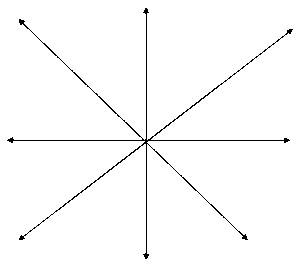
A bearing is the direction of one point from another. It is measured as an angle from the north line, turning in the clockwise direction. Bearings are written with three figures, so 45° is written 045°. Bearings are used with distances to describe where places are, for example in ships, aircraft and maps.
Bearings are measured from the north in the clockwise direction
Behavioural objectives
By the end of the lesson, students should be able to:
- state the bearings of the eight main compass points;
- write a bearing in three figures;
- find the back bearing of a given bearing;
- draw a bearing and use a scale to find a distance;
- solve simple problems on bearings and distances.
What is a bearing?
To give a bearing of point B from point A, stand at A, face north, then turn clockwise until you face B. The angle you turn through is the bearing of B from A.
Rules for writing bearings
- Always measure from the north line at the point you are starting from.
- Always measure clockwise.
- Always write three figures, with a degree sign: 005°, 045°, 120°, 270°.
Bearings of the compass points
| Direction | Bearing |
|---|---|
| North (N) | 000° |
| North-east (NE) | 045° |
| East (E) | 090° |
| South-east (SE) | 135° |
| South (S) | 180° |
| South-west (SW) | 225° |
| West (W) | 270° |
| North-west (NW) | 315° |
How do we find a back bearing?
The back bearing is the bearing of the starting point from the second point. The two bearings differ by 180°.
- If the bearing is less than 180°, add 180°.
- If the bearing is 180° or more, subtract 180°.
Example 1
The bearing of B from A is 070°. Find the bearing of A from B.
070° is less than 180°, so add 180°: 070° + 180° = 250°. The bearing of A from B is 250°.
Example 2
The bearing of Q from P is 240°. Find the bearing of P from Q.
240° is more than 180°, so subtract 180°: 240° − 180° = 060°. The bearing of P from Q is 060°.
How do we draw a bearing and find a distance?
A scale lets us use a small length on paper for a large real distance. For example, a scale of 1 cm to 10 km means 1 cm on the drawing stands for 10 km on the ground.
Steps for drawing
- Mark the starting point A and draw a north line through it.
- Place the centre of the protractor on A, with its zero line along the north line.
- Measure the bearing clockwise from north and mark the angle.
- Draw a line from A through the mark. Measure the length from the scale.
- Label the new point B.
Example 3
Town B is 60 km from town A on a bearing of 090°. Using a scale of 1 cm to 10 km, find the length of AB on the drawing.
Length = 60 ÷ 10 = 6 cm. Draw a line 6 cm long from A towards the east.
Example 4
A boat leaves a jetty and sails 8 km due north, then 6 km due east. How far is it from the jetty?
The two paths meet at a right angle, so use Pythagoras’ theorem. Distance² = 8² + 6² = 64 + 36 = 100. Distance = 10 km.
Evaluation
- Write the bearing of due west.
- Write the bearing of south-east.
- The bearing of B from A is 050°. Find the bearing of A from B.
- The bearing of Q from P is 300°. Find the bearing of P from Q.
- Using a scale of 1 cm to 20 km, what real distance is shown by 4.5 cm?
Answer key
- 270°
- 135°
- 050° + 180° = 230°
- 300° − 180° = 120°
- 4.5 × 20 = 90 km
Assignment
- Write the bearing of south-west.
- The bearing of B from A is 135°. Find the bearing of A from B.
- The bearing of Y from X is 215°. Find the bearing of X from Y.
- A village is 35 km from a school on a bearing of 090°. Using a scale of 1 cm to 5 km, what length shows this distance on a drawing?
- A man walks 12 km due north, then 5 km due east. How far is he from his starting point?
Answer key
- 225°
- 315°
- 035°
- 35 ÷ 5 = 7 cm
- 12² + 5² = 144 + 25 = 169, so the distance is 13 km
This term's Mathematics topics
JSS2 Third Term · 5 topics
Get Mathematics as PDF and Word
Every week of JSS2 Mathematics, Third Term, formatted and ready to print. Ad-free, and the copy lock comes off.
Get this term Card, bank transfer, USSD or OPay
JSS2 Mathematics Lesson Notes for Other Topics
Angles And Polygons
Read the full lesson note.
Angles of Elevation And Depression
Read the full lesson note.
Statistics -Data Representation (Bar Chart And Pie Charts)
Read the full lesson note.

Probability
Read the full lesson note.
Highest Common Factor (HCF) And Lowest Common Factor (LCF)
Read the full lesson note.
Whole Numbers, Common Multiples & Prime Factor
Read the full lesson note.
Fractions, Decimals And Percentages
Read the full lesson note.

Approximation To Significant Figures & Decimal Places
Read the full lesson note.
Multlipication And Division of Directed Number
Read the full lesson note.
Factorization And Algebraic Expressions
Read the full lesson note.
Multlipication And Division of Algebraic Fractions
Read the full lesson note.
Word Problem And Solving Inequalities
Read the full lesson note.

Linear Inequalities
Read the full lesson note.
Graphs: Graph of linear Equation
Read the full lesson note.
Plane Shapes
Read the full lesson note.
Lesson Notes for Other Classes

JSS1 Lesson Note
The complete lesson note to guide your studies.

JSS3 Lesson Note
The complete lesson note to guide your studies.
