
Length Measurement – Basic 1 Mathematics Lesson Note (Third Term)
Download this term · ₦1,000Lesson note at a glance
- Subject
- Mathematics
- Class
- Basic 1
- Term
- Third Term
- Topic
- Length Measurement
- Order
- Topic 8 of 16 this term
- Reading time
- 2 min
Non-standard measurement of length
What is Length? Length is how long or short something is.
Non-Standard Units: We can measure length using everyday objects:
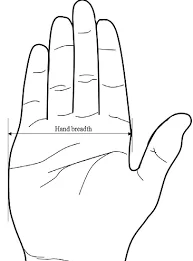
- Hand spans – width of your hand
- Footsteps – length of your foot

- Paper clips – small metal clips

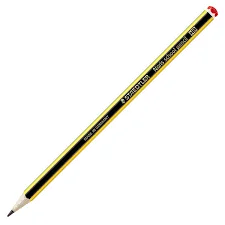
- Pencils – writing tools
- Books – school books

Exercise 11: Measure using hand spans:
- The table is _____ hand spans long
- The door is _____ hand spans tall
- The book is _____ hand spans wide
Exercise 12: Measure using footsteps:
- From the door to the board is _____ footsteps
- The length of the classroom is _____ footsteps
- From your seat to the teacher’s desk is _____ footsteps
Exercise 13: Measure using paper clips:
- Your pencil is _____ paper clips long
- Your ruler is _____ paper clips long
- Your book is _____ paper clips wide
Exercise 14: Choose the best unit to measure:
- Length of a worm: (hand spans/paper clips) ___
- Height of a tree: (footsteps/paper clips) ___
- Width of a table: (hand spans/footsteps) ___
5. Standard measurement of length
Standard Units: Standard units are the same for everyone.
Common Standard Units:
- Centimeter (cm) – for small objects

- Meter (m) – for bigger objects
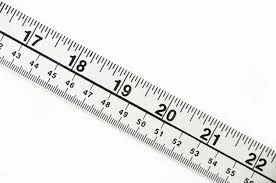
- Kilometer (km) – for very long distances
Exercise 15: What unit would you use?
- Length of your pencil: (cm/m/km) ___
- Distance to another town: (cm/m/km) ___
- Height of your friend: (cm/m/km) ___
- Width of your book: (cm/m/km) ___
Exercise 16: Circle the correct measurement:
- A pencil is about: (15 cm/15 m/15 km)
- A classroom is about: (8 cm/8 m/8 km)
- Distance between cities: (50 cm/50 m/50 km)
Exercise 17: True or False:
- We use centimeters to measure small things ___
- We use kilometers to measure long distances ___
- A meter is smaller than a centimeter ___
- Standard units are the same for everyone ___
6. Comparison of length
Comparing Lengths:
- Longer – has more length
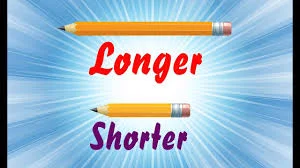
- Shorter – has less length
- Same length – equal length
Exercise 18: Compare these objects:
- A pencil and a ruler: The ruler is _____ than the pencil
- A book and a paper: The book is _____ than the paper
- Your arm and your finger: Your arm is _____ than your finger
Exercise 19: Circle the longer object:
- (Table/Chair) ___
- (Door/Window) ___
- (Bus/Car) ___
- (Tree/Flower) ___
Exercise 20: Circle the shorter object:
- (Pen/Pencil) ___
- (Book/Paper) ___
- (Finger/Arm) ___
Exercise 21: Put these in order from shortest to longest: Objects: Snake, Worm, Rope, Thread
Order: _____, _____, _____, _____
Exercise 22: Use the words: longer, shorter, same length
- A bus is _____ than a car
- Your two arms are the _____
- A snake is _____ than a worm
- An ant is _____ than a dog
Exercise 23: Measure and compare:
- Measure your desk with hand spans: _____ hand spans
- Measure your friend’s desk with hand spans: _____ hand spans
- Which desk is longer? _____
Exercise 24: Draw objects:
- Draw a long line: _____________
- Draw a short line: _____
- Draw two lines of the same length: _____ _____
This term's Mathematics topics
Basic 1 Third Term · 16 topics
- Numbers 181-190
- Nigerian Currencies
- Numbers 190-200
- Money (Continued)
- Numbers 201-210
- Length Measurement
- Numbers 211-220
- Weight
- Numbers 221-230
- Two-Dimensional Shapes
- Numbers 231-240
Get Mathematics as PDF and Word
Every week of Basic 1 Mathematics, Third Term, formatted and ready to print. Ad-free, and the copy lock comes off.
Get this term Card, bank transfer, USSD or OPay
Third Term Mathematics Lesson Notes for Other Topics
Bearing and Distances
Read the full lesson note.
Numbers 1-250
Read the full lesson note.
Data Collection
Read the full lesson note.
Numbers 241-250
Read the full lesson note.
Numbers 231-240
Read the full lesson note.
Two-Dimensional Shapes
Read the full lesson note.

Numbers 221-230
Read the full lesson note.
Weight
Read the full lesson note.
Numbers 211-220
Read the full lesson note.
Numbers 201-210
Read the full lesson note.
Money (Continued)
Read the full lesson note.
Numbers 190-200
Read the full lesson note.
Nigerian Currencies
Read the full lesson note.
Numbers 181-190
Read the full lesson note.
Subtraction
Read the full lesson note.
Lesson Notes for Other Classes

Basic 2 Lesson Note
The complete lesson note to guide your studies.

Basic 3 Lesson Note
The complete lesson note to guide your studies.

Basic 4 Lesson Note
The complete lesson note to guide your studies.

Basic 5 Lesson Note
The complete lesson note to guide your studies.
Basic 6 Lesson Note
The complete lesson note to guide your studies.
JSS1 Lesson Note
The complete lesson note to guide your studies.
