
Cellular Respiration – SS2 Biology Lesson Note (First Term)
Download Lesson NoteLesson note at a glance
- Subject
- Biology
- Class
- SS2
- Term
- First Term
- Topic
- Cellular Respiration
- Order
- Topic 4 of 9 this term
- Reading time
- 6 min
Cellular respiration is the biochemical process in which glucose is broken down in a series of enzyme-controlled reactions inside the cell to release energy as ATP, with carbon(IV) oxide and water as products. It begins with glycolysis in the cytoplasm. Aerobic respiration then continues in the mitochondria using oxygen, while anaerobic respiration takes place without oxygen.
Behavioural objectives
By the end of the lesson, students should be able to:
- define respiration and describe its two phases;
- state the conditions necessary for respiration and the characteristics of a respiratory surface;
- describe glycolysis and the Krebs cycle and state the ATP yield of cellular respiration;
- differentiate between aerobic and anaerobic respiration;
- describe how gaseous exchange takes place in plants, including the role of the guard cells.
What is respiration and what are its phases?
Respiration involves the taking in of oxygen, its transport within the body of the organism, its exchange in the cells and the eventual release of energy in the form of ATP, together with water and carbon(IV) oxide. The cells use the energy for their daily activities. Respiration can therefore be defined as a biochemical activity of the cell in which glucose is broken down in a series of reactions controlled by enzymes to release energy.
Respiration has two phases.
1. External respiration (breathing)
This is the taking in of oxygen (inhalation) into the respiratory organ (e.g. lungs or gills) and the breathing out (exhalation) of carbon(IV) oxide and water vapour.
2. Internal (tissue) respiration
This is the oxidation of food substances within the cells, leading to the release of energy, carbon(IV) oxide and water. It is made possible by the oxygen taken in through breathing. It can be represented by the following equation:
C6H12O6 + 6O2 → 6H2O + 6CO2 + Energy (ATP)
What conditions are necessary for respiration?
For effective exchange of gases to take place, the following conditions must be met:
- Respiratory medium: the environment from which the organism picks up oxygen, e.g. air and water.
- Respiratory organ: the organ the organism uses to pick up oxygen from the environment and pass out CO2 and water vapour, e.g. lungs in mammals and gills in fishes.
- Transport medium: this carries dissolved oxygen to the cells of the body. It then picks up CO2 and other waste products for elimination, e.g. blood in mammals.
- Ventilation: the movement of air over the respiratory surface. It replaces used oxygen and removes waste products. Ventilation mechanisms, e.g. breathing in humans, increase the rate of gaseous exchange.
- Respiratory surface: the actual surface of the body where gaseous exchange takes place, e.g. alveoli in mammals and the cell membrane in amoeba.
What are the characteristics of a respiratory surface?
All respiratory surfaces, in plants or animals, must have the following characteristics:
- It must be moist, because gases diffuse through it in solution.
- It must be permeable, to allow gases to pass in and out.
- It must be thin-walled, to make diffusion easier and faster.
- It must have an adequate supply of transport medium, e.g. blood.
- It must be large, to aid easy diffusion of gases.
- It must be highly vascularised, i.e. it must have many capillaries or similar networks to bring in and take away gases.
What is cellular (internal) respiration?
The oxidation of glucose to release energy is known as cellular respiration. It occurs in the mitochondria (the “powerhouse”) of living cells.
Glycolysis
Within the cytoplasm of the cell, enzymes in the cytoplasm break down one molecule of 6-carbon sugar into two molecules of 3-carbon pyruvate. This breakdown of glucose to pyruvic acid is called glycolysis. It does not require oxygen.
Krebs cycle
Each pyruvic acid is then oxidised completely to carbon(IV) oxide and water in the mitochondria. The series of chemical reactions in the mitochondrion that completes the breakdown of food molecules to carbon(IV) oxide, water and energy is known as the Krebs cycle (citric acid cycle). Seven enzymes carry it out.
Most of the ATP is generated in the mitochondrion (36 ATP). A total of 38 ATP molecules are formed when one molecule of glucose is completely oxidised.
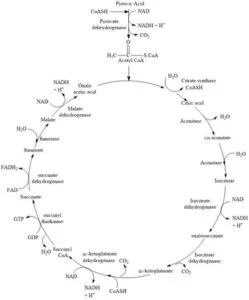
The Krebs cycle
What is the difference between aerobic and anaerobic respiration?
In most cells, cellular respiration takes place in the presence of oxygen. This is known as aerobic respiration. It generates the largest amount of ATP possible from one molecule of glucose (38 ATP).
In some other organisms, the cells get energy by breaking down glucose in the absence of oxygen. This is known as anaerobic respiration. Only two ATP molecules are produced.
- In animals, lactic acid often forms instead of pyruvic acid.
- Lactic acid is also produced by some microorganisms, which makes anaerobic respiration useful in the production of yoghurt.
- In plants, alcohol and carbon(IV) oxide are produced.
How do plants respire?
Plants have no special respiratory organ. Gases move in and out of the plant through the stomata and lenticels.
Stomata
Stomata are tiny pores in the lower epidermis of leaves. Each stoma is enclosed by two bean-shaped cells known as guard cells. The guard cells regulate the opening and closing of the stoma.
Lenticels
Lenticels are breathing pores, or tiny openings, found in the bark of older stems. They consist of a loose mass of small, thin-walled cells, which allows easy diffusion of gases in and out of the plant.
How does gaseous exchange take place in plants?
Oxygen, carbon(IV) oxide and water vapour are exchanged by simple diffusion. Oxygen diffuses into the plant through the stomata and lenticels, while CO2 and water vapour diffuse out through the same openings. The difference in the concentration gradient of these gases drives this movement.
Plants respire all the time. At night there is no photosynthesis, so the plant takes in oxygen and gives out carbon(IV) oxide and water vapour. During the day, the plant uses carbon(IV) oxide for photosynthesis and releases oxygen as a by-product.
The guard cells regulate the opening and closing of the stomata. When the guard cells are turgid, the stomata open. When the cells become flaccid, the stomata close.
Evaluation
- Define respiration.
- List the five conditions necessary for respiration.
- State four characteristics of a respiratory surface.
- State the number of ATP molecules produced in aerobic and in anaerobic respiration.
- How do the guard cells control the opening and closing of the stomata?
Assignment
- During anaerobic respiration, how many ATP are produced?
A. 2 ATP
B. 3 ATP
C. 4 ATP
D. 5 ATP - The cartilaginous flap which prevents food from entering the windpipe is the
A. glottis
B. epiglottis
C. larynx
D. oesophagus - Gaseous exchange in mammals takes place in the
A. trachea
B. bronchus
C. alveolus
D. lungs - When the guard cells are turgid, the stomata
A. open
B. close
C. shrink
D. break - In strenuous activities in the absence of oxygen, glucose is broken down into
A. pyruvic acid
B. carbon dioxide
C. lactic acid
D. alcohol - Explain fermentation.
- Differentiate between internal and external respiration.
This term's Biology topics
SS2 First Term · 9 topics
First Term Biology Lesson Notes for Other Topics
Reproduction - Asexual Reproduction
Read the full lesson note.
Reproduction II - Sexual Reproduction
Read the full lesson note.
Reproductive Health
Read the full lesson note.

Respiratory System
Read the full lesson note.
Excretory System
Read the full lesson note.
Tissues And Supporting Systems In Animals
Read the full lesson note.
Joints
Read the full lesson note.

Supporting Tissues In Plants
Read the full lesson note.
Reproduction
Read the full lesson note.
Movement
Read the full lesson note.
Some Properties And Functions Of The Cell III
Read the full lesson note.
Some Properties And Functions Of The Cell II
Read the full lesson note.
Some Properties And Functions Of The Cell
Read the full lesson note.
The Cell And It's Environment
Read the full lesson note.
The Cell
Read the full lesson note.
Lesson Notes for Other Classes

Basic 1 Lesson Note
The complete lesson note to guide your studies.

Basic 2 Lesson Note
The complete lesson note to guide your studies.

Basic 3 Lesson Note
The complete lesson note to guide your studies.

Basic 4 Lesson Note
The complete lesson note to guide your studies.

Basic 5 Lesson Note
The complete lesson note to guide your studies.
Basic 6 Lesson Note
The complete lesson note to guide your studies.


