
Respiratory System SS2 Biology Lesson Note
Download Lesson NoteTopic: Respiratory System
MECHANISM OF RESPIRATORY SYSTEM IN LOWER ANIMALS
-
Unicellular Organism
They require no elaborate respiratory system for they respire through their entire body surface (the cell membrane acts as the respiratory surface) through a simple diffusion process. Oxygen which is highly concentrated in the environment is absorbed in the organism which diffuses into the region with lower concentration.
- Insects
The tracheal system is what insects use for respiration. Air passes through a spiracle and then enters the tracheal trunk which diffuses throughout a complex, branching network of tracheal tubes that subdivides into smaller and smaller diameters and reaches every part of the body. At the end of each tracheal branch, a special cell (the tracheae) provides a thin, moist interface for the exchange of gasses between atmospheric air and a living cell. Oxygen in the tracheal tube first dissolves in the liquid of the trachea and then diffuses into the cytoplasm of an adjacent cell. At the same time, carbon dioxide, produced as a waste product of cellular respiration, diffuses out of the cell and, eventually, out of the body through the tracheal system.
- Fish
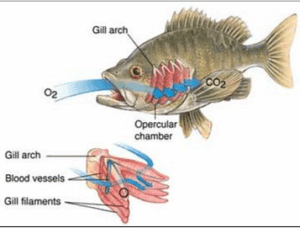
The gill is the respiratory organ in the fish. Enclosed is the gill chamber about three to four in number. Each gill is made up of a gill filament (where gaseous exchange takes place) the gill raker (that prevents food particles from entering the gill chamber) and the gill arch (in which the filaments are built). The gills are concealed by the operculum. The fish initiates breathing by closing the operculum opening the mouth and lowering the floor of the mouth. Water which contains dissolved oxygen rushes into the mouth of the fish. The fish then closes its mouth and water rushes into the gill chamber and moves across the gill filaments. Oxygen in the water then diffuses into the gill filaments while CO2 diffuses out of the body expelled through water as the fish opens its operculum.
- Toad
Tadpole: This is a larval toad or frog that hatch from eggs and can only survive in water. Tadpoles have tiny external gill flaps that extract oxygen from water as it passes over them. Tadpoles open their mouths as they swim and take in water. As the mouth closes, muscles transfer the water to the gills. These consist of thin membranes called lamellae, which take oxygen from the water where it enters the bloodstream through the process of diffusion. Tadpoles can also rise to the surface and gulp oxygen from the air. As tadpoles mature the gills are absorbed by the body as other respiratory systems develop.
- a) Adult Toad:
The adult toad respires in three different ways namely: the skin, mouth, and lungs
i. Buccal (Mouth) Gaseous Exchange
The toad can utilize its mouth as a respiratory organ because of the following:
– It is very large i.e. has a large surface area.
– It has a thin mucus membrane for easy diffusion
– It is well supplied with blood capillaries
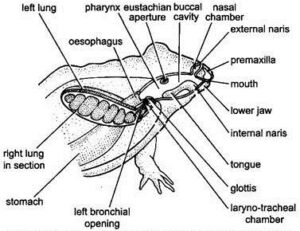
To initiate breathing, the toad closes its mouth, the nostrils are opened and the floor of the buccal cavity is lowered, air is drawn through the nostrils into the buccal cavity. After this, the capillaries and the glottis close and gaseous exchange takes place between the blood and the inhaled air. To get rid of air, the floor of the buccal cavity is raised, increasing the air pressure, and hereby forcing the nostrils to open and air in the buccal cavity containing carbon dioxide flows out.
ii. Skin /Cutaneous Respiration In Toad
This is possible because of the large surface area of the skin. The skin is moist because of continuous secretion from the mucus gland, there is an adequate supply of blood capillaries and finally, the membrane serving as the skin is thin. A simple diffusion of gases takes place through it both on land and water.
iii. Lungs /Pulmonary Respiration In Toad
This is similar to what is obtainable in buccal respiration but with a slight difference. To draw air into its mouth the toad lowers the floor of its mouth, which causes the throat to expand. Then the nostrils open allowing air to enter the enlarged mouth. The nostrils then close and the air in the mouth is forced into the lungs by contraction of the floor of the mouth. To eliminate the carbon dioxide in the lungs the floor of the mouth moves down, drawing the air out of the lungs and into the mouth. Finally, the nostrils are opened and the floor of the mouth is moved up pushing the air out of the nostrils.
- Respiratory System In Mammals
The respiratory system of mammals is the most complex of all respiratory systems. It comprises a pair of lungs enclosed in the thorax and connected to the outside by a series of branched air tubes.
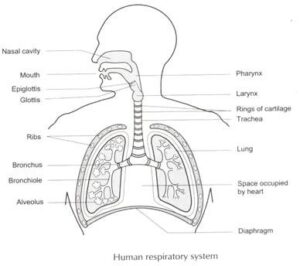
In human beings, air can be drawn in through the mouth or nose. Both lead into the pharynx a short passageway which branches at the end into two directions. One leads to the digestive tract while the other leads to the larynx (voice box) and the lower air pathway. The entrance of the larynx is called the glottis and it is covered by a cartilaginous flap (epiglottis) which prevents food from entering the windpipe. For air to enter the larynx, the glottis must remain open.
The trachea (windpipe) branches into two bronchi. The presence of cartilaginous rings in the trachea and bronchi prevents them from collapsing when the air pressure in them is low. Each bronchus leads to the lung where it branches into small tubes called bronchioles. The alveoli are richly supplied with blood capillaries and are situated on the surface where gaseous exchange takes place.
As oxygen follows this pathway from the outside to the lungs, C02 is released from the lungs to the outside via the same pathway.
Mechanism Of Respiration In Mammals
This entails two phases namely: external and internal respiration
This is the taking in of oxygen (inspiration or inhalation) and giving out of C02 and water vapour (expiration or exhalation)
Mechanism Of Inhalation In Man
- The intercostal muscles contract
- The ribs are moved upward and outward
- The diaphragm becomes flattened
- There is an increase in the volume of the thoracic cavity
- Consequently air is drawn from the nostril to the trachea, bronchi, bronchioles, and finally to the alveoli.
Mechanism Of Expiration or Exhalation In Man
- The intercostal muscles relax
- The ribs are moved downward and inward
- The diaphragm becomes a shape
- There is a decrease in the volume of the thoracic cavity.
- Consequently air is drawn from the alveoli, bronchioles, bronchi, and trachea.
- Consequently air containing waste products like CO2 and water vapour from inside the alveoli of the lungs is forced out through bronchioles, bronchi, trachea, and finally to the exterior through the nose.
Inhaled and exhaled air is made up of the following:
| Air Component | Inhaled Air | Exhaled Air |
| Oxygen | 21% | 16% |
| Carbon dioxide | 0.03% | 4% |
| Nitrogen | 78% | 78% |
| Water vapour | Variable | Saturated (higher) |
First Term Biology Lesson Notes for Other Topics
Reproduction - Asexual Reproduction
Explore lesson notes covering all topics.
Reproduction II - Sexual Reproduction
Explore lesson notes covering all topics.
Reproductive Health
Explore lesson notes covering all topics.
Cellular Respiration
Explore lesson notes covering all topics.
Excretory System
Explore lesson notes covering all topics.
Tissues And Supporting Systems In Animals
Explore lesson notes covering all topics.
Joints
Explore lesson notes covering all topics.

Supporting Tissues In Plants
Explore lesson notes covering all topics.
Reproduction
Explore lesson notes covering all topics.
Movement
Explore lesson notes covering all topics.
Some Properties And Functions Of The Cell III
Explore lesson notes covering all topics.
Some Properties And Functions Of The Cell II
Explore lesson notes covering all topics.
Some Properties And Functions Of The Cell
Explore lesson notes covering all topics.
The Cell And It's Environment
Explore lesson notes covering all topics.
The Cell
Explore lesson notes covering all topics.


Lesson Notes for Other Classes
Basic 1 Lesson Note
The complete lesson note to guide your studies.

Basic 2 Lesson Note
The complete lesson note to guide your studies.

Basic 3 Lesson Note
The complete lesson note to guide your studies.

Basic 4 Lesson Note
The complete lesson note to guide your studies.
Basic 5 Lesson Note
The complete lesson note to guide your studies.
Basic 6 Lesson Note
The complete lesson note to guide your studies.