Supporting Tissues in Plants – SS2 Biology Lesson Note (First Term)
Download Lesson NoteLesson note at a glance
- Subject
- Biology
- Class
- SS2
- Term
- First Term
- Topic
- Supporting Tissues in Plants
- Order
- Topic 8 of 9 this term
- Reading time
- 2 min
Supporting tissues are groups of plant cells that give a plant its definite shape, strength and rigidity, and help it resist external forces such as wind and water. The five types are parenchyma, collenchyma, sclerenchyma, xylem and phloem. Each type has its own cell structure and function.
Behavioural objectives
By the end of the lesson, students should be able to:
- State why plants need supporting tissues.
- List the five types of supporting tissues in plants.
- Describe the cell structure of each type.
- State the functions of each type.
Why do plants need supporting tissues?
Plants need supporting tissues for:
- Definite shape
- Strength
- Rigidity
- Resistance against external forces such as wind and water
What are the types of supporting tissues?
- Parenchyma tissues
- Collenchyma tissues
- Sclerenchyma tissues
- Xylem tissues
- Phloem tissues
Parenchyma tissues
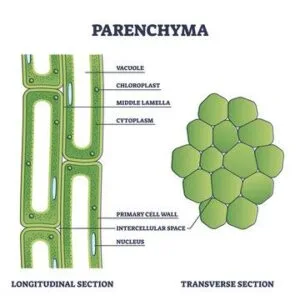
Parenchyma tissues are made up of living cells with cellulose and many air spaces within them. This is the most common and abundant plant tissue.
Functions
- It gives firmness and turgidity to the stems of the hibiscus.
- It stores food and water.
- It takes part in food synthesis in leaf mesophyll.
Collenchyma tissues

Collenchyma tissues are made up of living cells which are elongated and thickened at the corners.
Functions
- It provides strength and support in young growing plants.
- It gives flexibility and resilience to the plant.
Sclerenchyma tissues
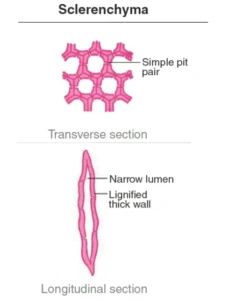
Sclerenchyma tissues are made up of thick cells containing cellulose and lignin. The tissues are rich in fibres.
Functions
- It gives flexibility to plants.
- It provides strength, rigidity, hardness and support to plants.
Xylem tissues

Xylem tissues are found in the vascular tissues of stems, roots and leaves.
Functions
- It provides support, strength and shape to the plant.
- It helps to conduct water and mineral salts from the roots to the leaves.
Phloem tissues
Phloem tissues are also located in the vascular bundles of all plants, in their roots, stems and leaves.
Functions
- It conducts manufactured food from the site of production to the site of consumption and storage.
- It assists in providing support to the entire plant.
Evaluation
- State four reasons why plants need supporting tissues.
- List the five types of supporting tissues in plants.
- Describe the cells of collenchyma tissue.
- State two functions of xylem tissues.
- Which plant tissue is the most common and abundant?
Assignment
- Name the two supporting tissues found in the vascular bundles and state one function of each.
- State two differences between the cells of parenchyma and sclerenchyma tissues.
This term's Biology topics
SS2 First Term · 9 topics
First Term Biology Lesson Notes for Other Topics
Reproduction - Asexual Reproduction
Read the full lesson note.
Reproduction II - Sexual Reproduction
Read the full lesson note.
Reproductive Health
Read the full lesson note.
Cellular Respiration
Read the full lesson note.

Respiratory System
Read the full lesson note.
Excretory System
Read the full lesson note.

Tissues And Supporting Systems In Animals
Read the full lesson note.
Joints
Read the full lesson note.
Reproduction
Read the full lesson note.

Movement
Read the full lesson note.
Some Properties And Functions Of The Cell III
Read the full lesson note.
Some Properties And Functions Of The Cell II
Read the full lesson note.
Some Properties And Functions Of The Cell
Read the full lesson note.
The Cell And It's Environment
Read the full lesson note.
The Cell
Read the full lesson note.
Lesson Notes for Other Classes

Basic 1 Lesson Note
The complete lesson note to guide your studies.
Basic 2 Lesson Note
The complete lesson note to guide your studies.

Basic 3 Lesson Note
The complete lesson note to guide your studies.

Basic 4 Lesson Note
The complete lesson note to guide your studies.

Basic 5 Lesson Note
The complete lesson note to guide your studies.

Basic 6 Lesson Note
The complete lesson note to guide your studies.