Some Properties and Functions of the Cell II – SS1 Biology Lesson Note (First Term)
Download Lesson NoteLesson note at a glance
- Subject
- Biology
- Class
- SS1
- Term
- First Term
- Topic
- Some Properties and Functions of the Cell II
- Order
- Topic 8 of 11 this term
- Reading time
- 4 min
Cellular respiration is the oxidation of glucose in the cell to release energy as ATP. Aerobic respiration uses oxygen and releases the most ATP. Anaerobic respiration takes place without oxygen and releases less ATP. It has two stages: glycolysis in the cytoplasm and the Krebs cycle in the mitochondrion.
Behavioural objectives
By the end of the lesson, students should be able to:
- define cellular respiration;
- distinguish between aerobic and anaerobic respiration and write their equations;
- state where glycolysis takes place and the ATP it yields;
- describe the main steps of the Krebs cycle;
- state the total ATP produced from one glucose molecule in aerobic respiration.
What is cellular (internal or tissue) respiration?
The oxidation of glucose in the cell to release energy is known as cellular respiration, and it occurs in the mitochondria of all living cells. There are two types of cellular respiration: aerobic and anaerobic respiration.
Aerobic respiration
Cellular respiration that takes place in the presence of oxygen is known as aerobic respiration. The largest amount of ATP possible is generated through it from one molecule of glucose, with carbon (iv) oxide and water released as by-products.
C6H12O6 + 6O2 → 6CO2 + 6H2O + 38ATP
Anaerobic respiration
In some organisms, such as bacteria, fungi and endoparasites, the cells get energy from breaking down glucose in the absence of oxygen. This is known as anaerobic respiration. A smaller amount of ATP is produced. The pyruvic acid produced is converted to alcohol in plants (alcoholic fermentation), while in animals lactic acid is produced, which leads to muscle fatigue in athletes.
In plants
C6H12O6 → 2CH3COCOOH → 2C2H5OH + 2CO2 + 2ATP
In animals
C6H12O6 → 2CH3COCOOH → 2CH3CHOHCOOH + 2ATP
What is the mechanism of cellular respiration?
Cellular respiration involves two main stages: glycolysis and the Krebs cycle.
Glycolysis
Glycolysis occurs in the cytoplasm of the cells. First, the glucose molecule is phosphorylated by the addition of a phosphate group to become glucose-6-phosphate. This is carried out by an enzyme known as hexokinase.
Ten steps in this pathway lead to the breakdown of one molecule of 6-carbon glucose into two molecules of 3-carbon pyruvic acid by the enzymes in the cytoplasm. This process does not require oxygen.

At the end of the pathway, 2 ATP are used to produce 4 ATP (2 ATP from each pyruvic acid), so a net energy of 2 ATP is generated in glycolysis. This is called “substrate-level phosphorylation”.
Krebs cycle
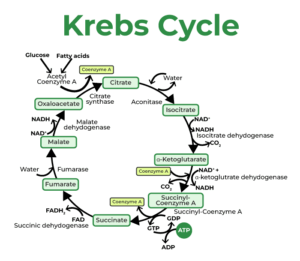
The Krebs cycle is also known as the citric acid cycle (CAC) or tricarboxylic acid cycle (TCA). Here, each pyruvic acid is further oxidised completely to carbon dioxide and water in the mitochondria. The pyruvic acid from glycolysis is converted to acetic acid through the removal of one molecule of CO2. The acetic acid is carried into the Krebs cycle by co-enzyme A.
The combination of acetic acid and co-enzyme A forms acetyl-CoA. Acetyl-CoA combines with oxaloacetic acid to form citric acid, which is an important start of the Krebs cycle. The Krebs cycle takes place in the matrix of the mitochondrion, and most of the ATP is generated in it. The oxidation process in the Krebs cycle leads to the production of 36 ATP (18 ATP from each pyruvic acid).
The process used in the production of ATP in the Krebs cycle is called oxidative phosphorylation. A total of 38 ATP is generated from the aerobic breakdown of glucose. The Krebs cycle is particularly important because it is a key pathway that connects proteins, fats and carbohydrates.
Evaluation
- Define cellular respiration.
- Name the two types of cellular respiration.
- Where does glycolysis take place, and what is the net ATP gain from it?
- Name the product of anaerobic respiration in animals that leads to muscle fatigue.
- State the name of the compound formed when acetyl-CoA combines with oxaloacetic acid.
Assignment
- The organelle involved in tissue respiration is the
- A. endoplasmic reticulum
- B. Golgi body
- C. mitochondrion
- D. ribosome
- In the absence of oxygen, the pyruvic acid produced during glycolysis is converted to
- A. CO2 and water
- B. glycerol
- C. ethanol
- D. citric acid
- Glycolysis takes place in the
- A. lysosome
- B. mitochondrion
- C. nucleus
- D. ribosome
- The starting substance in the Krebs cycle is
- A. citric acid
- B. acetic acid
- C. oxalic acid
- D. malic acid
- A total of __ ATP is produced from one glucose molecule during aerobic respiration.
- A. 34
- B. 36
- C. 38
- D. 40
- In a tabular form, differentiate between aerobic and anaerobic respiration.
- State three uses of alcoholic fermentation.
This term's Biology topics
SS1 First Term · 11 topics
First Term Biology Lesson Notes for Other Topics
Reproduction - Asexual Reproduction
Read the full lesson note.
Reproduction II - Sexual Reproduction
Read the full lesson note.
Reproductive Health
Read the full lesson note.
Cellular Respiration
Read the full lesson note.

Respiratory System
Read the full lesson note.
Excretory System
Read the full lesson note.
Tissues And Supporting Systems In Animals
Read the full lesson note.
Joints
Read the full lesson note.

Supporting Tissues In Plants
Read the full lesson note.
Reproduction
Read the full lesson note.
Movement
Read the full lesson note.
Some Properties And Functions Of The Cell III
Read the full lesson note.
Some Properties And Functions Of The Cell
Read the full lesson note.
The Cell And It's Environment
Read the full lesson note.
The Cell
Read the full lesson note.
Lesson Notes for Other Classes

Basic 1 Lesson Note
The complete lesson note to guide your studies.
Basic 2 Lesson Note
The complete lesson note to guide your studies.

Basic 3 Lesson Note
The complete lesson note to guide your studies.

Basic 4 Lesson Note
The complete lesson note to guide your studies.

Basic 5 Lesson Note
The complete lesson note to guide your studies.

Basic 6 Lesson Note
The complete lesson note to guide your studies.