
Sulphur – SS2 Chemistry Lesson Note (Second Term)
Download this term · ₦1,000Lesson note at a glance
- Subject
- Chemistry
- Class
- SS2
- Term
- Second Term
- Topic
- Sulphur
- Order
- Topic 9 of 9 this term
- Reading time
- 11 min
Sulphur is a yellow, non-metallic element with the symbol S and atomic number 16, found in Group VI of the periodic table.
Behavioural objectives
- State the general properties of the Group VI elements and write their electronic configurations.
- Describe the extraction of sulphur by the Frasch process.
- Distinguish between rhombic and monoclinic sulphur and state the transition temperature.
- Describe the preparation, properties, tests and uses of H2S, SO2, SO3 and H2SO3.
- Explain the Contact process and write the equations for the properties of tetraoxosulphate (VI) acid.
- Describe the tests for the trioxosulphate (IV) and tetraoxosulphate (VI) ions.
What are the Group VI elements?
The Group VI elements, also called the sulphur or oxygen family, are oxygen, sulphur, selenium, tellurium and polonium.
What are the general properties of Group VI elements?
- Outer shell: each atom has six electrons in its outermost shell.
- Oxidation number: it is -2 in most compounds. Sulphur also shows +4 and +6, as in SO2 and SO3.
- Metallic property: it increases down the group.
- Nature: oxygen and sulphur are non-metals, selenium and tellurium are metalloids, and polonium is a metal.
- Physical state: all are solids at room temperature except oxygen, which is a gas.
- Allotropy: oxygen and sulphur exist in more than one form.
- Electronegativity: it decreases down the group. Oxygen is a good oxidising agent.
What is the electronic structure of the Group VI elements?
Every Group VI element ends its configuration in s2p4, which gives six outer electrons.
| Element | Atomic number | Electronic configuration |
|---|---|---|
| Oxygen | 8 | 1s² 2s² 2p⁴ |
| Sulphur | 16 | 1s² 2s² 2p⁶ 3s² 3p⁴ |
| Selenium | 34 | 1s² 2s² 2p⁶ 3s² 3p⁶ 3d¹⁰ 4s² 4p⁴ |
| Tellurium | 52 | 1s² 2s² 2p⁶ 3s² 3p⁶ 3d¹⁰ 4s² 4p⁶ 4d¹⁰ 5s² 5p⁴ |
| Polonium | 84 | 1s² 2s² 2p⁶ 3s² 3p⁶ 3d¹⁰ 4s² 4p⁶ 4d¹⁰ 4f¹⁴ 5s² 5p⁶ 5d¹⁰ 6s² 6p⁴ |
Where does sulphur occur?
Sulphur occurs both free and combined in nature.
- Free state: underground deposits of native sulphur.
- Sulphides: compounds of sulphur with metals, such as iron pyrites.
- Sulphates: tetraoxosulphate (VI) salts, such as gypsum.
How is sulphur extracted?
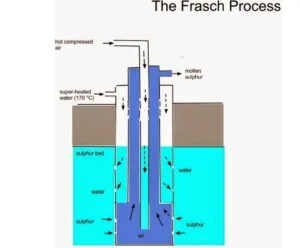
Sulphur is extracted from underground deposits by the Frasch process, which melts the sulphur with superheated water and brings it to the surface.
- Three concentric pipes are driven down a hole dug into the sulphur bed.
- Superheated water at 170°C and 10 atm is forced down the outer pipe. It melts the sulphur, which melts at 115°C.
- Hot compressed air at 15 atm is forced down the innermost pipe.
- The air pushes the molten sulphur up the middle pipe to the surface.
- The molten sulphur is pumped continuously into a large tank, where it solidifies.
- The sulphur obtained is about 99.5% pure.
What are the allotropes of sulphur?
Allotropes are different physical forms of the same element in the same state. Sulphur has two main crystalline allotropes and two non-crystalline forms.
What are the crystalline allotropes of sulphur?
- Rhombic sulphur: a bright yellow, octahedral crystalline solid made of S8 molecules. It is stable below 96°C.
- Monoclinic sulphur: an amber, needle-shaped crystalline solid made of S8 molecules. It is stable above 96°C and easily reverts to rhombic sulphur below 96°C.
- Transition temperature: the temperature at which the two forms change into each other. For sulphur it is 96°C.
What are the non-crystalline forms of sulphur?
- Amorphous sulphur: a form with no definite crystal shape.
- Plastic sulphur: a rubbery, elastic form made by pouring boiling sulphur into cold water. It slowly turns back to rhombic sulphur.
What is the difference between rhombic and monoclinic sulphur?
| Property | Rhombic sulphur | Monoclinic sulphur |
|---|---|---|
| Melting point | 113°C | 119°C |
| Colour | Bright yellow | Amber |
| Shape | Octahedral | Needle-like |
| Appearance | Translucent | Transparent |
| Stability | Stable below 96°C | Stable above 96°C |
What are the physical properties of sulphur?
Sulphur is a yellow, brittle solid that does not dissolve in water.
- Colour and state: a yellow solid.
- Solubility: insoluble in water, but soluble in toluene and carbon (IV) sulphide.
- Conductivity: a poor conductor of heat and electricity.
- Melting and boiling points: it melts at about 119°C (monoclinic form) and boils at 444°C.
What are the chemical properties of sulphur?
Sulphur combines directly with metals and non-metals, mostly on heating.
- With metals: it forms sulphides (S2-). Fe(s) + S(s) → FeS(s)
- With oxygen: it burns to form sulphur (IV) oxide. S(s) + O2(g) → SO2(g)
- With hydrogen: it forms hydrogen sulphide. H2(g) + S(s) → H2S(g)
- With carbon (coke): it forms carbon (IV) sulphide. C(s) + 2S(s) → CS2(l)
What are the uses of sulphur?
- Acid manufacture: making tetraoxosulphate (VI) acid.
- Vulcanisation: hardening and strengthening rubber.
- Germicide: killing germs and fungi.
- Bleaching agents: making bleaching agents.
- Other products: matches and gunpowder.
What are the compounds of sulphur?
The main compounds of sulphur in this topic are hydrogen sulphide, sulphur (IV) oxide, sulphur (VI) oxide, trioxosulphate (IV) acid and tetraoxosulphate (VI) acid.
What is hydrogen sulphide, H2S?
Hydrogen sulphide is a poisonous gas with a smell like rotten eggs. It occurs in volcanic gases, sulphur springs, coal gas and natural gas.
Laboratory preparation
- Dilute hydrochloric acid is added to iron (II) sulphide. 2HCl(aq) + FeS(s) → FeCl2(aq) + H2S(g)
- A Kipp’s apparatus gives a regular supply of the gas.

Physical properties
- Appearance: a colourless gas with a rotten egg smell.
- Toxicity: it is very poisonous.
- Density: about 1.18 times denser than air.
- Solubility: moderately soluble in water, giving a very weak acid.
- Burning: it burns with a pale blue flame.
Chemical properties
- As an acid: it reacts with alkalis to form a normal salt and water. 2NaOH(aq) + H2S(g) → Na2S(aq) + 2H2O(l)
- Burning in excess oxygen: it forms sulphur (IV) oxide. 2H2S(g) + 3O2(g) → 2H2O(l) + 2SO2(g)
- Burning in limited oxygen: it deposits sulphur. 2H2S(g) + O2(g) → 2H2O(l) + 2S(s)
- As a reducing agent: it reduces acidified KMnO4, acidified K2Cr2O7, chlorine gas, FeCl3, SO2, H2SO4 and HNO3.
Test for hydrogen sulphide
- Moisten a piece of filter paper with lead (II) trioxonitrate (V) solution.
- Drop it into a gas jar of the unknown gas.
- If the paper turns black, the gas is H2S. The black substance is lead (II) sulphide.
What is sulphur (IV) oxide, SO2?
Sulphur (IV) oxide is a colourless, poisonous gas with a smell like burning matches.
Laboratory preparation
- Warm sodium or potassium trioxosulphate (IV) with dilute tetraoxosulphate (VI) acid or hydrochloric acid.
- Equation: Na2SO3(aq) + 2HCl(aq) → 2NaCl(aq) + H2O(l) + SO2(g)
Physical properties
- Appearance: a colourless, poisonous gas with a smell like burning matches.
- Solubility: very soluble in water.
- Density: about 2.2 times denser than air.
Chemical properties
- As an acid: it reacts with alkalis to form a trioxosulphate (IV) salt and water only. 2NaOH(aq) + SO2(g) → Na2SO3(aq) + H2O(l)
- As a reducing agent: it reduces acidified KMnO4, acidified K2Cr2O7, FeCl3, HNO3 and chlorine gas.
- Colour changes: it turns acidified purple KMnO4 colourless and acidified orange K2Cr2O7 green.
- As a bleaching agent: it decolourises dyes, but only in the presence of water. It bleaches by reduction, while chlorine bleaches by oxidation.
- As an oxidising agent: it oxidises strong reducing agents such as hydrogen sulphide. 2H2S(g) + SO2(g) → 2H2O(l) + 3S(s)
- With carbon: C(s) + SO2(g) → CO2(g) + S(s)
Test for SO2
- If the unknown gas bleaches a coloured flower, SO2 is suspected.
- Bubble the gas through acidified potassium heptaoxodichromate (VI). If the orange colour turns green, the gas is SO2.
- Bubble the gas through acidified potassium tetraoxomanganate (VII). If the purple colour turns colourless, the gas is SO2.
Uses of SO2
- Acid manufacture: making tetraoxosulphate (VI) acid.
- Germicide and fumigant: destroying termites.
- Bleaching agent: bleaching straw, silk and wood.
- Preservative: keeping some liquids, such as orange juice, from spoiling.
- Refrigerant: liquid SO2 is used for cooling.
What is sulphur (VI) oxide, SO3?
Sulphur (VI) oxide is a white crystalline solid formed when sulphur (IV) oxide combines with oxygen.
Preparation conditions
- Catalyst: platinised asbestos or vanadium (V) oxide.
- Pressure: 1 atm.
- Temperature: 400°C to 450°C.
- Equation: 2SO2(g) + O2(g) ⇌ 2SO3(g)
Physical properties
- Appearance: white needle-like crystals at room temperature.
- Boiling point: low, so it vaporises on gentle heating.
- Solubility: it dissolves readily in water to give tetraoxosulphate (VI) acid.
What is trioxosulphate (IV) acid, H2SO3?
Trioxosulphate (IV) acid is a weak dibasic acid with the formula H2SO3, formed when sulphur (IV) oxide dissolves in water.
Laboratory preparation
- Dilute hydrochloric acid is added to warm sodium trioxosulphate (IV) to give SO2. Na2SO3(s) + 2HCl(aq) → 2NaCl(aq) + H2O(l) + SO2(g)
- The SO2 is dissolved in water. H2O(l) + SO2(g) ⇌ H2SO3(aq)
- Sulphur (IV) oxide is the acid anhydride of trioxosulphate (IV) acid.
Physical properties
- Litmus: it turns blue litmus paper red.
- Appearance: a colourless liquid.
- Solubility: it mixes readily with water.
- Smell: irritating and choking.
Chemical properties
- With alkalis: it forms a salt and water. 2NaOH(aq) + H2SO3(aq) → Na2SO3(aq) + 2H2O(l)
- Oxidation in air: it changes to tetraoxosulphate (VI) acid. 2H2SO3(aq) + O2(g) → 2H2SO4(aq)
- As a reducing agent: it reduces potassium tetraoxomanganate (VII) and potassium heptaoxodichromate (VI).
- Bleaching: it bleaches dyes in the presence of water.
Test for the trioxosulphate (IV) ion, SO32-
- Add barium chloride solution to the solution of the unknown substance.
- A white precipitate forms.
- The precipitate dissolves in dilute hydrochloric acid. This confirms SO32-.
Uses of H2SO3
- Bleaching: straw and other fabrics.
- Germicide: killing germs.
What is tetraoxosulphate (VI) acid, H2SO4?
Tetraoxosulphate (VI) acid is a strong dibasic acid used in almost every manufacturing process, so it is made industrially.
How is H2SO4 made industrially?
It is made by the Contact process, which has five steps.
- Sulphur is burned in dry air to give sulphur (IV) oxide. S(s) + O2(g) → SO2(g)
- The SO2 is mixed with excess air and passed through an electric chamber, which removes dust and impurities that would poison the catalyst. The gas mixture is then dried with concentrated H2SO4.
- The dry mixture enters the contact tower. SO2 and oxygen combine over pellets of vanadium (V) oxide, V2O5, at atmospheric pressure and 450°C to 500°C. 2SO2(g) + O2(g) ⇌ 2SO3(g) + heat
- The SO3 is cooled and dissolved in concentrated H2SO4 to give a thick liquid called oleum. H2SO4(l) + SO3(g) → H2S2O7(l)
- The oleum is diluted with water to give 98% tetraoxosulphate (VI) acid. H2O(l) + H2S2O7(l) → 2H2SO4(l)
- Why SO3 is not put directly into water: the reaction gives out a large amount of heat. The heat boils the acid into a mist of droplets that spreads through the factory and causes acid burns.
Physical properties
- Appearance: a colourless, viscous liquid with a density of 1.84 g cm-3.
- Corrosive: it causes burns on contact with the skin.
- Solubility: it is highly soluble in water and gives out a large amount of heat.
Chemical properties
- With metals (as an acid): metals above hydrogen in the electrochemical series release hydrogen. Zn(s) + H2SO4(aq) → ZnSO4(aq) + H2(g)
- With bases: it forms a salt and water. MgO(s) + H2SO4(aq) → MgSO4(aq) + H2O(l)
- With alkalis, acidic salt: H2SO4(aq) + NaOH(aq) → NaHSO4(aq) + H2O(l)
- With alkalis, normal salt: H2SO4(aq) + 2NaOH(aq) → Na2SO4(aq) + 2H2O(l)
- With trioxocarbonates (IV): they release carbon (IV) oxide. H2SO4(aq) + CuCO3(s) → CuSO4(aq) + H2O(l) + CO2(g)
How does concentrated H2SO4 act as an oxidising agent?
- With zinc: Zn(s) + 2H2SO4(l) → ZnSO4(aq) + 2H2O(l) + SO2(g)
- With carbon: C(s) + 2H2SO4(l) → 2H2O(l) + CO2(g) + 2SO2(g)
- With hydrogen sulphide: H2S(g) + H2SO4(l) → S(s) + SO2(g) + 2H2O(l)
How does concentrated H2SO4 act as a dehydrating agent?
- Meaning: it removes water from compounds such as sugar, ethanol, methanoic acid and ethanedioic acid.
- With sugar: sugar turns into black charcoal. C12H22O11(s) → 12C(s) + 11H2O(l)
How does concentrated H2SO4 displace volatile acids?
- Meaning: it drives volatile acids out of their salts.
- Example: KCl(s) + H2SO4(l) → KHSO4(s) + HCl(g)
Test for the tetraoxosulphate (VI) ion, SO42-
- Add barium chloride solution to the solution of the unknown substance.
- A white precipitate forms.
- The precipitate does not dissolve in excess dilute hydrochloric acid. This confirms SO42-.
Uses of H2SO4
- Fertilisers: making ammonium tetraoxosulphate (VI).
- Crude oil: purifying crude oil.
- Accumulators: the electrolyte in lead-acid accumulators.
- Drying agent: drying many gases, except NH3 and H2S.
- Metal cleaning: cleaning metals before electroplating.
What are the uses of tetraoxosulphate (VI) salts?
Tetraoxosulphate (VI) salts, also called sulphates, have uses in farming, industry, medicine and water treatment.
| Salt | Use |
|---|---|
| Ammonium tetraoxosulphate (VI) | Fertiliser |
| Sodium tetraoxosulphate (VI) | Paper manufacture and as a purgative |
| Calcium tetraoxosulphate (VI) | Mined as gypsum. When heated it forms plaster of Paris, used to set broken bones. |
| Aluminium tetraoxosulphate (VI) | Coagulates suspended particles in water purification |
| Iron (II) tetraoxosulphate (VI) | Treatment of anaemia |
Evaluation
- State the oxidation numbers shown by sulphur and give one compound for each.
- Describe the Frasch process in five steps.
- State two differences between rhombic and monoclinic sulphur.
- Describe the laboratory test for hydrogen sulphide and for sulphur (IV) oxide.
- Explain why sulphur (VI) oxide is dissolved in concentrated H2SO4 and not in water in the Contact process.
Assignment
Write out the five steps of the Contact process, with a balanced equation for each step that has one, and state the catalyst and temperature used.
This term's Chemistry topics
SS2 Second Term · 9 topics
Get Chemistry as PDF and Word
Every week of SS2 Chemistry, Second Term, formatted and ready to print. Ad-free, and the copy lock comes off.
Get this term Card, bank transfer, USSD or OPay
SS2 Chemistry Lesson Notes for Other Topics
Chemical Reactions
Read the full lesson note.

Energy, Energy Changes and Biotechnology
Read the full lesson note.

Thermodynamics
Read the full lesson note.

Chemical Equilibruim
Read the full lesson note.

Non Metals: Hydrogen
Read the full lesson note.
Non Metals: Oxgyen
Read the full lesson note.

Halogens
Read the full lesson note.

Nitrogens
Read the full lesson note.

Periodic Table
Read the full lesson note.

Families Of Elements
Read the full lesson note.

Families Of Elements II - Transition & Rare Earth Elements
Read the full lesson note.

Oxidation And Reduction Reaction
Read the full lesson note.

Electrolysis
Read the full lesson note.

Electrolysis II - Factors Affecting Preferential Discharge of Ions
Read the full lesson note.
Electrolysis III - Faraday's Laws of Electrolysis
Read the full lesson note.
Lesson Notes for Other Classes

SS1 Lesson Note
The complete lesson note to guide your studies.

SS3 Lesson Note
The complete lesson note to guide your studies.
