Electrolysis II: Factors Affecting Preferential Discharge of Ions – SS2 Chemistry Lesson Note (First Term)
Download this term · ₦1,000Lesson note at a glance
- Subject
- Chemistry
- Class
- SS2
- Term
- First Term
- Topic
- Electrolysis II: Factors Affecting Preferential Discharge of Ions
- Order
- Topic 6 of 8 this term
- Reading time
- 3 min
Preferential discharge is the process by which one ion is discharged at an electrode in preference to other ions present in the electrolyte. Three factors decide which ion is discharged: the position of the ion in the electrochemical series, the concentration of the ion, and the nature of the electrodes.
Behavioural objectives
By the end of the lesson, students should be able to:
- State the three factors that affect the preferential discharge of ions.
- Explain how the position of an ion in the electrochemical series decides whether it is discharged.
- Name the ions that are not discharged from aqueous solution.
- Explain the effect of concentration on the discharge of ions.
- Describe how the nature of the electrode affects discharge, with examples.
What factors affect the preferential discharge of ions?
The discharge of ions at the electrodes is governed by three conditions:
- The position of ions in the electrochemical series.
- The concentration of ions.
- The nature of the electrodes.
How does the position of ions in the electrochemical series affect discharge?
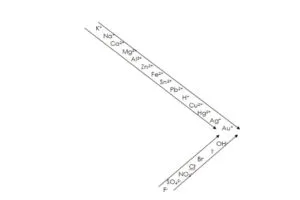
Cations
When all other factors are constant, a cation (an ion that moves to the cathode) which is lowest in the series (less electropositive) will be discharged in preference to one higher up (more electropositive). The less electropositive ion gains electron(s) more readily from the cathode, so it is reduced and discharged as a neutral atom. The more electropositive ion remains in the solution as a positive ion.
NOTE: K+, Na+ and Ca2+ are never discharged from aqueous solution, because of the large gap between them and H+. However, K+, Na+ and Ca2+ are discharged during the electrolysis of their molten salts.
Anions
An anion which is higher up in the series (less electronegative) is discharged in preference to one lower down the series (more electronegative). This is because the less electronegative ion loses electron(s) more readily than the more electronegative ion.
NOTE: F–, SO42- and NO3– are never discharged from aqueous solution, because of the large gap between them and OH–.
How does the concentration of ions affect discharge?
When the concentration of an ion in the electrolyte is increased, the ion is more likely to be discharged. The influence of concentration is effective only when the two competing ions are closely positioned in the electrochemical series. The effect of concentration becomes less important as the positions of the competing ions become further apart in the series.
How does the nature of the electrodes affect discharge?
Inert electrodes
Inert electrodes (for example platinum and graphite) do not take part in the electrolytic reactions. However, platinum is attacked by liberated chlorine and graphite is attacked by liberated oxygen.
Electrodes that influence discharge
Some electrodes have a strong affinity for certain ions and influence the discharge of those ions. For example, in the electrolysis of aqueous NaCl using a mercury cathode, Na+ is discharged at the cathode to form sodium amalgam, Na/Hg:
Na+(aq) + Hg(l) + e– → Na/Hg(l)
Also, in the electrolysis of CuSO4 solution using a copper anode, neither SO42- nor OH– is discharged. Instead, the Cu atoms lose electrons more readily and go into solution as Cu2+. For this reason, the copper anode is known as a reactive electrode.
Evaluation
- State the three factors that affect the preferential discharge of ions.
- Why are K+, Na+ and Ca2+ not discharged from aqueous solution?
- When does the concentration of an ion influence which ion is discharged?
- What is a reactive electrode? Give one example.
Assignment
- Explain what happens at the cathode when aqueous NaCl is electrolysed using a mercury cathode. Write the equation.
- Explain what happens at the anode when CuSO4 solution is electrolysed using a copper anode.
This term's Chemistry topics
SS2 First Term · 8 topics
- Periodic Table
- Families of Elements
- Families of Elements II: Transition & Rare Earth Elements
- Oxidation and Reduction Reaction
- Electrolysis
- Electrolysis II: Factors Affecting Preferential Discharge of Ions
- Electrolysis III: Faraday’s Laws of Electrolysis
- Electrochemical Cells
Get Chemistry as PDF and Word
Every week of SS2 Chemistry, First Term, formatted and ready to print. Ad-free, and the copy lock comes off.
Get this term Card, bank transfer, USSD or OPay
First Term Chemistry Lesson Notes for Other Topics

Periodic Table
Read the full lesson note.

Families Of Elements
Read the full lesson note.

Families Of Elements II - Transition & Rare Earth Elements
Read the full lesson note.

Oxidation And Reduction Reaction
Read the full lesson note.

Electrolysis
Read the full lesson note.

Electrolysis III - Faraday's Laws of Electrolysis
Read the full lesson note.

Electrochemical Cells
Read the full lesson note.

Symbols, Formula And Equations II
Read the full lesson note.

Chemical Combinations
Read the full lesson note.

Symbols, Formula And Equations
Read the full lesson note.

Particulate Nature Of Matter
Read the full lesson note.

Introduction To Chemistry I
Read the full lesson note.

Alloys
Read the full lesson note.

Alkanoic Acids/Carboxylic Acid
Read the full lesson note.

Fats And Oils
Read the full lesson note.
Lesson Notes for Other Classes

Basic 1 Lesson Note
The complete lesson note to guide your studies.

Basic 2 Lesson Note
The complete lesson note to guide your studies.

Basic 3 Lesson Note
The complete lesson note to guide your studies.

Basic 4 Lesson Note
The complete lesson note to guide your studies.

Basic 5 Lesson Note
The complete lesson note to guide your studies.

Basic 6 Lesson Note
The complete lesson note to guide your studies.