
Families of Elements – SS2 Chemistry Lesson Note (First Term)
Download this term · ₦1,000Lesson note at a glance
- Subject
- Chemistry
- Class
- SS2
- Term
- First Term
- Topic
- Families of Elements
- Order
- Topic 2 of 8 this term
- Reading time
- 6 min
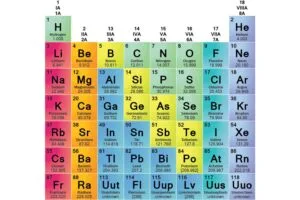
A family of elements is a group in the periodic table whose atoms have the same number of valence electrons and so show similar properties.
Behavioural objectives
By the end of the lesson, students should be able to:
- explain why elements in the same group are called a family;
- define group trend;
- name the elements in Groups I to VII and Group 0;
- state the main properties of each group;
- write equations for some reactions of the group elements and their oxides.
Why are elements in the same group called a family?
Elements in a group are called a family because their atoms have the same number of valence electrons.
- Same valence electrons: the group number tells the number of outer-shell electrons (Group 0 has 8, except helium, which has 2).
- Similar properties: the same outer-shell arrangement gives the same type of reactions.
- Example: lithium, sodium and potassium each have one valence electron, so all react with water to give an alkali.
What is a group trend?
A group trend is a gradual change in a property of elements as atomic number increases down a group.
- Atomic size: atoms get larger down a group because more electron shells are added.
- Metallic character: it increases down a group, as seen in Group IV, where carbon is a non-metal and lead is a metal.
- Reactivity of metals: it increases down Groups I and II.
- Reactivity of non-metals: it decreases down Group VII.
- Physical state: it changes down a group, as seen in the halogens (gas, liquid, solid).
What are the elements in Groups I to VII and Group 0?
The table below names the elements in each group and gives the valence electrons.
| Group | Valence electrons | Elements |
|---|---|---|
| I | 1 | Li, Na, K, Rb, Cs, Fr |
| II | 2 | Be, Mg, Ca, Sr, Ba, Ra |
| III | 3 | B, Al, Ga, In, Tl |
| IV | 4 | C, Si, Ge, Sn, Pb |
| V | 5 | N, P, As, Sb, Bi |
| VI | 6 | O, S, Se, Te, Po |
| VII | 7 | F, Cl, Br, I, At |
| 0 | 8 (helium has 2) | He, Ne, Ar, Kr, Xe, Rn |
What are the Group I elements?
The Group I elements are lithium (Li), sodium (Na), potassium (K), rubidium (Rb), caesium (Cs) and francium (Fr), known as the alkali metals.
- Valency: they are univalent, each having one valence electron.
- Reducing agents: they readily donate one electron to form a cation.
- Metals: they are good conductors of electricity and heat.
- Reaction with water: they react vigorously with cold water to liberate hydrogen and form an alkali, hence the name alkali metals.
2Na(s) + 2H2O(l) → 2NaOH(aq) + H2(g) - Oxides: they dissolve in water to give very strong alkalis.
K2O(s) + H2O(l) → 2KOH(aq) - Trend: reactivity increases down the group.
What are the Group II elements?
The Group II elements are beryllium (Be), magnesium (Mg), calcium (Ca), strontium (Sr), barium (Ba) and radium (Ra), known as the alkaline earth metals.
- Valency: they are divalent, each having two valence electrons.
- Reducing agents: they ionise by donating two valence electrons.
- Metals: they are hard, ductile and malleable, and they conduct electricity and heat.
- Reaction with water: beryllium does not react with cold water or steam, magnesium reacts with steam only, and calcium reacts slowly with cold water to liberate hydrogen.
- Oxides: the oxides of beryllium and magnesium are insoluble in water, while calcium oxide dissolves to form an alkali.
CaO(s) + H2O(l) → Ca(OH)2(aq)
What are the Group III elements?
The Group III elements are boron (B), aluminium (Al), gallium (Ga), indium (In) and thallium (Tl), and they are trivalent.
- Reducing agents: they can donate their three valence electrons, as aluminium does to form electrovalent compounds.
- Reaction with steam: only aluminium reacts with steam, when heated, to liberate hydrogen.
- Amphoteric oxide: aluminium oxide reacts with both acids and alkalis, so it has acidic and basic properties.
Al2O3(s) + 3H2SO4(aq) → Al2(SO4)3(aq) + 3H2O(l) - Amphoteric hydroxide: aluminium hydroxide reacts with both acids and alkalis.
Al(OH)3(s) + NaOH(aq) → NaAl(OH)4(aq)
Al(OH)3(s) + 3HCl(aq) → AlCl3(aq) + 3H2O(l)
What are the Group IV elements?
The Group IV elements are carbon (C), silicon (Si), germanium (Ge), tin (Sn) and lead (Pb), each with four valence electrons.
- Bonding: they form covalent compounds.
- Oxidation states: they show +2 and +4.
- Inert pair effect: the s-electrons of the valence shell resist bonding, so +2 becomes more prominent down the group.
- Electropositivity: it increases down the group.
- Type of element: carbon is a non-metal, silicon and germanium are metalloids, and tin and lead are metals.
- Reaction with water: carbon does not react with cold water, but silicon and tin react with steam at red heat to form +4 oxides and hydrogen.
Si(s) + 2H2O(g) → SiO2(s) + 2H2(g)
Sn(s) + 2H2O(g) → SnO2(s) + 2H2(g)
What are the Group V elements?
The Group V elements are nitrogen (N), phosphorus (P), arsenic (As), antimony (Sb) and bismuth (Bi), each with five valence electrons.
- Oxidation states: they show -3 and +5.
- Group trend: nitrogen and phosphorus are non-metals, arsenic and antimony are metalloids, and bismuth is a metal.
- Oxidising nature: they are electron acceptors.
- Oxides: many dissolve in water to form acids, except nitrogen(I) oxide.
N2O5(s) + H2O(l) → 2HNO3(aq)
What are the Group VI elements?
The Group VI elements are oxygen (O), sulphur (S), selenium (Se), tellurium (Te) and polonium (Po), each with six valence electrons.
- Type of element: oxygen and sulphur are non-metals, selenium and tellurium are metalloids, and polonium is a metal.
- Physical state: all are solids at room temperature, except oxygen, which is a gas.
- Oxidising nature: they are electron acceptors, and they gain two electrons to form ions such as O2- and S2-.
- Reaction with water: they do not react with water.
- Reaction with hydrogen: oxygen and sulphur combine directly with hydrogen to give water and hydrogen sulphide respectively.
What are the Group VII elements?
The Group VII elements are fluorine (F), chlorine (Cl), bromine (Br), iodine (I) and astatine (At), known as the halogens (salt-makers).
- Ions: they gain one electron to form univalent anions.
- Molecules: they exist as diatomic molecules, such as Cl2 and Br2.
- Oxidising agents: all halogens are electron acceptors.
- Physical state: fluorine and chlorine are gases, bromine is a liquid, and iodine and astatine are solids at room temperature.
- Trend: reactivity decreases down the group, so fluorine is the most reactive.
What are the Group 0 elements?
The Group 0 elements are helium (He), neon (Ne), argon (Ar), krypton (Kr), xenon (Xe) and radon (Rn), known as the noble or rare gases.
- Non-reactive: they do not readily form compounds.
- Stable outer shell: helium has two valence electrons and the others have eight.
- Monatomic: each exists freely as single atoms in the atmosphere.
- Uses: helium fills balloons, neon is used in signs and argon fills electric bulbs.
Evaluation
- Why are elements in the same group said to belong to a family?
- What is a group trend?
- Why are the Group I elements called alkali metals?
- State the oxidation states shown by the Group IV elements and say which becomes more prominent down the group.
- Describe the physical state of the halogens at room temperature.
Assignment
Answer all parts in your notebook:
- Write the equation for the reaction of sodium with cold water.
- Explain why the oxide and hydroxide of aluminium are described as amphoteric.
- List the elements in Group 0 and give two reasons why they are called noble gases.
This term's Chemistry topics
SS2 First Term · 8 topics
Get Chemistry as PDF and Word
Every week of SS2 Chemistry, First Term, formatted and ready to print. Ad-free, and the copy lock comes off.
Get this term Card, bank transfer, USSD or OPay
SS2 Chemistry Lesson Notes for Other Topics

Periodic Table
Read the full lesson note.

Families Of Elements II - Transition & Rare Earth Elements
Read the full lesson note.

Oxidation And Reduction Reaction
Read the full lesson note.

Electrolysis
Read the full lesson note.

Electrolysis II - Factors Affecting Preferential Discharge of Ions
Read the full lesson note.
Electrolysis III - Faraday's Laws of Electrolysis
Read the full lesson note.
Electrochemical Cells
Read the full lesson note.
Chemical Reactions
Read the full lesson note.

Energy, Energy Changes and Biotechnology
Read the full lesson note.
Thermodynamics
Read the full lesson note.

Chemical Equilibruim
Read the full lesson note.

Non Metals: Hydrogen
Read the full lesson note.
Non Metals: Oxgyen
Read the full lesson note.
Halogens
Read the full lesson note.
Nitrogens
Read the full lesson note.
Lesson Notes for Other Classes

SS1 Lesson Note
The complete lesson note to guide your studies.

SS3 Lesson Note
The complete lesson note to guide your studies.
