
Electrolysis III: Faraday’s Laws of Electrolysis – SS2 Chemistry Lesson Note (First Term)
Download this term · ₦1,000Lesson note at a glance
- Subject
- Chemistry
- Class
- SS2
- Term
- First Term
- Topic
- Electrolysis III: Faraday’s Laws of Electrolysis
- Order
- Topic 7 of 8 this term
- Reading time
- 5 min
Faraday’s laws of electrolysis state how the amount of substance discharged at an electrode depends on the quantity of electricity passed.
Behavioural objectives
By the end of the lesson, students should be able to:
- State Faraday’s first and second laws of electrolysis.
- Write the mathematical expression for the first law and give the unit of each quantity.
- Describe experiments that verify both laws.
- Solve simple calculations on the electrochemical equivalent and the Faraday.
- List the industrial applications of electrolysis and state the objectives of electroplating.
What is Faraday’s first law of electrolysis?
Faraday’s first law states that the mass (m) of an element discharged during electrolysis is directly proportional to the quantity of electricity (Q) passed.
- Step 1: m is directly proportional to Q.
- Step 2: Since Q = It, m is directly proportional to It.
- Step 3: m = EIt, or m = EQ.
- E: the constant of proportionality, called the electrochemical equivalent of the substance.
What is the electrochemical equivalent?
The electrochemical equivalent (E) is the mass of a substance discharged by one coulomb of electricity.
- Meaning: a large E means more mass is deposited for the same charge.
- Formula: E = m / (It) = m / Q.
What are the units of the quantities?
| Quantity | Symbol | Unit |
|---|---|---|
| Mass discharged | m | gram (g) |
| Current | I | ampere (A) |
| Time | t | second (s) |
| Quantity of electricity | Q | coulomb (C) |
| Electrochemical equivalent | E | g A-1 s-1 or g C-1 |
How can the first law be used to compare two experiments?
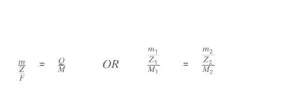
For the same electrolytic process run at different times, the masses and charges are in the same ratio.
- m1/Q1 = m2/Q2
- m1/(I1t1) = m2/(I2t2)
How is the first law verified?
The first law is verified by showing that the mass of copper deposited is directly proportional to current and to time.

- Weigh the copper cathode at the start.
- Pass a steady current of 1 A for 10 minutes, then switch off.
- Weigh the cathode again to find the gain in mass.
- Repeat with different time intervals.
- Plot gain in mass against time. The graph is a straight line through the origin.
- Repeat with different currents for a fixed time.
- Plot gain in mass against current. This graph is also a straight line through the origin.
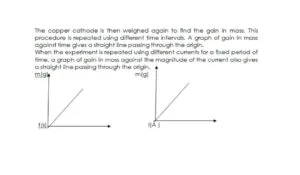
- Conclusion: mass deposited is directly proportional to current and to time, so m is directly proportional to It.
What is Faraday’s second law of electrolysis?
Faraday’s second law states that when the same quantity of electricity passes through different electrolytes, the relative number of moles of elements discharged is inversely proportional to the charges on their ions.
- Meaning: the higher the charge on the ion, the fewer moles are discharged by the same charge.
- Reason: each ion needs more electrons to be discharged when its charge is higher.
What is the Faraday?
The Faraday (F) is the quantity of electricity needed to liberate one mole of a univalent ion, equal to 96500 C.
- Link to electrons: 1 F is the charge of one mole of electrons.
- Number of electrons: one mole of electrons contains Avogadro’s number, 6.02 × 10²³.
- Divalent ions: 2 F discharge 1 mole of ions such as Pb2+, as in M2+ + 2e– → M.
| Ion | Charge | Faradays per mole discharged |
|---|---|---|
| Ag+ | +1 | 1 F |
| Cu2+ | +2 | 2 F |
| Al3+ | +3 | 3 F |
How is the second law verified?
The second law is verified by passing the same current through copper(II) sulphate and silver nitrate solutions in series.
- Set up one cell with copper electrodes in CuSO4 solution.
- Set up a second cell with silver electrodes in AgNO3 solution.
- Weigh the copper and silver cathodes.
- Pass a steady current of 1 A for about 15 minutes, then switch off.
- Weigh each cathode again to find the gain in mass.
- Convert each gain in mass to moles.
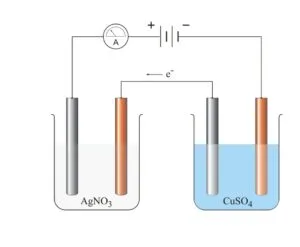
- Result: if Y moles of copper are deposited, 2Y moles of silver are deposited.
- Charges: Cu2+ is +2 and Ag+ is +1.
- Conclusion: moles deposited are inversely proportional to the charge on the ions.
What is the difference between the two laws?
The first law links mass to charge for one substance. The second law compares moles of different substances for the same charge.
| Point | First law | Second law |
|---|---|---|
| Compares | Mass and quantity of electricity | Moles of different elements |
| Relationship | Directly proportional | Inversely proportional to ionic charge |
| Expression | m = EIt | Moles discharged ∝ 1 / charge on ion |
How do we calculate with Faraday’s laws?
Calculations use m = EIt, with time converted to seconds and Q = It in coulombs.
Example 1: finding the electrochemical equivalent
Question: Calculate the electrochemical equivalent of a metal M if 5 A passed for 1 hour deposits 2 g of M.
- m = 2 g, I = 5 A, t = 1 hr = 60 × 60 = 3600 s.
- m = EIt, so 2 = E × 5 × 3600.
- E = 2 / 18000 = 1.11 × 10⁻⁴ g A-1 s-1.
Example 2: finding mass using the Faraday
Question: Find the mass of copper deposited by 2 A passed for 30 minutes (Cu = 63.5, 1 F = 96500 C).
- Q = It = 2 × (30 × 60) = 3600 C.
- Cu2+ + 2e– → Cu, so 2 × 96500 = 193000 C deposit 63.5 g.
- Mass = (3600 / 193000) × 63.5 = 1.18 g (to 3 significant figures).
What are the applications of electrolysis?
Electrolysis is used in industry to extract, purify and plate metals and to make compounds.
- Extraction of elements: Na, K, Mg, Ca, Al, Zn and non-metals such as H2, F2 and Cl2 are obtained from ores, fused compounds or aqueous solutions.
- Purification of metals: metals such as Cu, Hg, Ag and Au are refined.
- Electroplating: one metal is coated with another.
- Preparation of compounds: examples are sodium hydroxide and sodium trioxochlorate (V).
What is electroplating?
Electroplating is the coating of the surface of one metal with another metal by electrolysis.
- Metals used for plating: usually copper, silver, chromium, nickel or gold.
- Objective 1, decoration: plating makes an article look attractive.
- Objective 2, protection: plating guards the base metal against corrosion.
- Articles plated: cutlery, jewellery and iron or steel objects such as metallic parts of motor cars.

Evaluation
- State Faraday’s first law of electrolysis and write its mathematical expression.
- What is one Faraday? How many Faradays are needed to discharge 1 mole of Pb2+ ions?
- Describe how you would verify Faraday’s first law using a copper cathode.
- State the two main objectives of electroplating.
- Name two compounds prepared by electrolysis.
Assignment
In your notebook, answer all three parts: (a) state Faraday’s second law; (b) explain why, for the same quantity of electricity, the moles of silver deposited are double the moles of copper deposited; (c) list four industrial applications of electrolysis.
This term's Chemistry topics
SS2 First Term · 8 topics
Get Chemistry as PDF and Word
Every week of SS2 Chemistry, First Term, formatted and ready to print. Ad-free, and the copy lock comes off.
Get this term Card, bank transfer, USSD or OPay
SS2 Chemistry Lesson Notes for Other Topics

Periodic Table
Read the full lesson note.

Families Of Elements
Read the full lesson note.

Families Of Elements II - Transition & Rare Earth Elements
Read the full lesson note.

Oxidation And Reduction Reaction
Read the full lesson note.

Electrolysis
Read the full lesson note.

Electrolysis II - Factors Affecting Preferential Discharge of Ions
Read the full lesson note.

Electrochemical Cells
Read the full lesson note.

Chemical Reactions
Read the full lesson note.

Energy, Energy Changes and Biotechnology
Read the full lesson note.

Thermodynamics
Read the full lesson note.

Chemical Equilibruim
Read the full lesson note.

Non Metals: Hydrogen
Read the full lesson note.

Non Metals: Oxgyen
Read the full lesson note.

Halogens
Read the full lesson note.

Nitrogens
Read the full lesson note.
Lesson Notes for Other Classes

SS1 Lesson Note
The complete lesson note to guide your studies.

SS3 Lesson Note
The complete lesson note to guide your studies.
