
Periodic Table – SS2 Chemistry Lesson Note (First Term)
Download this term · ₦1,000Lesson note at a glance
- Subject
- Chemistry
- Class
- SS2
- Term
- First Term
- Topic
- Periodic Table
- Order
- Topic 1 of 8 this term
- Reading time
- 9 min
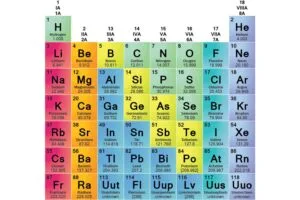
The periodic table is an arrangement of the elements in order of increasing atomic number, which places elements with similar properties in the same group.
Behavioural objectives
By the end of the lesson, students should be able to:
- state the modern periodic law and explain how it differs from Mendeleev’s law;
- state the number of sub-orbitals and the maximum number of electrons in the s, p, d and f orbitals;
- state the Aufbau principle and the order in which orbitals are filled;
- describe how atomic radius, ionic radius, ionisation energy, electron affinity and electronegativity vary across a period and down a group;
- describe how the hydrolysis of chlorides and the metallic character of elements change across the third period.
What is the periodic law?
The modern periodic law states that the properties of the elements are periodic functions of their atomic number.
- Periodic function: a property that repeats at regular intervals as atomic number increases.
- Periodic properties: atomic radius, ionisation energy, electron affinity and electronegativity change in a regular way down a group and across a period.
- Basis of the modern table: the elements are arranged by atomic number.
How was the periodic table developed?
The periodic table developed over about a century, from the early grouping of elements by Lavoisier to Mendeleev’s table of 1869.
Early attempts at classification
| Scientist | Contribution |
|---|---|
| Antoine Lavoisier (French, 1789) | Grouped the elements into gases, metals, non-metals and earth. |
| Döbereiner | Classified elements by their properties, using groups of three called triads. |
| Newlands | Classified elements by their properties, using his law of octaves. |
| Lothar Meyer | Classified elements by their properties, working at about the same time as Mendeleev. |
| Dmitri Mendeleev (Russian, 1869) | Prepared the first widely accepted periodic table, arranged by atomic mass. |
What did Mendeleev’s periodic law state?
Mendeleev’s law states that the properties of the elements vary periodically with their relative atomic masses.
- Arrangement: he placed the elements in increasing order of atomic mass (atomic weight).
- Pattern: elements with similar properties kept recurring at regular intervals, which formed families of related elements.
How does the modern law differ from Mendeleev’s law?
The modern law uses atomic number as the basis of arrangement. Mendeleev’s law used atomic mass.
- Reason for the change: the discovery of the electronic structure of atoms showed that properties follow atomic number more regularly than atomic mass.
| Feature | Mendeleev’s law | Modern periodic law |
|---|---|---|
| Basis of arrangement | Relative atomic mass | Atomic number |
| Statement | Properties are periodic functions of atomic mass. | Properties are periodic functions of atomic number. |
| Year | 1869 | After the discovery of atomic structure |
What are groups and periods?
Groups are the vertical columns of the periodic table, and periods are the horizontal rows.
- Group: a vertical column of elements with the same number of valence electrons and similar properties.
- Period: a horizontal row of elements whose atoms have the same number of occupied shells.
- Third period: the row from sodium (Na) to argon (Ar).
What is electronic configuration?
The electronic configuration of an atom is the arrangement of its electrons among the shells and subshells.
- Use: it is commonly used to describe the orbitals of an atom in its ground state.
- Sodium (Na): 1s2 2s2 2p6 3s1.
- Chlorine (Cl): 1s2 2s2 2p6 3s2 3p5.
What is an atomic orbital?
An orbital is the region of space around the nucleus where there is a high probability of finding an electron.
- Four types: s, p, d and f.
- Capacity: one orbital holds a maximum of two electrons.
- s: one orbital, holding 2 electrons.
- p: three degenerate orbitals, holding 6 electrons.
- d: five sub-orbitals, holding 10 electrons.
- f: seven sub-orbitals, holding 14 electrons.
| Orbital | Number of sub-orbitals | Maximum number of electrons | Shape |
|---|---|---|---|
| s | 1 | 2 | Spherical |
| p | 3 | 6 | Dumbbell |
| d | 5 | 10 | Double dumbbell |
| f | 7 | 14 | Complex |
What rules govern the filling of electrons?
The Aufbau principle states that electrons fill orbitals in order of increasing energy.
- Aufbau principle: the orbital with the lowest energy is filled first.
- Pauli exclusion principle: an orbital holds at most two electrons, and they must spin in opposite directions.
- Hund’s rule: electrons occupy separate orbitals of the same energy singly before they pair up.
The order of filling is:
- 1s
- 2s
- 2p
- 3s
- 3p
- 4s
- 3d
- 4p, and so on (5s, 4d, 5p, 6s, 4f, 5d, 6p).
What are periodic properties?
Periodic properties are properties of atoms that change in a regular way down a group and across a period.
- Why size is hard to define: the electrons form a cloud with no sharp edge, so atomic size has to be measured in a stated situation.
- Properties covered: atomic radius, ionic radius, ionisation energy, electron affinity and electronegativity.
What is atomic radius?
Atomic radius is the distance of closest approach to another identical atom in a given bonding situation.
- Covalent radius: half the distance between the nuclei of two identical atoms that are chemically bonded.
- Van der Waals radius: half the distance between the nuclei of two identical atoms that are close but not bonded.
For both types, two variations are noticeable:
- The atomic radius increases down a group.
- The atomic radius decreases across a period.
Why does atomic radius increase down a group?
- The number of valence electrons stays the same.
- Each new period adds a shell, so the atom gets larger despite the rise in nuclear charge.
- Examples: potassium is larger than sodium, and caesium is larger than rubidium.
Why does atomic radius decrease across a period?
- Electrons are added to orbitals in the same shell, so all valence electrons are at the same energy level.
- The nuclear charge increases with atomic number.
- The nucleus attracts the electrons more strongly.
- The electron cloud contracts and the atom becomes smaller.
What is ionic radius?
Ionic radius is the size of an ion, which differs from the size of its parent atom.
- Cation (positive ion): smaller than its parent metal atom, because the electrons are pulled in by a greater effective nuclear charge.
- Anion (negative ion): bigger than its parent non-metal atom, because the effective nuclear charge on each electron is reduced.
- Across the third period: cationic radii decrease from sodium to aluminium.
- Across the third period: anionic radii decrease from phosphorus to chlorine.
What is ionisation energy?
The first ionisation energy is the energy needed to remove one mole of electrons from one mole of gaseous atoms.
- Ionisation: a gaseous atom loses an outer electron and becomes positively charged, for example K(g) → K+(g) + e–.
- Other name: ionisation potential.
- Unit: kilojoules per mole (kJ mol-1).
- Across a period: the first ionisation energy generally increases, and the noble gas has the highest value.
- Down a group: the first ionisation energy decreases.
First ionisation energies of alkali metals (approximate values)
| Element | Li | Na | K | Rb | Cs |
|---|---|---|---|---|---|
| First ionisation energy (kJ mol-1) | 520 | 500 | 420 | 400 | 380 |
First ionisation energies of the elements in the third period
| Element | Na | Mg | Al | Si | P | S | Cl | Ar |
|---|---|---|---|---|---|---|---|---|
| First ionisation energy (kJ mol-1) | 496 | 737 | 577 | 786 | 1012 | 999 | 1255 | 1520 |
- Dip at aluminium: the outer electron is in a 3p orbital, which has slightly higher energy than 3s, so it is easier to remove.
- Dip at sulphur: two electrons share one 3p orbital and repel each other, so one is easier to remove.
What factors affect ionisation energy?
- The distance of the outermost electrons from the nucleus.
- The size of the positive (effective) nuclear charge.
- The screening effect of the inner electrons.
Why does ionisation energy increase across a period?
- The nuclear charge increases across the period.
- The atomic radius decreases, so the outer electrons are closer to the nucleus.
- The screening effect stays almost the same.
Why does ionisation energy decrease down a group?
- The outer electrons are farther from the nucleus.
- The inner shells screen them from the nuclear charge.
- The nuclear attraction on the outermost electron is therefore weaker.
What is electron affinity?
Electron affinity is the energy released when an electron is added to a gaseous atom in its lowest energy state.
- Unit: kJ mol-1 or electron volts (eV).
- Across a period: it increases from left to right.
- Down a group: it decreases.
- Group 1 (alkali metals): the least tendency to add electrons to neutral atoms.
- Groups VI and VII: the greatest tendency to accept electrons.
- Noble gases (group 8 or 0): they have a stable electronic configuration.
What is electronegativity?
Electronegativity is the power of an atom in a molecule to attract a shared pair of electrons.
- Where it shows most: in heteronuclear molecules, where two different atoms share one or more pairs of electrons.
- Across a period: it increases from left to right, because nuclear charge rises and atomic size falls.
- Down a group: it decreases, because atomic size and the screening effect of inner shells weaken the pull on shared electrons.
- Fluorine: a halogen with the highest electronegativity, due to its strong affinity for electrons.
- Noble gases: they have no electronegativity values, because their shells are complete.
What is the summary of the trends?
| Property | Across a period (left to right) | Down a group |
|---|---|---|
| Atomic radius | Decreases | Increases |
| First ionisation energy | Increases | Decreases |
| Electron affinity | Increases | Decreases |
| Electronegativity | Increases | Decreases |
| Metallic character | Decreases | Increases |
How do properties change across the third period (Na to Ar)?
Properties change gradually from sodium to argon, both in the elements and in their compounds.
How does the hydrolysis of the chlorides change?
Hydrolysis is the reaction of a compound with water, and the chlorides of the third period are hydrolysed to different extents.
| Chloride | Behaviour in water |
|---|---|
| Sodium chloride | Not hydrolysed in aqueous solution. |
| Magnesium chloride | Not hydrolysed in solution. Its hydrated crystals hydrolyse on heating, giving off HCl and leaving a basic salt. |
| Aluminium chloride | Appreciable hydrolysis. The solution turns blue litmus red. |
| Chlorides of silicon, phosphorus and sulphur | Hydrolysed completely in water. |
How does metallic character change?
Metallic character decreases from left to right across a period of representative elements.
- Tendency to lose electrons: decreases.
- Non-metallic character: the tendency to gain electrons increases.
- Ionic property: decreases.
- Covalent property: increases.
Evaluation
- State the modern periodic law.
- Define the first ionisation energy of an element.
- Explain why atomic radius decreases across a period.
- Why does the first ionisation energy decrease down a group?
- State the maximum number of electrons that the s, p, d and f orbitals can hold.
Assignment
Explain the term electron affinity, discuss how it varies across a period and down a group, and list three periodic properties that generally increase across a period.
This term's Chemistry topics
SS2 First Term · 8 topics
Get Chemistry as PDF and Word
Every week of SS2 Chemistry, First Term, formatted and ready to print. Ad-free, and the copy lock comes off.
Get this term Card, bank transfer, USSD or OPay
SS2 Chemistry Lesson Notes for Other Topics

Families Of Elements
Read the full lesson note.

Families Of Elements II - Transition & Rare Earth Elements
Read the full lesson note.

Oxidation And Reduction Reaction
Read the full lesson note.

Electrolysis
Read the full lesson note.

Electrolysis II - Factors Affecting Preferential Discharge of Ions
Read the full lesson note.

Electrolysis III - Faraday's Laws of Electrolysis
Read the full lesson note.

Electrochemical Cells
Read the full lesson note.
Chemical Reactions
Read the full lesson note.

Energy, Energy Changes and Biotechnology
Read the full lesson note.

Thermodynamics
Read the full lesson note.

Chemical Equilibruim
Read the full lesson note.

Non Metals: Hydrogen
Read the full lesson note.

Non Metals: Oxgyen
Read the full lesson note.

Halogens
Read the full lesson note.

Nitrogens
Read the full lesson note.
Lesson Notes for Other Classes

SS1 Lesson Note
The complete lesson note to guide your studies.

SS3 Lesson Note
The complete lesson note to guide your studies.
