
Electrochemical Cells – SS2 Chemistry Lesson Note (First Term)
Download this term · ₦1,000Lesson note at a glance
- Subject
- Chemistry
- Class
- SS2
- Term
- First Term
- Topic
- Electrochemical Cells
- Order
- Topic 8 of 8 this term
- Reading time
- 6 min
An electrochemical cell is a device that converts chemical energy to electrical energy.
Behavioural objectives
By the end of the lesson, students should be able to:
- state the difference between an electrolytic cell and an electrochemical cell;
- write a cell diagram using conventional notation;
- state the functions of a salt bridge;
- explain electrode potential and standard electrode potential;
- calculate the e.m.f. of a cell from standard electrode potentials.
What are electrolytic and electrochemical cells?
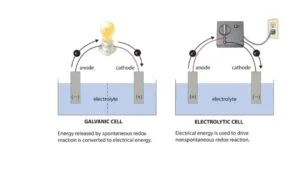
An electrochemical cell converts chemical energy to electrical energy, while an electrolytic cell converts electrical energy to chemical energy.
What is an electrochemical cell?
An electrochemical cell, also called a galvanic cell, produces electricity from a spontaneous chemical reaction.
- Two half-cells: an oxidation half-cell (anode) and a complementary reduction half-cell (cathode).
- Two electrodes: an anode and a cathode, each dipped in its own electrolyte.
- A link: a salt bridge or porous partition joins the two half-cells.
- Example: the zinc/copper cell, which gives about 1.10 V under standard conditions.
What is an electrolytic cell?
An electrolytic cell uses electrical energy from an outside source to force a chemical change.
- Energy source: a battery or other direct current supply pushes the electrons.
- Examples of use: electroplating, purifying copper and extracting aluminium.
What are the differences between an electrolytic cell and an electrochemical cell?
| SN | Electrolytic cell | Electrochemical cell |
|---|---|---|
| 1 | Electrical energy is converted to chemical energy. | Chemical energy is converted to electrical energy. |
| 2 | The cathode is the negative electrode while the anode is the positive electrode. | The cathode is the positive electrode while the anode is the negative electrode. |
| 3 | No salt bridge is required. | A salt bridge or porous partition is required. |
| 4 | The electrolyte may not contain ions of the metal electrode used. | The electrolyte usually contains ions of the metal electrode used. |
| 5 | Electrons are pushed by an external source, such as a battery. | Electrons are generated by oxidation at the anode. |
How do you draw and write cell diagrams?
A cell diagram is a short notation that describes an electrochemical cell without drawing it.
- Half-cell: an element (metal) in contact with its ions.
- Metal electrode symbol: M(s)/Mn+(aq) or Mn+(aq)/M(s), for a metal dipped into a solution of its ions.
- General example: X/X+//Y+/Y.
- Single line (/): the boundary (interphase) between the metal and its ion solution.
- Double line (//): the salt bridge or porous partition.
- Specific example: Zn(s)/Zn2+(aq)//Cu2+(aq)/Cu(s).
In which direction do electrons flow?
- Direction: electrons flow through the external wire from the anode (negative electrode) to the cathode (positive electrode).
- Condition for electricity: the anode element must be more reactive than the cathode element.
- Electrochemical series: the anode element must be higher in the series than the cathode element.
What is a salt bridge?
A salt bridge is a filter paper soaked in a salt solution that links two half-cells.
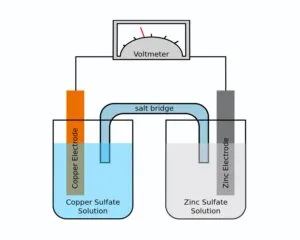
- Purpose: it replaces a porous partition and keeps the electrolytes electrically neutral.
- Common salts: sodium chloride solution, KCl or NH4NO3.
- Without it: the circuit is incomplete and the cell stops producing current.
What are the functions of a salt bridge?
- It helps to complete the electric circuit.
- It lets ions migrate from one half-cell to the other, to maintain electrical neutrality in the solutions when current flows.
What is electrode potential?
Electrode potential is the potential difference set up between a metallic electrode and its electrolyte.
What is the copper ion/copper system?
- Setup: a copper plate dipped into CuSO4 solution.
- Net reaction: Cu2+(aq) + 2e– ⇌ Cu(s).
- Written as: Cu2+(aq)/Cu(s).
What is the zinc ion/zinc system?
- Setup: a zinc plate dipped into ZnSO4 solution.
- Net reaction: Zn2+(aq) + 2e– ⇌ Zn(s).
- Written as: Zn2+(aq)/Zn(s).
What is standard electrode potential?
Standard electrode potential (E°) is the electrode potential of a metal ion/metal system measured under standard conditions against the standard hydrogen electrode.
What does the electrode potential of a system depend on?
- the overall energy change of the half-reaction (the nature of the metal)
- the concentration of ions in the solution
- the temperature
How is standard electrode potential measured?
- Purpose: E° lets us compare the electrode potentials of different metal ion/metal systems.
- Method: find the difference, in volts, between the metallic electrode and the standard hydrogen electrode.
- Reference value: the standard hydrogen electrode is given an arbitrary value of zero.
- Standard conditions: ion concentration of 1 mol/dm3, temperature of 298 K and 1 atmosphere pressure for gases.
| Half-cell | E° (volts) |
|---|---|
| Zn2+(aq)/Zn(s) | -0.76 |
| H+(aq)/H2(g) (standard hydrogen electrode) | 0.00 |
| Cu2+(aq)/Cu(s) | +0.34 |
How is the e.m.f. of a cell calculated?
The e.m.f. of a cell is the algebraic difference between the electrode potentials of its two half-cells.
What are the steps for calculating e.m.f.?
- Write the cell diagram with the left-hand and right-hand electrodes.
- Write down the standard electrode potential of each electrode.
- Subtract: E°cell = E°R – E°L.
- State the sign of the answer and what it means.
Worked example: the Zn/Cu cell
- Cell diagram: Zn(s)/Zn2+(aq)//Cu2+(aq)/Cu(s).
- Right-hand electrode: E°R = +0.34 V (copper).
- Left-hand electrode: E°L = -0.76 V (zinc).
- Anode reaction (oxidation): Zn(s) → Zn2+(aq) + 2e–.
- Cathode reaction (reduction): Cu2+(aq) + 2e– → Cu(s).
- Overall reaction: Zn(s) + Cu2+(aq) → Zn2+(aq) + Cu(s).
- Calculation: Etotal = E°R – E°L = +0.34 – (-0.76) = +1.10 V.
What does the sign of the e.m.f. mean?
- Positive e.m.f.: the reaction is thermodynamically feasible as written, from left to right.
- Negative e.m.f.: the reaction is thermodynamically impossible as written.
Where are electrochemical cells used?
Electrochemical cells are the source of the portable electricity in batteries.
- Dry (Leclanché) cell: used in torches, radios and remote controls.
- Lead-acid accumulator: used in vehicles and for inverter backup.
Evaluation
- Define an electrolytic cell and an electrochemical cell.
- State two differences between an electrolytic cell and an electrochemical cell.
- State two functions of a salt bridge.
- What do the single line (/) and the double line (//) represent in a cell diagram?
- State the three factors on which the electrode potential of a system depends.
Assignment
Answer these three parts on the cell Zn(s)/Zn2+(aq)//Cu2+(aq)/Cu(s).
- Explain why the anode element must be more reactive than the cathode element for an electrochemical cell to produce electricity.
- Given that E° of the copper electrode is +0.34 V and E° of the zinc electrode is -0.76 V, calculate the e.m.f. of the cell.
- State what a positive e.m.f. and a negative e.m.f. indicate about a cell reaction.
This term's Chemistry topics
SS2 First Term · 8 topics
Get Chemistry as PDF and Word
Every week of SS2 Chemistry, First Term, formatted and ready to print. Ad-free, and the copy lock comes off.
Get this term Card, bank transfer, USSD or OPay
SS2 Chemistry Lesson Notes for Other Topics

Periodic Table
Read the full lesson note.

Families Of Elements
Read the full lesson note.

Families Of Elements II - Transition & Rare Earth Elements
Read the full lesson note.

Oxidation And Reduction Reaction
Read the full lesson note.

Electrolysis
Read the full lesson note.

Electrolysis II - Factors Affecting Preferential Discharge of Ions
Read the full lesson note.

Electrolysis III - Faraday's Laws of Electrolysis
Read the full lesson note.

Chemical Reactions
Read the full lesson note.

Energy, Energy Changes and Biotechnology
Read the full lesson note.

Thermodynamics
Read the full lesson note.

Chemical Equilibruim
Read the full lesson note.

Non Metals: Hydrogen
Read the full lesson note.

Non Metals: Oxgyen
Read the full lesson note.

Halogens
Read the full lesson note.

Nitrogens
Read the full lesson note.
Lesson Notes for Other Classes

SS1 Lesson Note
The complete lesson note to guide your studies.

SS3 Lesson Note
The complete lesson note to guide your studies.
