
Receipt and Payment Account – SS2 Book Keeping Lesson Note (Third Term)
Download this term · ₦1,000Lesson note at a glance
- Subject
- Book Keeping
- Class
- SS2
- Term
- Third Term
- Topic
- Receipt and Payment Account
- Order
- Topic 3 of 5 this term
- Reading time
- 6 min
A receipt and payment account is a classified summary of the cash book of a not-for-profit organisation, showing all cash and bank receipts and payments in a period.
- Basis: it is kept on a cash basis, not on the accrual basis.
- Content: it records receipts and payments of capital and revenue nature.
- Time: it includes cash settled in the period, whether it relates to the current, previous or next year.
- Grouping: items are grouped under suitable account heads.
Behavioural objectives
By the end of the lesson, students should be able to:
- define a receipt and payment account;
- state the features of a receipt and payment account;
- list the steps in preparing a receipt and payment account;
- state the differences between a receipt and payment account and a cash book;
- prepare a simple receipt and payment account from given information.
What is a not-for-profit organisation?
A not-for-profit organisation is a body formed to provide service to its members or the public, not to make profit.
- Social clubs: members pay subscriptions to enjoy facilities.
- Religious bodies: churches and mosques depend on offerings and donations.
- Professional associations: members pay entrance fees and annual dues.
- Parent-teacher associations: funds come from levies and donations.
- Community and charity groups: funds come from donations and grants.
How does a receipt and payment account work?
A receipt and payment account records all cash received on the debit side and all cash paid on the credit side.
- Debit side: opening cash balances and all receipts.
- Credit side: all payments and the closing cash balances.
- Opening balances: cash in hand and cash at bank at the start of the period.
- Closing balances: cash in hand and cash at bank at the end of the period.
- Result: the account shows the cash position of the organisation fairly.
What are examples of receipts and payments?
Receipts are cash inflows and payments are cash outflows of the organisation.
| Receipts (debit side) | Payments (credit side) |
|---|---|
| Subscriptions received | Salaries and wages |
| Entrance fees | Printing and stationery |
| Donations | Advertisement |
| Sale of old newspapers | Audit fees |
| Sale of assets | Purchase of furniture |
| Grants | Insurance and taxes |
What are the features of a receipt and payment account?
A receipt and payment account has six main features.
- Nature: it is a real account and a classified summary of cash receipts and payments.
- Basis of recording: all transactions and events settled in cash are recorded on a cash basis.
- Recording of transactions: it records capital and revenue items together, without separating them.
- Period: it is prepared for a specific period, such as a month or a year. It does not separate current, previous or later periods.
- Adjustments: it is not based on the accrual system, so only cash transactions are recorded.
- Purpose: it gives a fair idea of the cash position, showing opening and closing cash in hand and cash at bank.
What are the steps in preparing a receipt and payment account?
There are five steps in preparing a receipt and payment account.
- Write the opening balances of cash in hand and cash at bank on the receipt (debit) side. If there is a bank overdraft at the start, write it on the payment (credit) side.
- Write all cash and bank receipts on the debit side, whether of capital or revenue nature.
- Write all cash and bank payments on the credit side, whether of capital or revenue nature.
- Leave out accrued incomes and outstanding expenses, because they cause no inflow or outflow of cash.
- Compare both sides. Write the difference on the credit side as the closing balance of cash in hand and cash at bank.
What is the format of a receipt and payment account?
The format is a two-sided account with receipts on the debit side and payments on the credit side.
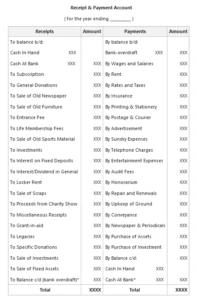
The asterisk (*) shows that cash at bank can be positive or negative.
- Receipts greater than payments: the difference is a positive balance of cash at bank.
- Payments greater than receipts: the difference is a bank overdraft, a negative balance of cash at bank.
What are the limitations of a receipt and payment account?
The account shows only cash movements, so it does not give the full financial position.
- No surplus or deficit: it does not show whether the organisation earned more than it spent.
- No accruals: it ignores accrued incomes and outstanding expenses.
- No assets and liabilities: it does not show the value of assets owned or debts owed.
- Mixed items: capital and revenue items are together, so it is hard to judge the year’s performance.
What is the difference between a receipt and payment account and a cash book?
A receipt and payment account is a summary of cash transactions for a period, prepared by a not-for-profit organisation.
A cash book is the book in which every cash and bank receipt and payment is recorded daily, in date order.
| SN | Basis | Receipt and payment account | Cash book |
|---|---|---|---|
| 1 | Recording | It is a classified summary of the cash book. The transactions and events settled in cash are recorded. | The cash book records each receipt and payment. |
| 2 | Period | It is prepared at the end of the accounting year. | The cash book records transactions daily. |
| 3 | Date | Dates are not recorded. | Transactions are recorded date-wise. |
| 4 | Ledger folio | There is no column for ledger folio. | There is a separate column for ledger folio. |
| 5 | Entity | It is prepared by a non-profit organisation. | The cash book is generally prepared by any commercial organisation. |
| 6 | Format of account | All receipts are written on the debit side and all payments on the credit side. | The cash book has debit and credit sides with date, particulars, cash and bank amount columns, and ledger folio columns. |
How do we prepare a receipt and payment account? (Worked example)
From the following information, prepare a receipt and payment account of Nisha Foundation for the year ended 31st March 2021.
Balance at the beginning of the year:
- Cash in Hand $5,500
- Cash at Bank $24,000
Other information:
- Subscription for the year is $92,000.
- Petty cash payment of $870.
- Sundry expenses:
- Printing and stationery expenses $2,300
- Advertisement expenses $1,700
- Audit fees $10,500
- Purchase of furniture $21,000.
- Sale of old newspaper $1,200.
- Entrance fees received $80,000.
- Donation received from Mr. Rajesh Kumar for building $30,000.
- Insurance paid $37,000.
- Taxes paid by the organisation are $1,400.
The closing balance of Cash in Hand at 31st March 2021 was $7,000. Find the closing balance of Cash at Bank also.
Solution

Working
- Total receipts: 5,500 + 24,000 + 92,000 + 1,200 + 80,000 + 30,000 = $232,700.
- Total payments before closing balances: 870 + 2,300 + 1,700 + 10,500 + 21,000 + 37,000 + 1,400 = $74,770.
- Closing cash in hand: $7,000 (given).
- Closing cash at bank: 232,700 − 74,770 − 7,000 = $150,930.
Evaluation
- Define a receipt and payment account.
- On which side of the account are receipts written, and on which side are payments written?
- State three features of a receipt and payment account.
- Why are accrued incomes and outstanding expenses not included in the account?
- State three differences between a receipt and payment account and a cash book.
Assignment
List the five steps in preparing a receipt and payment account, and explain how a bank overdraft is shown in the account.
This term's Book Keeping topics
SS2 Third Term · 5 topics
Get Book Keeping as PDF and Word
Every week of SS2 Book Keeping, Third Term, formatted and ready to print. Ad-free, and the copy lock comes off.
Get this term Card, bank transfer, USSD or OPay
SS2 Book Keeping Lesson Notes for Other Topics
Single Entry And Incomplete Records
Read the full lesson note.
Account Of Non-Profit Making Organizations
Read the full lesson note.
Income And Expenditure Account
Read the full lesson note.

Basic Concepts Of Marketing
Read the full lesson note.
Bad Debts And Doubtful Debts
Read the full lesson note.

Stock Evalaution
Read the full lesson note.
Control Account
Read the full lesson note.

Entreprenuership Education
Read the full lesson note.

Relational Models
Read the full lesson note.
Lesson Notes for Other Classes

SS1 Lesson Note
The complete lesson note to guide your studies.
SS3 Lesson Note
The complete lesson note to guide your studies.
