
Control Account – SS2 Book Keeping Lesson Note (Second Term)
Download this term · ₦1,000Lesson note at a glance
- Subject
- Book Keeping
- Class
- SS2
- Term
- Second Term
- Topic
- Control Account
- Order
- Topic 3 of 5 this term
- Reading time
- 5 min
A control account is an account which records in total what has been entered in detail in the ledger account to which it relates.
Behavioural objectives
By the end of the lesson, students should be able to:
- define a control account;
- list the ledgers for which control accounts can be kept;
- state the uses of a control account;
- distinguish between the sales ledger control account and the purchases ledger control account;
- determine sales and purchases ledger balances from given figures.
What is a control account?
A control account is a special account that shows the total balance of many related subsidiary accounts.
- Memorandum account: it is kept for checking and does not form part of the double-entry system.
- Totals only: it shows the total of entries, while the ledger shows each customer or supplier separately.
- Check on accuracy: its closing balance should agree with the total of the individual balances in the ledger.
- Source of figures: the totals come from the books of original entry, such as the sales journal, purchases journal and cash book.
Which ledgers have control accounts?
Control accounts can be kept for four ledgers: the sales ledger, the purchases ledger, the inventory ledger and the fixed assets ledger.
| Ledger | Accounts it controls |
|---|---|
| Sales ledger | Customers |
| Bought/purchases ledger | Suppliers |
| Inventory ledger | Stocks |
| Fixed assets ledger | Fixed assets |
What are the uses of a control account?
A control account helps the business check the accuracy of its ledgers and control its debtors and creditors.
- Location of errors: if the control account and the ledger totals disagree, the error is in that ledger.
- Prevention of fraud: a different person keeps the control account, so it is hard to hide theft.
- Aids management control: managers get total debtors and creditors figures quickly.
- Internal check on the ledger clerk: the control account checks the work of the clerk who keeps the ledger.
- Easy detection of missing figures: a missing entry shows up as a difference between the totals.
- Ascertainment of debtors’ and creditors’ balances: the total owed by customers and to suppliers is found without adding every account.
- Preparation of information for final accounts: the totals are used for the statement of financial position.
- Saves time: the totals are checked at once, so each account need not be searched.
- Grouping of accounts: similar accounts are brought together under one total.
What are the types of control account?
There are two main control accounts: the sales ledger control account and the purchases ledger control account.
What is the sales ledger control account?
The sales ledger control account is the control account for the sales (debtors’) ledger.
- Other name: it is sometimes called the total debtors control account.
- Meaning: it shows all the entries posted to the sales ledger as if only one debtor existed.
- Normal balance: a debit balance, because customers owe the business.
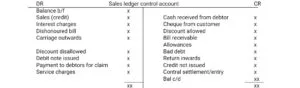
Common items:
| Debit side | Credit side |
|---|---|
| Opening balance of debtors | Cash and cheques received from customers |
| Credit sales (from the sales journal) | Discount allowed |
| Dishonoured cheques | Returns inwards |
| Bad debts written off | |
| Set-off against the purchases ledger | |
| Closing balance carried down |
What is the purchases ledger control account?
The purchases ledger control account is the control account for the purchases (creditors’) ledger.
- Other name: it is referred to as the total creditors control account.
- Meaning: it shows all the entries posted to the purchases ledger as if only one creditor existed.
- Normal balance: a credit balance, because the business owes its suppliers.
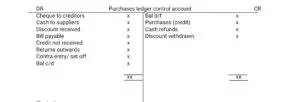
Common items:
| Debit side | Credit side |
|---|---|
| Payments to suppliers | Opening balance of creditors |
| Discount received | Credit purchases (from the purchases journal) |
| Returns outwards | Refunds received from suppliers |
| Set-off against the sales ledger | |
| Closing balance carried down |
What is the difference between the two control accounts?
The sales ledger control account deals with customers who owe the business, while the purchases ledger control account deals with suppliers the business owes.
| Point | Sales ledger control account | Purchases ledger control account |
|---|---|---|
| Other name | Total debtors account | Total creditors account |
| Ledger controlled | Sales ledger | Purchases ledger |
| Opening balance | Debit side | Credit side |
| Credit transactions | Credit sales | Credit purchases |
| Returns | Returns inwards (credit) | Returns outwards (debit) |
| Discount | Discount allowed (credit) | Discount received (debit) |
How do you find ledger balances from control accounts?
You find a closing balance by entering each figure on its correct side and subtracting the smaller total from the larger.
The following balances are extracted from the books of JKO Ltd for June.
| Item | Amount |
|---|---|
| Sales ledger balance, 1 June 19×3 | 47,020 |
| Purchases ledger balance, 1 June 19×3 | 27,570 |
| Purchases journal balance, 30 June 19×3 | 374,370 |
| Sales journal balance, 30 June 19×3 | 408,000 |
| Returns inwards | 9,100 |
| Returns outwards | 7,490 |
| Receipts from customers (cash) | 385,290 |
| Discount allowed | 13,450 |
| Payments to suppliers | 354,150 |
| Discount received | 7,460 |
| Bad debts written off | 1,150 |
| Sales ledger set-off | 2,090 |
| Purchases ledger set-off | 1,100 |
On 30th June 19×3, it was discovered that a supplier was paid twice in error for ₦1,570. The amount was refunded on that date.
You are required to determine the sales and purchases ledger balances on 1 July 19×3.
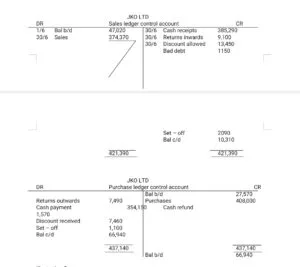
Steps for the solution
- Draw the sales ledger control account and enter the opening balance and credit sales on the debit side.
- Enter returns inwards, cash received, discount allowed, bad debts and set-off on the credit side.
- Subtract the credit total from the debit total to get the closing balance.
- Draw the purchases ledger control account and enter the opening balance, credit purchases and the refund on the credit side.
- Enter returns outwards, payments, discount received and set-off on the debit side.
- Subtract the debit total from the credit total to get the closing balance.
Sales ledger control account
| Debit | ₦ | Credit | ₦ |
|---|---|---|---|
| Balance b/d | 47,020 | Returns inwards | 9,100 |
| Sales | 408,000 | Cash received | 385,290 |
| Discount allowed | 13,450 | ||
| Bad debts | 1,150 | ||
| Set-off | 2,090 | ||
| Balance c/d | 43,940 | ||
| Total | 455,020 | Total | 455,020 |
Sales ledger balance on 1 July 19×3: ₦43,940 (debit).
Purchases ledger control account
| Debit | ₦ | Credit | ₦ |
|---|---|---|---|
| Returns outwards | 7,490 | Balance b/d | 27,570 |
| Payments to suppliers | 354,150 | Purchases | 374,370 |
| Discount received | 7,460 | Refund from supplier | 1,570 |
| Set-off | 1,100 | ||
| Balance c/d | 33,310 | ||
| Total | 403,510 | Total | 403,510 |
Purchases ledger balance on 1 July 19×3: ₦33,310 (credit).
Evaluation
- Define a control account.
- Name the ledgers for which control accounts can be kept.
- State five uses of a control account.
- Why is a control account called a memorandum account?
- What is another name for the sales ledger control account?
Assignment
- Explain the difference between the sales ledger control account and the purchases ledger control account.
- Explain how a control account helps in the location of errors and the prevention of fraud.
This term's Book Keeping topics
SS2 Second Term · 5 topics
Get Book Keeping as PDF and Word
Every week of SS2 Book Keeping, Second Term, formatted and ready to print. Ad-free, and the copy lock comes off.
Get this term Card, bank transfer, USSD or OPay
SS2 Book Keeping Lesson Notes for Other Topics
Bad Debts And Doubtful Debts
Read the full lesson note.

Stock Evalaution
Read the full lesson note.

Entreprenuership Education
Read the full lesson note.

Relational Models
Read the full lesson note.
Single Entry And Incomplete Records
Read the full lesson note.

Account Of Non-Profit Making Organizations
Read the full lesson note.

Receipt And Payment Account
Read the full lesson note.
Income And Expenditure Account
Read the full lesson note.

Basic Concepts Of Marketing
Read the full lesson note.
Lesson Notes for Other Classes

SS1 Lesson Note
The complete lesson note to guide your studies.
SS3 Lesson Note
The complete lesson note to guide your studies.
