
Income and Expenditure Account – SS2 Book Keeping Lesson Note (Third Term)
Download this term · ₦1,000Lesson note at a glance
- Subject
- Book Keeping
- Class
- SS2
- Term
- Third Term
- Topic
- Income and Expenditure Account
- Order
- Topic 4 of 5 this term
- Reading time
- 6 min
An Income and Expenditure Account is a nominal account prepared by a not-for-profit organisation to show its surplus or deficit for the accounting year.
Behavioural objectives
- State what an Income and Expenditure Account is and who prepares it.
- List the features of an Income and Expenditure Account.
- Explain where the surplus or deficit is transferred to.
- Follow the steps in preparing an Income and Expenditure Account.
- Prepare a simple Income and Expenditure Account from given information.
What is an Income and Expenditure Account?
An Income and Expenditure Account is a nominal account that lists the income and expenses of one year to find the surplus or deficit.
- Who prepares it: clubs, churches, mosques, old students’ associations, hospitals, societies and other not-for-profit organisations.
- Purpose: these bodies exist for welfare and service, so they measure surplus or deficit instead of profit or loss.
- Similar to: the Profit and Loss Account of a business.
- Debit side: all expenses and losses of the year.
- Credit side: all incomes and gains of the year.
- Basis: accrual basis, and revenue items only.
What are the key terms used in the account?
The key terms below explain the words used when preparing the account.
- Surplus: the amount by which total income is more than total expenditure.
- Deficit: the amount by which total expenditure is more than total income.
- Accrual basis: recording income and expenses for the year in which they arise, whether cash has moved or not.
- Revenue item: an income or expense of the current year, such as subscriptions, rent and electricity.
- Capital item: a receipt or payment that affects assets or the Capital Fund, such as buying a building.
- Non-cash expenditure: an expense with no cash payment, such as depreciation.
- Capital Fund: the net worth of a not-for-profit organisation, also called the Accumulated Fund.
Where is the surplus or deficit transferred to?
The surplus or deficit is transferred to the Capital Fund in the Balance Sheet.
- Surplus: income side is bigger, so the surplus is added to the Capital Fund.
- Deficit: expenditure side is bigger, so the deficit is deducted from the Capital Fund.
From which records is the account prepared?
The account is prepared from the trial balance or from the Receipts and Payments Account, depending on the books kept.
- Trial balance: used when the organisation keeps complete sets of books.
- Receipts and Payments Account: used when complete sets of books are not kept.
What are the features of an Income and Expenditure Account?
There are five main features of an Income and Expenditure Account.
- Revenue nature: it is a nominal account for revenue items. Expenses and losses are debited. Incomes and gains are credited.
- Accrual basis of recording: transactions are recorded when they arise, not only when cash moves.
- Current period: only the current year’s incomes, expenses and losses appear, whether paid or not. Items of the preceding or succeeding period are excluded.
- No opening balance: the closing balance is the surplus or deficit of the year, and it goes to the Capital Fund.
- Adjustments: it includes prepaid and outstanding items, depreciation and provision for doubtful debts. It also records non-cash expenditure.
What is the difference between a Receipts and Payments Account and an Income and Expenditure Account?
A Receipts and Payments Account is a summary of the cash book, showing all cash received and paid in the year.
An Income and Expenditure Account shows only the revenue income and expenses of the year, after adjustments.
| Point | Receipts and Payments Account | Income and Expenditure Account |
|---|---|---|
| Type of account | Real account (a summary of the cash book) | Nominal account |
| Items recorded | Cash receipts and payments, capital and revenue | Revenue items only |
| Basis | Cash basis | Accrual basis |
| Opening and closing balance | Shows opening and closing cash and bank balances | Has no opening or closing cash balance |
| Adjustments | No adjustment for outstanding or prepaid items | Adjusted for outstanding, prepaid and non-cash items |
| Result | Closing cash balance | Surplus or deficit |
What are the usual items in an Income and Expenditure Account?
The items fall into income (credit side) and expenditure (debit side).
Income items
- Subscriptions: regular fees paid by members for the year.
- Donations: general donations are income. Donations for a special purpose, such as a building, are capital receipts.
- Hall rent received: money earned from letting the hall.
- Bank interest: interest earned on the organisation’s bank balance.
- Sale of old newspapers: a small revenue receipt.
Expenditure items
- Rent and taxes: running costs of the premises.
- Electricity and general expenses: day-to-day costs.
- Printing and stationery: office costs.
- Depreciation: yearly fall in value of fixed assets such as furniture.
What are the steps in preparing an Income and Expenditure Account?
There are six steps in preparing an Income and Expenditure Account.
- Credit all revenue receipts to the income side. Exclude amounts for the preceding and succeeding years. Include current-year amounts not yet received.
- Debit all revenue expenditure. Adjust for amounts paid in advance and amounts outstanding.
- Record the non-cash items to find the surplus or deficit:
- depreciation of fixed assets;
- provision for doubtful debts, if required;
- profit or loss on sale of fixed assets.
- Read the Receipts and Payments Account carefully and pick the revenue items, if the account is prepared from it.
- Leave out the opening and closing cash balances, as they are not income.
- Leave out capital items. Capital receipts and payments go to the Balance Sheet.
What is the format of an Income and Expenditure Account?
The format has the organisation’s name, the title and period, then expenditure on the debit side and income on the credit side.
- Name of the organisation
- Income and Expenditure Account (for the year ended…)
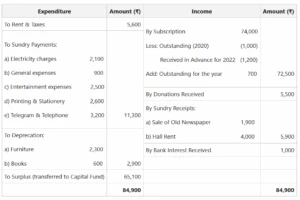
- Asterisk (*): shows that the account ends with either a surplus or a deficit balance.
- Surplus: the income side is greater than the expenditure side.
- Deficit: the expenditure side is greater than the income side.
Worked example
From the following information, prepare the Income and Expenditure Account of Geeks Foundation for the year ended 31st March 2021:
- Subscriptions received during the year ₦74,000, which included ₦1,000 for the year 2020 and ₦1,200 for the year 2022.
- Rent and taxes paid during the year ₦5,600.
- Outstanding subscription for the year 2021 amounts to ₦700.
- Sundry payments include:
- Electricity charges ₦2,100
- General expenses ₦900
- Entertainment expenses ₦2,500
- Printing and stationery ₦2,600
- Telegram and telephone expenses ₦3,200
- Sundry receipts included:
- Sale of old newspaper ₦1,900
- Hall rent received ₦4,000
- Donations received ₦5,500.
- Write off ₦2,300 from furniture and ₦600 from books.
- Bank interest received ₦1,000.
Solution
Geeks Foundation Income and Expenditure Account (for the year ended 31st March, 2021)
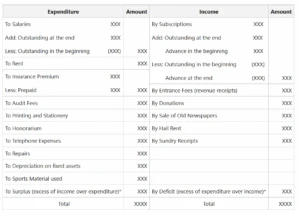
Working for subscriptions
- Subscriptions received: ₦74,000.
- Subtract the amount for 2020: ₦1,000.
- Subtract the amount for 2022 (received in advance): ₦1,200.
- Add the outstanding amount for 2021: ₦700.
- Subscriptions for 2021: ₦72,500.
Expenditure (debit side)
| Item | Amount (₦) |
|---|---|
| Rent and taxes | 5,600 |
| Electricity charges | 2,100 |
| General expenses | 900 |
| Entertainment expenses | 2,500 |
| Printing and stationery | 2,600 |
| Telegram and telephone expenses | 3,200 |
| Depreciation: furniture | 2,300 |
| Depreciation: books | 600 |
| Total expenditure | 19,800 |
Income (credit side)
| Item | Amount (₦) |
|---|---|
| Subscriptions for 2021 | 72,500 |
| Sale of old newspaper | 1,900 |
| Hall rent received | 4,000 |
| Donations | 5,500 |
| Bank interest | 1,000 |
| Total income | 84,900 |
- Surplus: ₦84,900 − ₦19,800 = ₦65,100, added to the Capital Fund.
Evaluation
- What is an Income and Expenditure Account, and who prepares it?
- State three features of an Income and Expenditure Account.
- Where is the surplus or deficit from the account transferred to?
- Name two items that are not recorded in the Income and Expenditure Account.
- From which two sources can an Income and Expenditure Account be prepared?
Assignment
- Explain how the Income and Expenditure Account treats subscriptions that relate to the preceding or succeeding year, and name three non-cash items recorded in the account.
This term's Book Keeping topics
SS2 Third Term · 5 topics
Get Book Keeping as PDF and Word
Every week of SS2 Book Keeping, Third Term, formatted and ready to print. Ad-free, and the copy lock comes off.
Get this term Card, bank transfer, USSD or OPay
SS2 Book Keeping Lesson Notes for Other Topics
Single Entry And Incomplete Records
Read the full lesson note.
Account Of Non-Profit Making Organizations
Read the full lesson note.

Receipt And Payment Account
Read the full lesson note.

Basic Concepts Of Marketing
Read the full lesson note.
Bad Debts And Doubtful Debts
Read the full lesson note.

Stock Evalaution
Read the full lesson note.
Control Account
Read the full lesson note.

Entreprenuership Education
Read the full lesson note.

Relational Models
Read the full lesson note.
Lesson Notes for Other Classes

SS1 Lesson Note
The complete lesson note to guide your studies.

SS3 Lesson Note
The complete lesson note to guide your studies.
