
Bad Debts and Doubtful Debts – SS2 Book Keeping Lesson Note (Second Term)
Download this term · ₦1,000Lesson note at a glance
- Subject
- Book Keeping
- Class
- SS2
- Term
- Second Term
- Topic
- Bad Debts and Doubtful Debts
- Order
- Topic 1 of 5 this term
- Reading time
- 5 min
A bad debt is an amount owed by a debtor that cannot be collected and is written off as an expense, while a provision for doubtful debts is an estimate of the part of the debtors’ total that may not be collected.
Behavioural objectives
By the end of the lesson, students should be able to:
- define bad debts and a provision for doubtful debts;
- state the causes of bad debts;
- state the entries for bad debts, bad debts recovered, and for creating, increasing and decreasing a provision for doubtful debts;
- show where the provision appears in the balance sheet;
- list the items that require adjustments in final accounts.
What is a bad debt?
A bad debt is a debt that the business has found impossible to collect from a debtor.
- Debtor: a person or business that owes money for goods or services bought on credit.
- Write-off: removing the debtor’s balance from the books because it will not be paid.
- Effect: bad debts are an expense, so they reduce the profit of the business.
What are the causes of bad debts?
A debt becomes irrecoverable when the debtor cannot or will not pay.
- Bankruptcy or insolvency: the debtor has no money or assets to pay creditors.
- Death of the debtor: the debtor dies leaving no estate from which to pay.
- Debtor cannot be traced: the debtor moves away or disappears without paying.
- Poor trading conditions: the debtor’s business collapses and cannot meet its debts.
- Fraud or dispute: the debtor refuses to pay and the cost of suing is too high.
- Weak credit control: goods are sold on credit to customers who were not checked properly.
How are bad debts recorded?
A bad debt is first transferred from the debtor’s account to the bad debts account, then to the profit and loss account at the end of the period.
Writing off a bad debt
- Debit the bad debts account and credit the debtor’s account with the amount.
- At the end of the period, debit the profit and loss account and credit the bad debts account.
Recovering a bad debt written off earlier
- Debit the debtor’s account and credit the bad debts recovered account, to restore the debt.
- Debit the cash or bank account and credit the debtor’s account, when the money is received.
- At the end of the period, transfer the bad debts recovered account to the credit side of the profit and loss account as income.
What is a provision for doubtful debts?
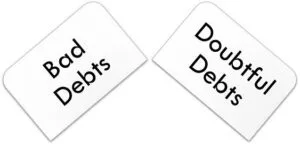
A provision for doubtful debts is an estimate of the part of the total debt owed by debtors that may not be collected.
- Doubtful debt: a debt that has not yet become bad, but there is doubt whether it will be paid.
- Why not show it in full: including it in the balance sheet as if there were no doubt would be misleading.
- Why not write it off: the debt has not yet become bad, so writing it off would be wrong.
- The solution: a provision is made to cover the doubtful debt.
- Nature: it is an estimate, because the amount cannot be calculated with substantial accuracy.
- Treatment: it is charged to the profit and loss account as an expense.
What is the difference between a bad debt and a doubtful debt?
A bad debt is certain to be lost and is written off. A doubtful debt may still be paid, so only a provision is made.
| Point | Bad debt | Provision for doubtful debts |
|---|---|---|
| Meaning | Debt known to be irrecoverable | Estimate of debts that may not be paid |
| Certainty | Certain loss | Possible loss |
| Debtor’s account | Closed by writing off | Not changed |
| Balance sheet | Debtor removed from debtors | Deducted from total debtors |
| Profit and loss account | Actual expense | Estimated expense |
How do you create and maintain a provision for doubtful debts?
When the provision is first created, the full amount is entered. In later years, the entries record only the increase or decrease needed.
| Situation | Debit | Credit |
|---|---|---|
| Creating the provision for the first time | Profit and loss account | Provision for doubtful debts account, with the full amount of the provision |
| Increasing the provision | Profit and loss account | Provision for doubtful debts account, with the increase in the provision |
| Decreasing the provision | Provision for doubtful debts account | Profit and loss account, with the decrease in the provision |
- Calculation: the provision is usually a percentage of debtors left after bad debts are written off.
- Increase: the new provision is larger than the old one, so the difference is an extra expense.
- Decrease: the new provision is smaller than the old one, so the difference is a gain to the business.
Worked example
A business provides 5% on debtors each year, after writing off bad debts.
| Year | Debtors (₦) | Provision needed at 5% (₦) | Existing provision (₦) | Effect on profit and loss |
|---|---|---|---|---|
| 1 | 50,000 | 2,500 | Nil | Expense of ₦2,500 |
| 2 | 60,000 | 3,000 | 2,500 | Increase of ₦500, an expense |
| 3 | 40,000 | 2,000 | 3,000 | Decrease of ₦1,000, a gain |
How is the provision shown in the final accounts?
The provision is deducted from debtors in the balance sheet, and its increase or decrease goes to the profit and loss account.
- Profit and loss account: bad debts and any increase in the provision are expenses.
- Profit and loss account (decrease): a decrease in the provision is added as income.
- Balance sheet: the provision is deducted from total debtors under current assets.
- Same in every case: the whole provision is deducted, not only the increase or decrease.
Using Year 1 of the example, the balance sheet shows:
| Item | ₦ |
|---|---|
| Debtors | 50,000 |
| Less provision for doubtful debts | (2,500) |
| Net debtors | 47,500 |
What are adjustments of the final accounts?
Adjustments are closing entries or amendments made in the books of accounts at the end of the accounting period to achieve a proper matching of costs and expenses with revenue.
Adjustments are required for the following:
- Accruals
- Prepayments
- Depreciation of fixed assets
- Provision for doubtful debts
- Provision for discounts on debtors
- Bad debts
- Closing stock
- Capital and revenue items of income and expenditure
- Set-offs
- Correction of errors, e.g. errors of omission, errors of principle, casting errors etc.
- Provision for contingencies, e.g. legal charges and accountancy charges
Evaluation
- What is a provision for doubtful debts?
- State the entries made when a provision for doubtful debts is first created.
- State the entries made when the provision is decreased.
- Where is the provision for doubtful debts shown in the balance sheet?
- Define adjustments in final accounts.
Assignment
- List any five items that may cause adjustments in final accounts.
- Outline any four factors that may make a debt irrecoverable.
This term's Book Keeping topics
SS2 Second Term · 5 topics
- Bad Debts and Doubtful Debts
- Stock Evalaution
- Control Account
- Entreprenuership Education
- Relational Models
Get Book Keeping as PDF and Word
Every week of SS2 Book Keeping, Second Term, formatted and ready to print. Ad-free, and the copy lock comes off.
Get this term Card, bank transfer, USSD or OPay
SS2 Book Keeping Lesson Notes for Other Topics

Stock Evalaution
Read the full lesson note.
Control Account
Read the full lesson note.

Entreprenuership Education
Read the full lesson note.

Relational Models
Read the full lesson note.
Single Entry And Incomplete Records
Read the full lesson note.

Account Of Non-Profit Making Organizations
Read the full lesson note.

Receipt And Payment Account
Read the full lesson note.

Income And Expenditure Account
Read the full lesson note.

Basic Concepts Of Marketing
Read the full lesson note.
Lesson Notes for Other Classes

SS1 Lesson Note
The complete lesson note to guide your studies.

SS3 Lesson Note
The complete lesson note to guide your studies.
