
Word Processing Application SS1 Digital Technologies Lesson Note
Download Lesson NoteTopic: Word Processing Application
Subject: Digital Technologies
Class: SS1
What is Word Processing?
In the old days, if you made a mistake while typing a letter on a typewriter, you had to start the whole page over or use messy white-out fluid. Word Processing changed all that.
Definition: Word Processing is the use of computer software to create, edit, format, and print documents.
Common Word Processors:
- Microsoft Word: The most famous one, used in almost every office.
- Google Docs: A free, online version that lets you work with friends at the same time.
- WPS Office: Very popular on Android phones and tablets.
Why use them?
- You can fix mistakes easily.
- You can add pictures and tables.
- You can save your work and print it many times.
The Main Features (The Tools)
When you open Microsoft Word or Google Docs, you see a lot of buttons at the top. This area is often called the Ribbon or the Toolbar.
Key Tools to Know:
- The Cursor: The blinking vertical line that shows where your next letter will appear.
- Scroll Bar: Used to move up and down through your pages.
- Status Bar: Found at the bottom; it tells you how many words you have written and what page you are on.
- Title Bar: At the very top, showing the name of your document (e.g., “My_Assignment.docx”).
Text Formatting (Making it Look Good)
Formatting is just a fancy word for changing the appearance of your text to make it look organized and professional.
- Font Styles and Sizes
- Font: This is the “handwriting” style. Examples include Times New Roman (formal) or Arial (modern).
- Font Size: How big the letters are. Most school reports use size 12.
- The “Big Three” Styles
- Bold (B): Makes text darker (used for Headings).
- Italic (I): Slants the text (used for titles or emphasis).
- <u>Underline (U):</u> Puts a line under the text.
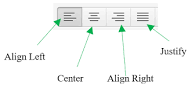
- Text Alignment
This decides where the text sits on the page:
- Left Align: Text starts from the left (standard for letters).
- Center: Text is in the middle (standard for titles).
- Right Align: Text sits against the right side (used for dates or addresses).
- Justify: Text is stretched so both sides are perfectly straight (common in textbooks).
Editing and Organizing
Creating a document isn’t just about typing; it’s about making it easy to read.
Lists (Bullets and Numbering)
- Use Bullets for a shopping list or a list of items where the order doesn’t matter.
- Use Numbering for steps in a recipe or instructions where order is important.
Cut, Copy, and Paste
- Copy: Makes a duplicate of the text (Shortcut: Ctrl + C).
- Cut: Removes the text from its original spot to move it elsewhere (Shortcut: Ctrl + X).
- Paste: “Drops” the copied or cut text into a new spot (Shortcut: Ctrl + V).
Spelling and Grammar Check
The computer acts like an English teacher! A Red squiggly line means a spelling mistake. A Blue or Green line usually means a grammar mistake.
Saving and Printing
The most important rule in computing is: Save your work! If the power goes out and you haven’t saved, your work is gone.
- Save vs. Save As:
- Use Save to update the file you are currently working on.
- Use Save As if you want to make a second copy of the file with a different name.
- Page Orientation:
- Portrait: The page is tall (like a normal letter).
- Landscape: The page is wide (like a certificate or a map).
- Printing: Before you print, always use Print Preview. It shows you exactly how the paper will look so you don’t waste ink and paper.
Class Activity
- Open a blank document. Type your name, center it, and make it Bold.
- Write a list of 5 African countries using Bullets.
- Change the font of your favorite country to Italics.
Discussion: If you were writing a letter to the President, which Font and Alignment would you use?
Third Term Digital Technologies Lesson Notes for Other Topics
Practical Project II
Explore lesson notes covering all topics.

Practical Project I
Explore lesson notes covering all topics.

Past Questions Drills
Explore lesson notes covering all topics.

Comprehensive Revision of SS1, 2 and 3
Explore lesson notes covering all topics.

Mobile Application Development II
Explore lesson notes covering all topics.

Cloud Computing II
Explore lesson notes covering all topics.

Blockchain Technology
Explore lesson notes covering all topics.

Cybersecurity III
Explore lesson notes covering all topics.

Digital Entrepreneurship
Explore lesson notes covering all topics.

Cyber Laws and Digital Rights
Explore lesson notes covering all topics.

Project Work
Explore lesson notes covering all topics.

Mobile Application Development I
Explore lesson notes covering all topics.

Spreadsheets Application I
Explore lesson notes covering all topics.

Spreadsheets Application II
Explore lesson notes covering all topics.

Presentation Software
Explore lesson notes covering all topics.

Lesson Notes for Other Classes
Basic 1 Lesson Note
The complete lesson note to guide your studies.

Basic 2 Lesson Note
The complete lesson note to guide your studies.
Basic 3 Lesson Note
The complete lesson note to guide your studies.

Basic 4 Lesson Note
The complete lesson note to guide your studies.
Basic 5 Lesson Note
The complete lesson note to guide your studies.
Basic 6 Lesson Note
The complete lesson note to guide your studies.