Introduction to Renewable Energy – SS1 Digital Technologies Lesson Note (First Term)
Download Lesson NoteLesson note at a glance
- Subject
- Digital Technologies
- Class
- SS1
- Term
- First Term
- Topic
- Introduction to Renewable Energy
- Order
- Topic 8 of 8 this term
- Reading time
- 3 min
What is Renewable Energy?
Imagine you have a bag of pure water. Once you drink it, it’s gone. You have to buy another one. That is how Non-Renewable Energy (like petrol or coal) works. Once we burn it, it’s finished.
Renewable Energy, however, is like a flowing stream. No matter how much water you take out today, the rain and the earth will refill it. It is energy from sources that never run out because nature replaces them constantly.
Why do we care?
- It’s Clean: It doesn’t produce the “black smoke” (carbon emissions) that makes the air dirty.
- It’s Cheap (Long-term): You don’t have to “buy” the sun or the wind; they are free gifts from nature.
- It’s Reliable: As long as the earth exists, these sources will be there.
Solar and Wind Energy
- Solar Energy (Power from the Sun)
This is the most popular form of renewable energy in Nigeria. We use Solar Panels to catch sunlight and turn it into electricity.
- How it works: Sunlight hits the panel, and the cells inside the panel move to create a flow of electricity.
- Use: Charging phones, lighting up streetlights, and powering homes.

- Wind Energy (Power from the Air)
Have you ever felt a strong breeze almost push you over? That movement is energy!
- How it works: We use giant fans called Wind Turbines. When the wind blows, it turns the blades. This spinning motion turns a generator that creates light.
- In Nigeria: This is most effective in northern states like Katsina, where the wind blows very strongly across the open land.
Hydro and Biomass Energy
- Hydro-power (Power from Water)
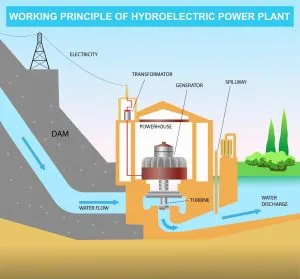
In Nigeria, a lot of our electricity comes from places like the Kainji Dam.
- How it works: Water is held behind a big wall (a dam). When the water is released, it falls with great force. This falling water spins a “turbine” (like a wheel), which makes electricity.
- The Benefit: It provides a huge amount of power for entire cities.
- Biomass (Power from Waste)
This sounds fancy, but it’s actually very basic. Biomass is energy from organic materials—things like plants, wood, and even animal dung.
- How it works: When we burn wood, we get heat. In more advanced ways, scientists can turn food waste or animal poop into Biogas, which can be used for cooking or to run small engines.
- The Benefit: It helps us manage waste. Instead of leaving trash to rot, we turn it into power.
Why Solar Energy is a “Game Changer” for Nigeria
Nigeria is blessed with an incredible amount of sunshine almost all year round. Here is why focusing on Solar is the best path for us:
- Reaching the “Off-Grid” Areas: Many villages don’t have NEPA/PHCN poles. It is much easier to give a villager a solar panel than to run wires for hundreds of kilometers through the bush.
- Reducing Cost for Small Businesses: Barbers, tailors, and cold-room owners spend too much money on “I-pass-my-neighbor” generators and expensive petrol. Solar helps them keep their profits.
- Solving the “Grid Collapse”: When the national power grid fails, homes with solar stay bright. It provides energy independence.
- Environmental Health: Less generator noise and less smoke mean fewer breathing problems for our elderly and children.
Summary and Class Activity
Summary Table
| Source | Origin | One Major Benefit |
| Solar | Sun | Available everywhere in Nigeria. |
| Wind | Moving Air | No fuel needed; works day and night. |
| Hydro | Falling Water | Very powerful; can run whole factories. |
| Biomass | Organic Waste | Turns “trash” into “treasure.” |
Class Discussion Questions
- Look around your neighborhood. Aside from lighting bulbs, what else can we use solar energy for?
- Why do you think Nigeria still struggles with light even though we have so much sun and water?
- If you were the Minister of Power, which of these four sources would you spend the most money on? Why?
This term's Digital Technologies topics
SS1 First Term · 8 topics
First Term Digital Technologies Lesson Notes for Other Topics
Data Protection and Backup System
Read the full lesson note.
Internet of Things (IoT) Application
Read the full lesson note.
Cloud and Virtualization
Read the full lesson note.
Networking II
Read the full lesson note.
Software Development Lifecycle
Read the full lesson note.
Advanced Programming II
Read the full lesson note.
Advanced Programming I
Read the full lesson note.
Web Design II
Read the full lesson note.
Web Publishing and Hosting
Read the full lesson note.

Advanced Word Processing Tools
Read the full lesson note.

Advanced Spreadsheet I
Read the full lesson note.
Advanced Spreadsheet II
Read the full lesson note.

Advanced Presentation Tools
Read the full lesson note.
Web Design I
Read the full lesson note.
History and Evolution of Digital Technologies
Read the full lesson note.
Lesson Notes for Other Classes

Basic 1 Lesson Note
The complete lesson note to guide your studies.
Basic 2 Lesson Note
The complete lesson note to guide your studies.
Basic 3 Lesson Note
The complete lesson note to guide your studies.
Basic 4 Lesson Note
The complete lesson note to guide your studies.
Basic 5 Lesson Note
The complete lesson note to guide your studies.
Basic 6 Lesson Note
The complete lesson note to guide your studies.